Luka Mrkić
Head of BD
Insights, strategies, and real-world playbooks on AI-powered marketing.
MAY 5, 2026
How to Set Up Claude API for Marketing Teams in 2026
66% of marketers use AI in their daily roles, yet most still log into Claude.ai and copy-paste one prompt at a time (HubSpot State of AI Report, Jun 2025). When a content team needs 10,000 personalized emails, 500 blog intros, or daily campaign reports generated automatically, the Claude API is the right layer.
The gap between teams using the API and those still copy-pasting shows up in output volume, cost per asset, and how cleanly Claude connects to existing tools. This guide covers API key setup in under 10 minutes, which model to use for which task, what every common marketing workflow actually costs on the Batch API, and the three integration paths that connect Claude to your marketing stack.
Key Takeaways
- 77% of Claude API interactions are automation-dominant vs. roughly 50% on Claude.ai (Anthropic Economic Index, Jan 2026). The API is for workflows that repeat, not one-off prompts.
- Claude Haiku 4.5 Batch API costs $0.50/MTok input: 10,000 personalized emails run under $5.
- Below 50 task repetitions per month, the Teams plan is the right choice. Above that, the API earns its setup cost.
Why do marketing teams use the Claude API instead of Claude.ai?
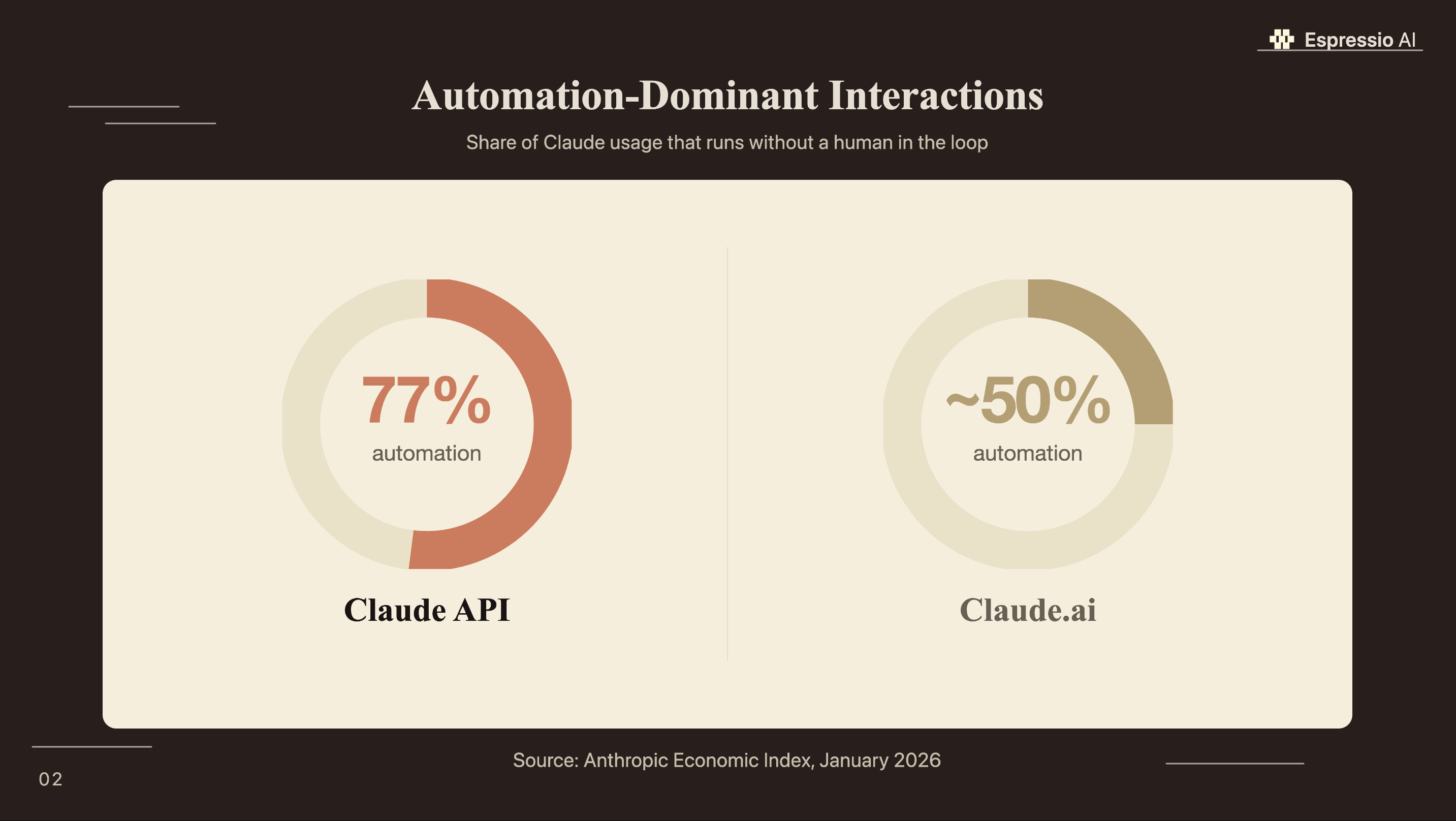
77% of Claude API interactions are automation-dominant, compared to roughly 50% on Claude.ai (Anthropic Economic Index, Jan 2026). The API is built for programmatic repetition. Claude.ai is built for conversation.
The difference matters in practice. In Claude.ai, one prompt generates one output. In the API, one system prompt plus a list of 1,000 leads generates 1,000 personalized outputs in a single batch job overnight. A campaign launch that used to mean two days of copywriting becomes a two-hour API job. Lead enrichment that used to live in a spreadsheet becomes an automated pipeline.
According to Anthropic’s January 2026 Economic Index, 77% of Claude API business interactions are automation-dominant compared to roughly 50% on Claude.ai. The API is the right interface for any marketing workflow that repeats more than a handful of times per month.
For teams building a full AI content agent stack, the Claude API is the generation layer that feeds every downstream automation.
Claude API vs. Claude Teams plan — which fits your marketing workflow?
Gartner projects more than 80% of enterprises will have used GenAI APIs in production by 2026 (Gartner, Oct 2023). That figure doesn’t mean every marketing team should use the API today. The right decision depends on how often a given task repeats.
| Dimension | Claude Teams Plan | Claude API |
|---|---|---|
| Setup time | 0 minutes | 30-60 minutes |
| Technical requirement | None | Basic Python or JavaScript |
| Cost model | Per-seat monthly subscription | Per-token usage billing |
| Best for | Exploratory prompting, fewer than 50 tasks/month | Repeating workflows, high-volume batches |
| CRM/tool integration | Manual copy-paste | Native via n8n, Zapier, MCP servers |
| Prompt caching | No | Yes, at 10% of base input price |
| Batch processing | No | Yes, 50% discount on all batch jobs |
The guidance most API guides skip: if a marketing task runs fewer than 50 times per month, the Teams plan is the right choice. The API requires an API key, environment variable setup, and either an n8n workflow or a basic script. That overhead earns its keep at high volume. Below 50 repetitions per month, it’s engineering spend that doesn’t pay back. Start on Teams. Switch to the API when one workflow hits 50-plus runs per month and you’re manually triggering it every time.
Gartner expects 40% of enterprise applications to have task-specific AI agents by end of 2026, up from fewer than 5% in 2025 (Gartner, Aug 2025). The infrastructure you build now will carry that load as volume grows.
How do you get your Claude API key and make your first call?
The Anthropic Console issues API keys with usage-tier controls, rate limit settings, and per-key cost tracking. Claude Haiku 4.5 costs $1 per million input tokens at standard pricing, roughly $0.0001 per average marketing prompt (Anthropic Pricing, May 2026). Getting a key and making a first call takes under 10 minutes.
Setup steps:
- Go to console.anthropic.com and create an account.
- Add a payment method under Billing. Set a monthly usage limit (start at $20).
- Under Settings → API Keys, click “Create Key.” Name it something specific, like “marketing-prod.”
- Install the SDK:
pip install anthropicfor Python ornpm install @anthropic-ai/sdkfor Node.js. - Set your key as an environment variable:
export ANTHROPIC_API_KEY="your_key_here". Never hardcode it in a repo. - Run the test call below to confirm everything works.
import anthropic

client = anthropic.Anthropic()  # reads ANTHROPIC_API_KEY from environment

message = client.messages.create(
    model="claude-haiku-4-5-20251001",
    max_tokens=200,
    messages=[
        {
            "role": "user",
            "content": "Write a 60-word LinkedIn connection request for a VP of Marketing at a SaaS company who just posted about pipeline challenges."
        }
    ]
)

print(message.content[0].text)
That call costs roughly $0.00004. A team running 1,000 variations of that prompt spends $0.04. Once the test works, the next step is either a Batch API job for high-volume output or an n8n workflow for recurring automation.
For teams planning to automate larger content pipelines, automating content pipelines with Claude and AWS covers the infrastructure layer for high-volume batch processing.
What does the Claude API cost for marketing workloads?
Processing 10,000 personalized cold emails on Claude Haiku 4.5 using the Batch API costs under $5. The Batch API applies a 50% discount on all calls; prompt caching drops cached system prompt reads to 10% of the base input price (Anthropic Pricing, May 2026). For marketing teams running the same system prompt across hundreds of leads or content items, prompt caching alone cuts costs by 60-80%.
| Model | Standard input | Standard output | Batch input | Batch output |
|---|---|---|---|---|
| Claude Haiku 4.5 | $1.00/MTok | $5.00/MTok | $0.50/MTok | $2.50/MTok |
| Claude Sonnet 4.6 | $3.00/MTok | $15.00/MTok | $1.50/MTok | $7.50/MTok |
| Claude Opus 4.6 | $5.00/MTok | — | $2.50/MTok | — |
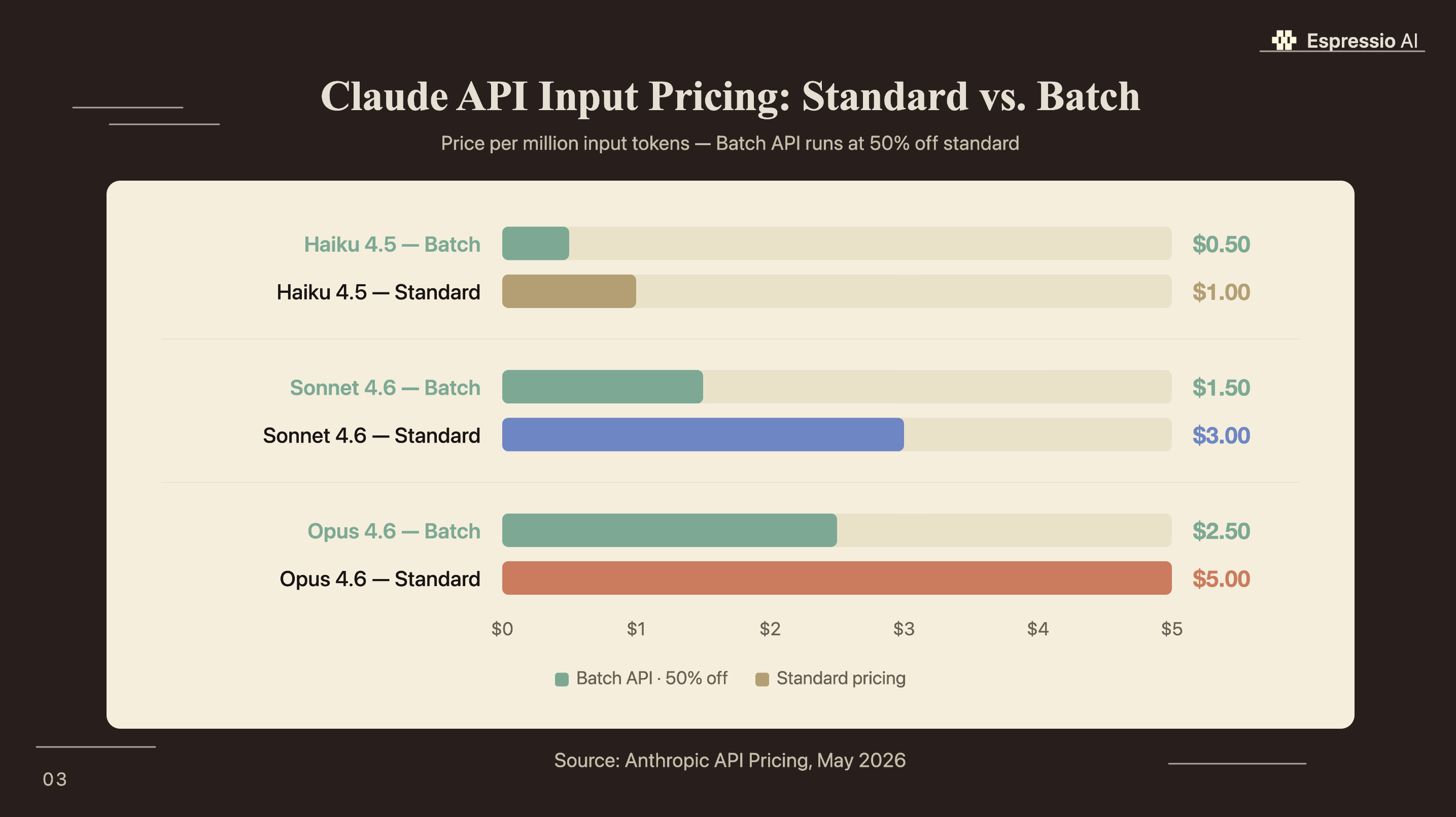
Running the cost math on five common marketing workflows using Batch API pricing with a 300-token cached system prompt (cached reads at $0.05/MTok):
| Workflow | Volume | Model | Batch API cost |
|---|---|---|---|
| Cold email personalization (60-word output) | 10,000 | Haiku 4.5 | ~$4.00 |
| Blog intro paragraphs (100-word output) | 500 | Sonnet 4.6 | ~$0.90 |
| Social captions (50-word output) | 2,000 | Haiku 4.5 | ~$0.55 |
| Campaign performance narratives (200-word output) | 100 | Sonnet 4.6 | ~$0.35 |
| Lead enrichment summaries (80-word output) | 1,000 | Haiku 4.5 | ~$0.40 |
Standard API calls at peak cost roughly twice as much. The break-even point vs. a $50/month SaaS content tool is approximately 250 content pieces per month at Haiku 4.5 Batch rates.
Which marketing workflows produce the best Claude API ROI?
Generative AI saves marketers approximately 1-2 hours daily (HubSpot State of AI Report, Jun 2025). 85% of marketers use AI for content creation; 83.82% confirm AI increased their productivity (CoSchedule State of AI in Marketing, Jan 2025). The workflows that produce the strongest API ROI share two traits: they repeat frequently and they have a structured output format Claude can follow consistently.
| Workflow | Recommended model | Why |
|---|---|---|
| Cold email personalization | Haiku 4.5 | Short output, high volume, structured prompt |
| LinkedIn connection requests | Haiku 4.5 | 60-word output, fast turnaround |
| Blog intro paragraphs | Sonnet 4.6 | Nuanced tone, longer context needed |
| Ad copy variations (A/B sets) | Haiku 4.5 | Rapid generation, simple creative brief |
| Campaign performance narratives | Sonnet 4.6 | Data interpretation, analytical output |
| Lead enrichment summaries | Haiku 4.5 | Short, structured, high volume |
| Long-form blog drafts | Sonnet 4.6 | Quality matters more than cost at this length |
In Espressio’s work setting up Claude API workflows for agency clients, the consistent pattern is that teams default to Claude Sonnet 4.6 for everything when they start. After the first month’s cost report, they switch 80% of workflows to Haiku 4.5 with no measurable quality difference in structured short-form output. The remaining 20% (long-form drafts, nuanced persuasion sequences, and analytical reports) stays on Sonnet. That split typically cuts the monthly API bill by 60-66% with no change in output quality for volume tasks.
For teams routing API output into a structured content calendar, Claude and Notion for content calendar automation covers scheduling and managing API-generated content at the campaign level.
How do you connect the Claude API to your marketing stack?
Companies that systematically integrate AI into marketing see 20-30% higher campaign ROI; AI leaders generate 40% more revenue from personalization than average performers (McKinsey, 2024). The Claude API is stateless: it receives a prompt, returns a completion, and closes. Integration is the responsibility of the tools around it. Three paths exist for connecting Claude to your marketing stack.
Zapier/Make (no-code bridge): Zero engineering required. Configure a Zap that triggers on a CRM event (new lead, form submission, deal stage change), sends data to Claude via an HTTP request, and routes the output back to your tool. Volume caps apply around 1,000 runs per month before task pricing becomes expensive. For teams starting this week, connecting Claude to Zapier as a no-code bridge is the fastest path to a first running workflow.
n8n (self-hosted pipeline): Handles high-volume batch flows without per-task pricing. An n8n workflow pulls a list of 500 leads from HubSpot, loops through each one, sends a Claude API call, and writes the output back to HubSpot as a contact note. For the HubSpot connection, Claude and HubSpot for AI sales follow-up covers five integration paths with ready-to-copy templates. For Airtable-based workflows, Claude and Airtable for structured content workflows covers the n8n Airtable node setup.
MCP servers are the newest integration path, giving Claude Desktop direct read/write access to HubSpot, Airtable, Notion, and other tools with no middleware required.
MCP is the next integration layer most marketing teams haven’t reached yet. As MCP adoption grows through 2026, direct Claude Desktop connections to marketing tools will replace much of the n8n middleware for non-engineering teams. Setting up one MCP connection now (even just Airtable or Notion) is a lower-cost way to understand how Claude integrates with live data before committing to a full n8n pipeline.
How do you measure ROI from the Claude API for marketing?
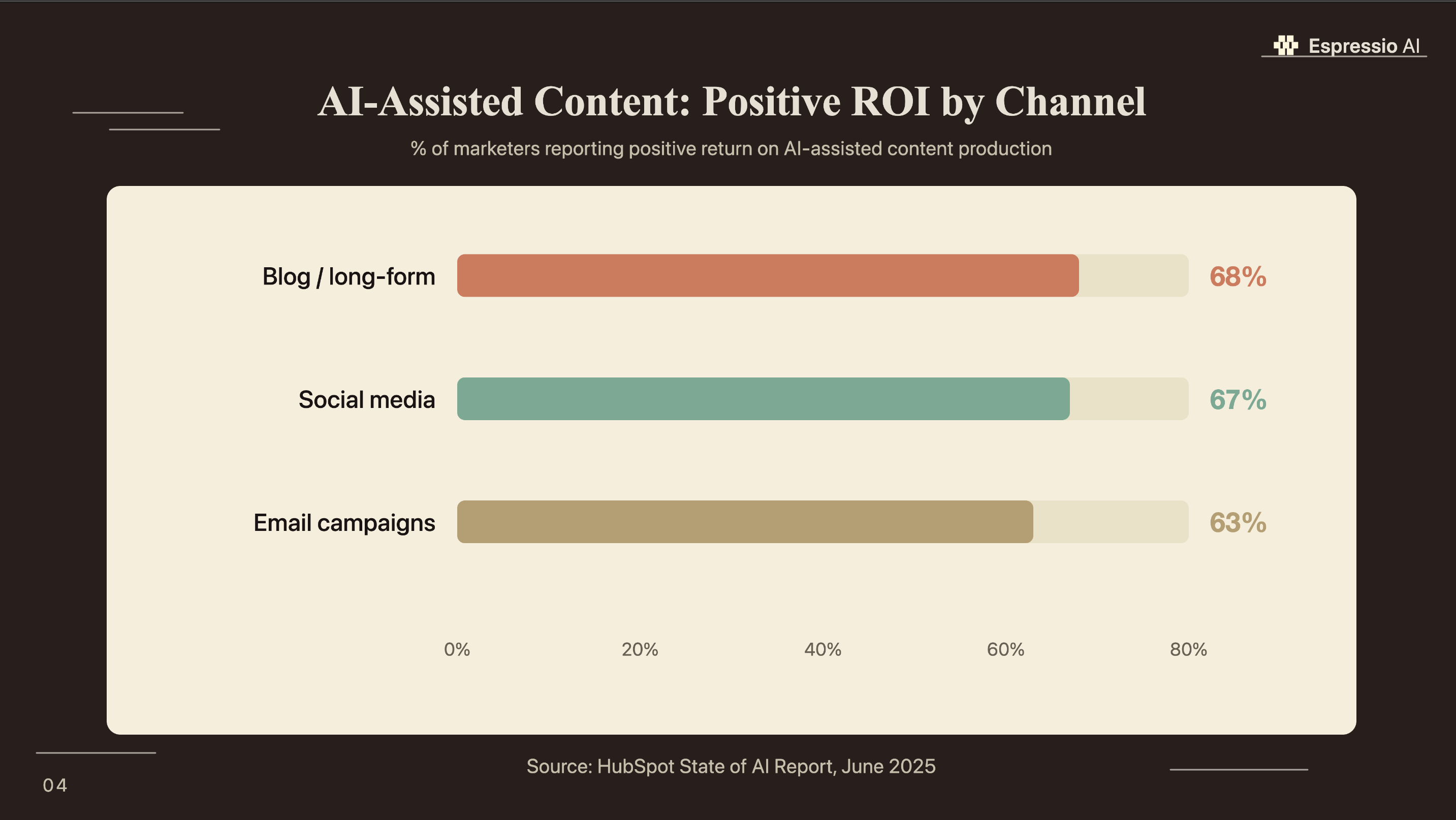
75% of marketing leaders whose organizations invested in AI report positive ROI (HubSpot State of AI Report, Jun 2025). Measuring that ROI from the Claude API requires three baselines: cost per asset before API adoption, time-to-publish per content type, and campaign performance metrics for the channels where Claude generates output.
A 90-day measurement framework:
-
Baseline (weeks 1-2): Record current cost per content piece (agency fees or staff hours times rate), average time from brief to published asset, and current open rate, CTR, or reply rate for the channels you’re targeting.
-
First API run (weeks 3-4): Deploy Claude API for one workflow. Track API cost per batch run. Record time from triggering the batch to having reviewed, approved output ready to publish.
-
Compare at 90 days: Cost per asset (API plus review time) vs. baseline. Time-to-publish vs. baseline. Campaign performance delta — expect 0-15% improvement in the first quarter as prompt templates mature.
The metric that surprises most teams is output volume, not cost savings. A team that previously published 20 emails per campaign ships 200 with the same review headcount. That volume increase compounds in A/B test data, which improves the next campaign’s performance.
For agencies managing Claude API workflows across a full client book, how Lunar Strategy built an AI operating system in 18 months covers how to layer Claude API automation across departments and multiple client accounts at scale.
If you’re looking to set up Claude API automation for your marketing team, get in touch with us and we’ll map out the right workflows and integrations for your stack.
Frequently asked questions
Does the Claude API require a developer to set up?
Basic Python or JavaScript knowledge is enough for the initial setup: creating an API key, installing the SDK, and making a first test call takes under 10 minutes. 66% of marketers already use AI in their daily roles (HubSpot, Jun 2025). Connecting to the API requires a developer for complex integrations like n8n pipelines, but not for testing or single-workflow automations.
What is the cheapest Claude model for marketing automation?
Claude Haiku 4.5 on the Batch API is the lowest-cost option: $0.50 per million input tokens and $2.50 per million output tokens (Anthropic Pricing, May 2026). For short-form marketing tasks like email personalization, social captions, and lead summaries, Haiku 4.5 delivers output quality comparable to Sonnet on structured prompts at roughly one-sixth the cost.
Can I use the Claude API with HubSpot?
Yes. The most common integration paths are an n8n HTTP node that posts Claude output to HubSpot contact records, a Zapier HTTP action as a no-code alternative, or the HubSpot MCP server for direct Claude Desktop access. All three support reading lead data from HubSpot, sending it to Claude, and writing enriched output back. Gartner projects 40% of enterprise apps will have task-specific AI integrations by end of 2026 (Gartner, Aug 2025).
How is the Claude API different from OpenAI’s API for marketing?
The primary practical difference for marketing teams is context window size: Claude supports up to 200K tokens, compared to GPT-4o’s 128K. This matters for workflows that send long documents (full CRM account histories, lengthy product briefs, or multi-page reports) as Claude can process the entire document in a single call. Pricing at the Haiku/GPT-4o-mini tier is comparable. Claude’s instruction-following is generally stronger on structured output formats.
Is there a free tier for the Claude API?
No. Anthropic provides a $5 trial credit for new Console accounts, which covers initial testing without a payment method. After that, usage-based billing applies from the first call. At Haiku 4.5 Batch pricing, $5 processes roughly 10 million input tokens, enough to generate approximately 25,000 short marketing emails before the trial credit runs out (Anthropic Pricing, May 2026).
Conclusion
The Claude API gives marketing teams the output volume that the chat interface can’t reach. Start with the manual copy-paste method on Claude.ai to prove a prompt template works. Once a workflow hits 50 repetitions per month, move it to the API. Run Haiku 4.5 Batch for structured short-form output; use Sonnet 4.6 for long-form drafts and analytical reports. Connect to your stack via n8n or Zapier first, then evaluate MCP connections as workflows stabilize.
Key actions to take this week:
- Create an Anthropic Console account and set a $20 usage limit
- Run the Python test call above with one real lead from your CRM
- Use the cost benchmark table above to estimate your first workflow’s monthly spend
- Pick one task that runs 50-plus times per month and build the first Batch API job
- Set a 90-day baseline before comparing campaign performance
For teams using the Claude API to power outreach workflows on top of LinkedIn data, Claude and LinkedIn Sales Navigator for outreach covers the four integration methods and prompt templates that pair with the API layer.