Luka Mrkić
Head of BD
Insights, strategies, and real-world playbooks on AI-powered marketing.
APR 28, 2026
How to Build an AI Operating System for Your Agency
Greg Alanney, COO of Lunar Strategy, opened an Espressio webinar in April 2026 with a line worth holding onto: “What we’re about to share isn’t theory. It’s something that actually happened within our agency once we stopped debating AI and started building with it.”
Lunar Strategy is a Web3 marketing agency that has been running since 2019. At the time of the webinar, the agency had 37 active clients, a 32-person team, and a network of over 600 creators, all running through a single AI operating system built with Espressio over 18 months. This is what that build looked like, where it broke, and what any agency can take from it.
Key Takeaways
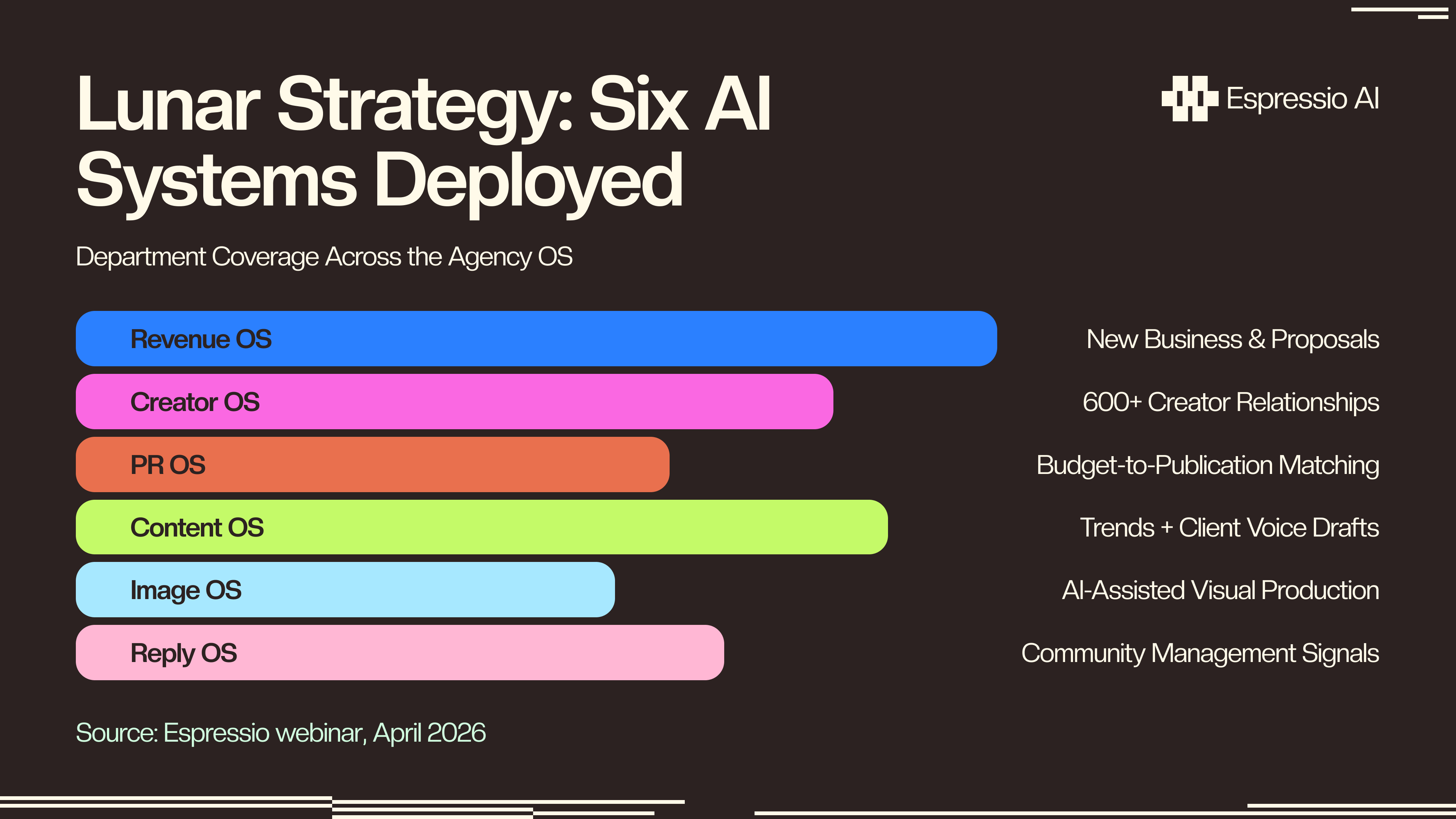
- Lunar Strategy deployed six AI systems across its full operation: Revenue OS, Creator OS, PR OS, Content OS, Image OS, and Reply OS, all through a single agency-wide interface (Espressio webinar, April 2026)
- The build took 18 months; Espressio’s new agency clients begin 80% of the way there, with the architecture already built and tested
- Team adoption unlocked when account managers received tested, working tools rather than training decks
- “Anyone can access the model. Nobody can access what you build on top of it.” — Greg Alanney, COO, Lunar Strategy
What was making Lunar Strategy’s model fragile?
Running 37 client accounts across a 32-person team, Lunar Strategy had most of its institutional knowledge sitting inside individual contributors rather than any system (Espressio webinar, April 2026). When a team member left, client knowledge left. When accounts changed hands, the new manager spent weeks rebuilding context that should have been documented from the start, what Greg called “catch-up tax.”
Coverage gaps appeared during leave. New hires couldn’t service clients at the level the agency’s reputation required. “Knowledge lived within people’s heads and that isn’t a business,” Greg said. “That’s a dependency.” The agency had five strong service lines: PR, content, social media, go-to-market strategy, and creator campaigns. Each was run well. None were documented in a way that any team member could pick up mid-account without a significant ramp period.
At that scale, that’s a fragility problem. As the agency grows, it becomes a structural ceiling.
Why did Lunar Strategy choose to build rather than wait?
Sam Altman had predicted that 95% of what marketers use agencies for would eventually be handled by AI. The industry split into panic and denial. Lunar Strategy did neither. “Debating a prediction doesn’t move your business forward,” Greg said. “We asked a better question: what do we build while everyone else argues?”
Every agency currently sits between three paths:
- Path A: wait for the perfect model. The cost is four to six months behind by the time any action is taken.
- Path B: bolt-on every new tool as it launches. The cost is no foundation, constant context-switching, and a team chasing announcements instead of serving clients.
- Path C: build from real operational pain, lay a spine, and compound on it every day.
Lunar Strategy chose Path C in late 2023. That decision, made before most agencies had moved past experimentation, is the reason the agency now has a system that any team member can step into and run a full client account without a handover meeting.
The build became viable through the partnership structure. Lunar Strategy owned the problems: live data from active client accounts, domain expertise across five service lines, and cryptonative content knowledge that no generic model could replicate. Espressio owned the build: architecture, model selection, workflow design, and continuous updates. That split between problem owner and build partner is why the project produced a live, functioning system rather than a proof-of-concept that gathered dust after the first sprint.
The spine: one AI operating system for the entire agency
Most agencies that try to adopt AI end up with a collection of disconnected tools. One team uses one model for copy, another uses a different tool for research, a third runs a separate automation for reporting. The result is a fragmented stack that requires constant retraining and produces no compounding benefit.
Lunar Strategy’s north star was specific from the beginning: any team member should be able to run a full client account using only the agency’s standalone tools. That single outcome shaped every decision. Everything had to connect to one spine, one AI operating system that anyone on the team could access through one interface.
The distinction Greg drew between the spine and the tools is what makes this model work. The spine is the business logic, the client knowledge, and the institutional memory. The AI models and automations run off the spine. When better models come out, Espressio updates them in the backend. The account management team sees one clean interface with no retraining, no new adoption curve, and no disruption to live client work. “Espressio sits in the back end making sure the operating system is always getting the best of what AI has to offer,” Greg explained. “Luna focuses on clients using one operating system.” That separation is the operational innovation.
What Lunar Strategy’s six-system AI OS actually looks like
Lunar Strategy and Espressio built six AI systems over 18 months, each targeting a specific operational friction point (Espressio webinar, April 2026). Together they cover the full agency workflow from new business through daily delivery.
Revenue OS: Greg calls it “the brain of the operation.” Before any client call, Revenue OS researches the client, their competitors, and their market position. After the call, it generates a proposal. Pre-call prep and proposal drafting that previously consumed hours happens before the account manager walks in.
Creator OS: Managing outreach, briefs, approvals, and relationships across a 600+ creator network requires a system. Creator OS gives one team member the ability to coordinate across the full network without manual tracking.
PR OS: Takes a client’s budget and objectives and maps them to the best publication options. What was previously a senior judgment call drawn from memory of past placements is now a systematic process any team member can run.
Content OS: Surfaces trending topics, maps them against the client’s positioning and competitor activity, and generates drafts aligned with the client’s voice. The voice is trained against real account output rather than described in a prompt.
Image OS: AI-assisted visual generation, developed alongside Lunar Strategy’s design team. “We do not and will never accept AI slop,” Greg said. Image OS gives designers a production tool; it doesn’t replace them.
Reply OS: Identifies which accounts the agency should engage with, surfaces what the community wants to hear, and prioritizes the relevant context for the account manager to act on.
The 80/20 principle applies to new deployments: when Espressio builds for a new agency, the core architecture and workflows from the Lunar Strategy engagement are already in place. The remaining work is customizing for the new agency’s clients, voice, and service structure.
The friction that nobody shows in transformation highlights
“Anyone who says that going fully into AI has been easy is wrong and is lying,” Greg said at minute 16, without prompting. Four specific friction points came up during the session.
Brand voice is invisible until it produces the wrong output. It has to be trained against real approved work: actual campaigns, accepted posts, and rejected drafts. Getting voice right required feeding substantial real client output into the system before it could produce content that didn’t need a full rewrite.
Prompt rot. Workflows that performed well in January needed rebuilding in March. Model updates, platform changes, and accumulated edge cases degrade prompt performance over time. Keeping prompts current is an ongoing maintenance requirement that needs to be owned by someone with both technical and business context.
Team adoption is the real bottleneck. The unlock at Lunar Strategy was handing over tested, working tools rather than running training sessions. When account managers experienced a task that previously took eight hours completing in a fraction of that time, adoption followed without a persuasion campaign. “Make it impossible for them to do it any other way,” Greg said. One operating system with one interface made that possible.
Token costs are also worth planning for explicitly. “For the first time in my life, I’m seeing tokens and AI tooling as their own separate budget line,” Greg noted. Running AI at agency scale across their client base and six systems requires the same budget discipline as any other operational cost. Teams that treat AI as a free addition to existing subscriptions get surprised by the invoice.
What changed after 18 months of building?
The north star — any team member can run a full client account using only the agency’s standalone tools — has been reached (Espressio webinar, April 2026). Four concrete things changed.
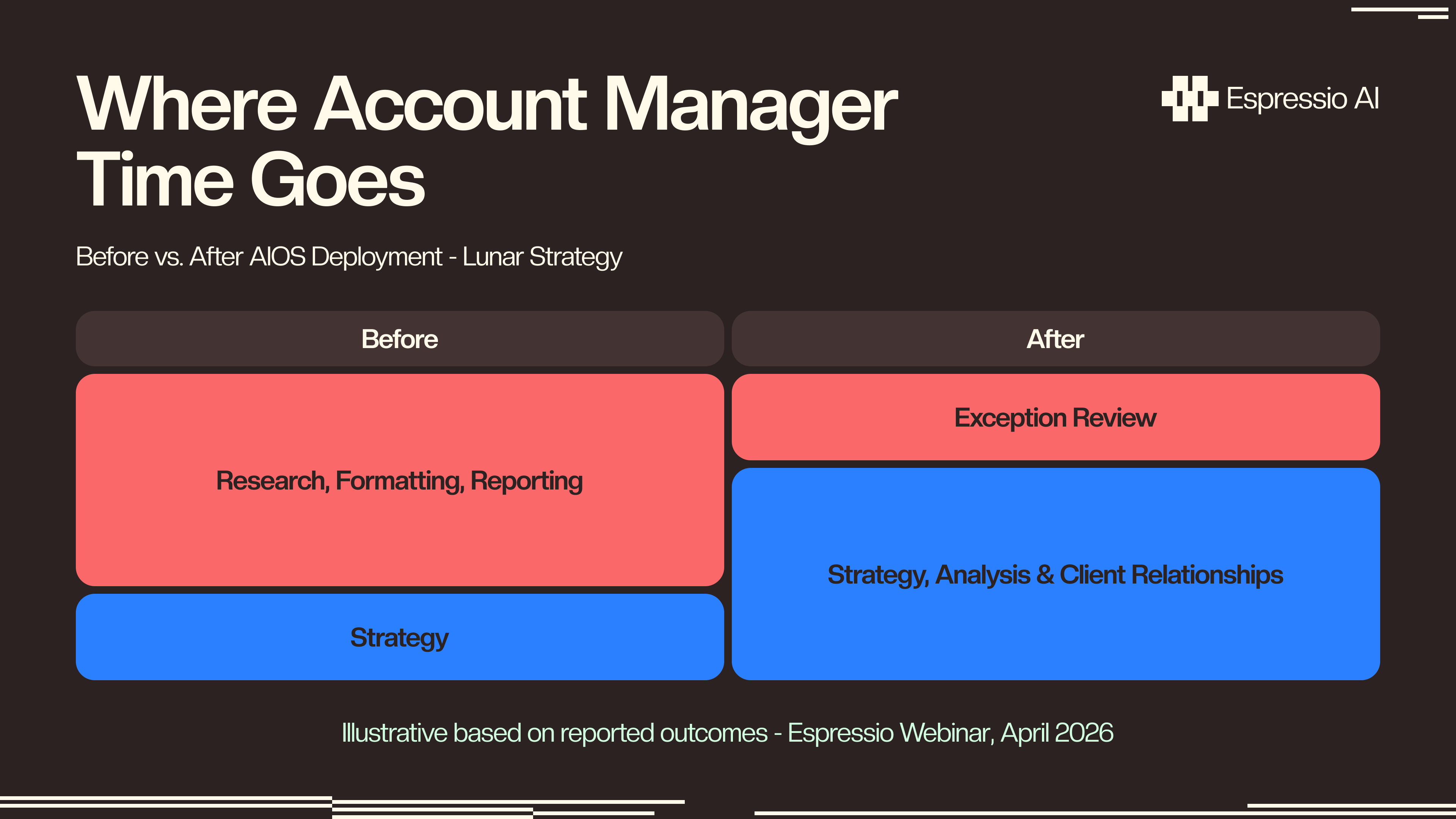
Revenue OS alone reclaimed hours of pre-call research and proposal preparation per engagement. Time previously spent aggregating competitor intelligence and formatting decks belongs to the account manager’s actual client work now.
Consistency. Client voice, strategy history, and best practices accumulated over Lunar Strategy’s seven years are encoded in the OS. Any team member picking up an account has access to the same institutional knowledge the most experienced person on the team carries.
Capacity. “We have a team of 32 members but an army of agents,” Greg said. “Anyone can access ChatGPT. Nobody can access Lunar Strategy’s operating system.” The competitive advantage sits in the proprietary layer built on top of those models. Every competitor has access to the same underlying AI.
Human focus shifted up. Strategy, client relationships, and context-dependent judgment stayed with the team. The execution that previously consumed most of an account manager’s week moved to agents. “AI is an amazing drone, but it needs a fantastic pilot,” Greg said. “That’s what our team is.” Pilots with a higher skill ceiling than they had before.
What should your agency build first?
For small agencies, Luka Mrkic outlined a clear starting point during the Q&A: two systems, in sequence (Espressio webinar, April 2026).
Business development first. Track market signals, identify ICPs, source verified leads, and generate proposals from the call brief. For a founder handling BD alongside delivery, this reclaims hours per week and produces more consistent output: better research, better proposals, faster turnaround. Tim Haldorsson mentioned building a quiz-based lead tool in Lovable on a Saturday afternoon as one early proof-of-concept. “Things that previously would have taken weeks and thousands of dollars, you can now do yourself in a couple of hours.”
Content pipeline second. A predictable research-to-draft workflow covers trend monitoring, topic ideation, draft generation, and scheduling. For agencies producing content for clients, this means the same headcount delivers more without compressing quality. For agencies producing their own brand content, it means marketing no longer competes with delivery for the founder’s time.
Tim’s advice for founders who haven’t started: take two hours with the Claude Academy, Google’s AI course library, or Perplexity. The major labs offer free structured learning that covers enough to understand what’s actually possible before committing to a build. Then build one small thing and ship it. The compound benefit of starting accumulates with every project.
For teams wanting to go further, the Lunar Strategy model is replicable. Espressio’s deployment sequence starts from the architecture built during this engagement, not from a blank page. For AI marketing skills that support this kind of build, formal training programs from the major labs provide the technical foundation.
Ready to build your agency’s AI operating system?
We built the Lunar Strategy OS from scratch: six systems, 18 months, 37 live client accounts running through it. When Espressio starts with a new agency, that architecture is already in place. The 80% is done. What remains is your clients, your voice, your service lines — the 20% that makes it yours. Get in touch with us to start with a workflow audit.
Frequently Asked Questions
How long does it take to build an AI operating system for a marketing agency?
Lunar Strategy’s full six-system build took 18 months from the first deployment to a fully running OS across all departments. New agency clients working with Espressio start with the core architecture, workflows, and integrations already built and tested. Customization for a specific agency’s clients, voice, and service lines is the remaining work (Espressio webinar, April 2026).
What is the biggest barrier to AI adoption inside an agency team?
Team adoption is what actually slows most deployments. The unlock at Lunar Strategy was handing over tested, working tools rather than running training sessions. When account managers experienced a meaningful time saving from the first use, adoption followed without any mandate. The tool had to perform reliably before it was handed over.
What should a small agency automate first with AI?
Start with the highest-friction point in your current workflow. For most agencies that is pre-call research and proposal generation (Revenue OS territory) or content production. Build one system, run it alongside the manual process for 30 days, validate the output quality, then expand. Deploying everything at once produces nothing usable and burns team goodwill on imperfect tools.
Does this model work for agencies outside of Web3 or marketing?
Luka Mrkic addressed this directly in the Q&A: AI agent systems are applicable to every business that has repetitive operational workflows, which is every business. Espressio has built for agencies in marketing, BD, and operations functions. The same BD pipeline and content OS architecture applies across verticals. The customization layer covers the domain-specific knowledge that makes the tools relevant to a particular niche.
How does the Espressio partnership model actually work?
Lunar Strategy owned the operational problems; Espressio owned the build. Lunar Strategy provided live client data, domain expertise, and real friction from 37 active accounts. Espressio provided the architecture, model selection, workflow design, and ongoing maintenance. The agency team works on one clean interface while Espressio updates the backend with better models and improved workflows as they become available, without disrupting live client delivery.
The window to build is open. The compounding gap is growing.
A New York Times blind test of 86,000 readers found 54% preferred the AI-generated article over the human-written one (Tim Haldorsson, Espressio webinar, April 2026). The margin was narrow enough to be uncomfortable rather than reassuring: AI writing is competitive with professional human writing, and the models keep improving. The agencies building now are widening an operational advantage every week.
“We didn’t wait, we built,” Greg said in closing. “And the systems now compound every single day because of it.” Eighteen months in, that ambition has been realized: any team member, any client account, using only the tools the agency built. The difference grows with every month of compounding.
For teams looking at how similar agentic architecture applies beyond marketing operations, how crypto finance teams automate accounting with AI agents covers the same five-layer approach applied to a different function.