Shann Holmberg
Head of Product
Insights, strategies, and real-world playbooks on AI-powered marketing.
APR 27, 2026
The Complete Perplexity AI Guide for 2026
Perplexity AI processed 780 million queries in May 2025, growing more than 20% month-over-month, according to CEO Aravind Srinivas at the Bloomberg Tech Summit (TechCrunch, June 2025). At that scale, Perplexity has become the product people reach for the way they once reached for Google.
Most guides treat Perplexity as a simple alternative to typing something into a search bar. They cover the basics, miss half the features, and go stale the moment Perplexity ships something new. This guide is different. It covers how Perplexity actually works, what the Free, Pro, and Max tiers each give you, what changed in 2025 and 2026, and why the product matters for marketers who want to understand where AI-driven search is heading.
Key Takeaways
- Perplexity processed 780 million queries in May 2025, growing 20%+ month-over-month (TechCrunch, June 2025).
- The free tier limits you to roughly 5 Pro Searches per day; $20/month Pro unlocks unlimited model selection, Deep Research, and Spaces.
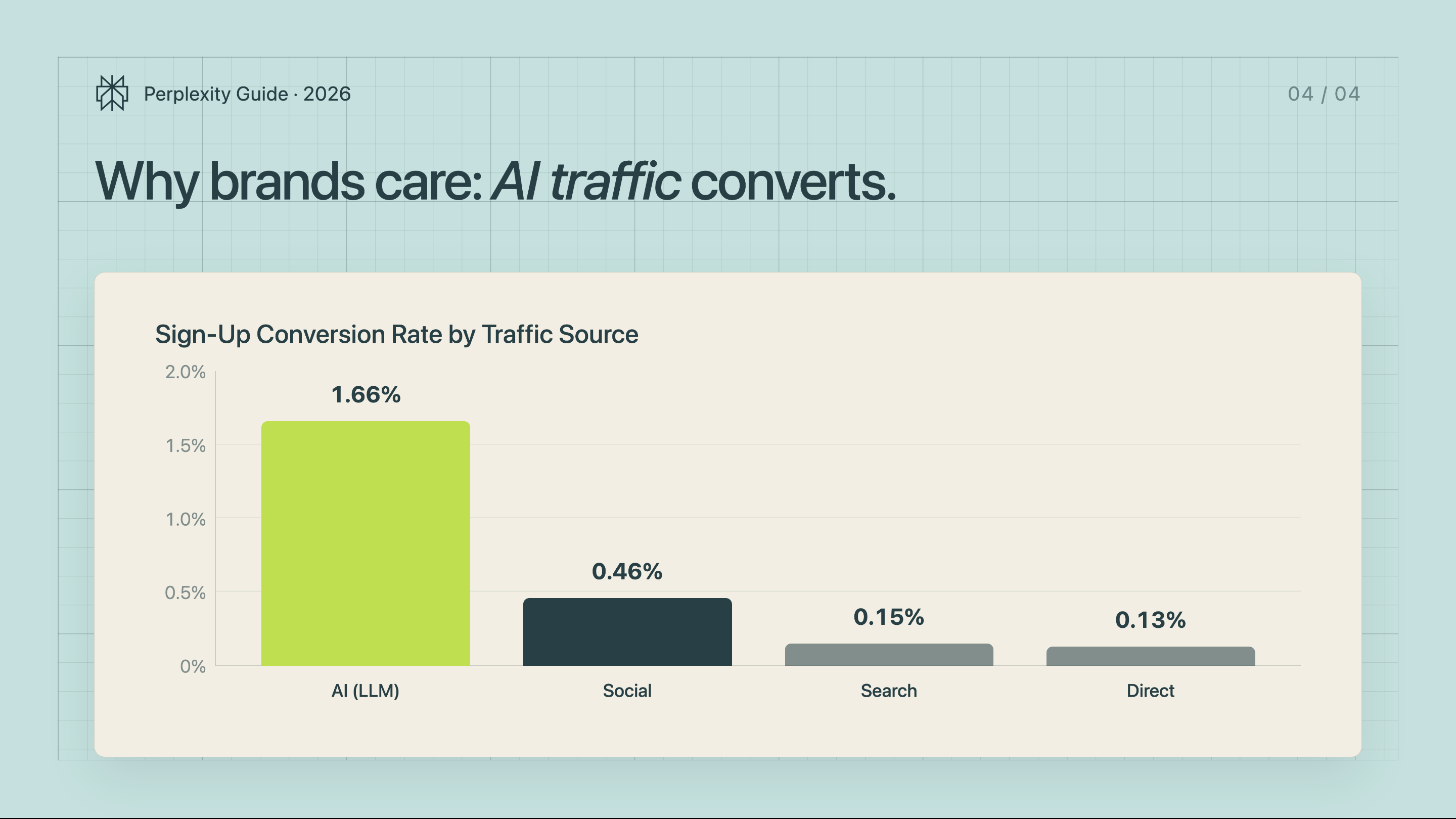
- AI referral traffic converts at 1.66% for sign-up CTR vs 0.15% for organic search (Microsoft Clarity, 2025), making Perplexity a distribution channel worth appearing in, as much as a research productivity tool.
- Two major features launched in February 2026 (Model Council and Perplexity Computer) that no current guide covers.
What is Perplexity AI and how does it work?
Perplexity had 30 million monthly active users as of April 2025, up from 10 million in January 2024, making it the fastest-growing AI search product in that period (Backlinko, January 2026). It occupies its own category: an answer engine that retrieves live web content, synthesizes it through a large language model, and cites every source inline. Too real-time for a pure chatbot, too synthesis-focused for a conventional search engine.
The underlying architecture matters because it explains what Perplexity is actually good at. When you submit a query, the Sonar model family runs real-time retrieval across the web (or a specific source type if you’ve activated a Focus mode), then generates a synthesized answer grounded in those retrieved documents. Every claim in the answer links to the page it came from. You can verify any fact in one click, and you can follow up in natural language without re-entering context.
That combination (retrieval, synthesis, and citation) is what makes Perplexity structurally different from a standard LLM. Ask ChatGPT (without browsing) a question about last week’s earnings report and it will tell you it doesn’t know. Ask Perplexity the same question and it retrieves current sources, synthesizes them, and shows you where it got the information.
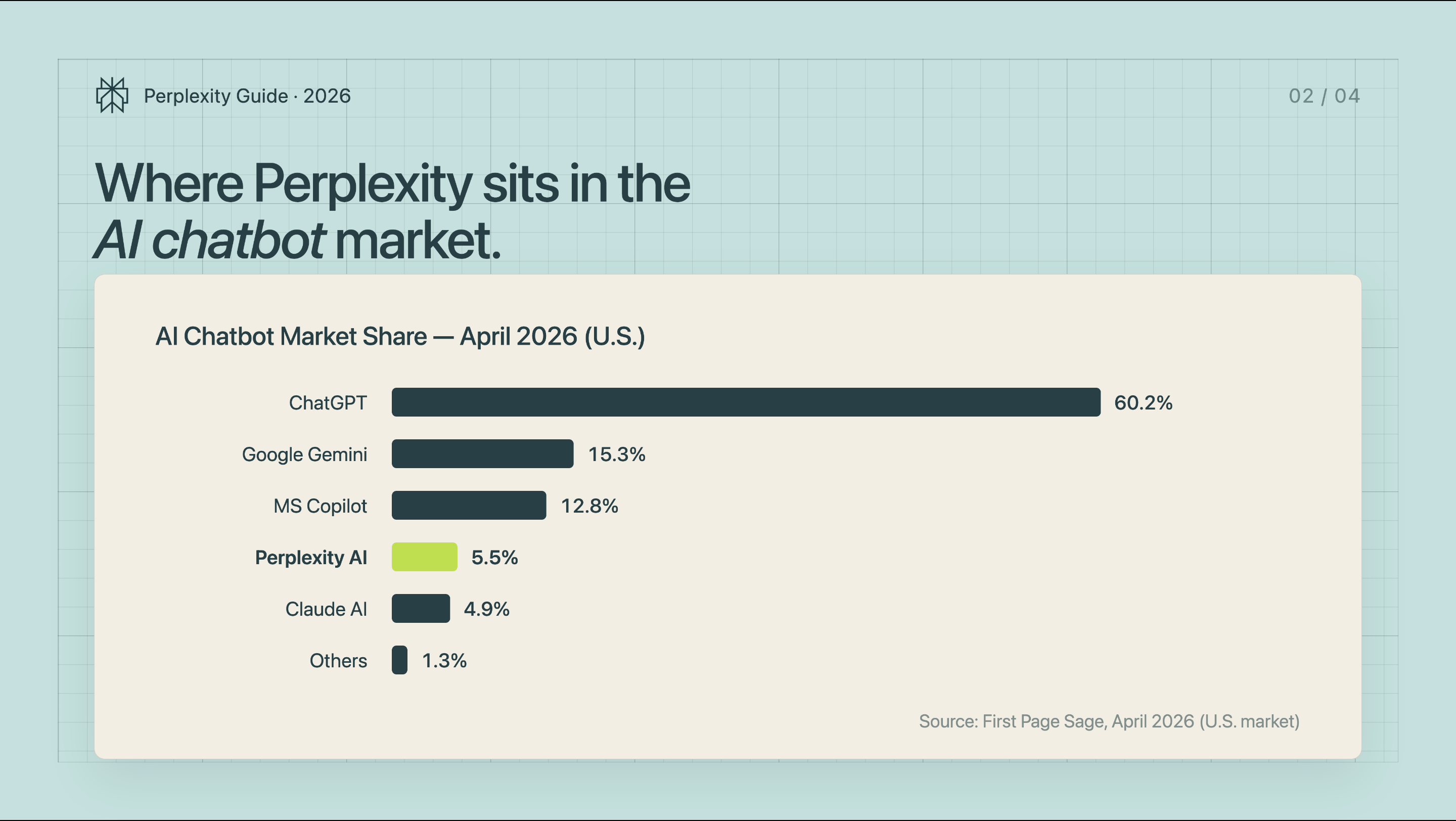
At 5.5% market share, Perplexity sits fourth in the U.S. AI chatbot market behind ChatGPT (60.2%), Google Gemini (15.3%), and Microsoft Copilot (12.8%) (First Page Sage, April 2026). The share figure understates its trajectory: the company’s valuation grew 40x in roughly 18 months, from $500 million in early 2024 to $20 billion after a $200 million Series E in September 2025 (PYMNTS, September 2025).
How does Perplexity compare to Google and ChatGPT?
58.5% of Google searches in the U.S. now end without a click, rising to 93% in Google’s AI Mode, according to a study cited by Exposure Ninja (2025). Perplexity was built from the ground up around that zero-click reality: its native format is the synthesized answer with inline citations, not a list of links you may or may not visit.
The comparison most people make is wrong. They ask whether Perplexity is better or worse than Google Search. The more useful question is what job each tool does. Google is optimized for finding specific pages: e-commerce, local business, and navigational queries. Perplexity is optimized for synthesizing information across multiple sources into a single coherent answer. Those are different jobs, and the tool that’s better for your work depends on which job you’re doing most.
Against ChatGPT (without web browsing), the distinction is simpler: Perplexity always retrieves current sources. If recency matters and accuracy matters (financial data, recent product specs, current regulations), Perplexity’s citation model gives you something to verify, and the live retrieval means the information is current. ChatGPT without browsing will hallucinate confidently about events it wasn’t trained on.
The third comparison is against Google Gemini and Copilot. Both now fetch live sources with inline citations. Perplexity’s advantage there is the depth of its Focus modes (Web, Academic, Social, Video, Writing), the maturity of Spaces for team collaboration, and the Model Council feature available to Max subscribers, which runs the same query through multiple frontier models simultaneously.
AI referral traffic grew 357% from June 2024 to June 2025, generating 1.13 billion referral visits in June 2025 alone (Exposure Ninja, 2025). That number is what makes the Perplexity vs Google comparison strategically relevant for marketers: if Perplexity is sending referral traffic, and that traffic converts at 1.66% vs 0.15% for organic search (Microsoft Clarity, 2025), then Perplexity visibility is a distribution question alongside a productivity consideration.
What does Perplexity cost? Free vs Pro vs Max explained
The free tier gives roughly 5 Pro Searches per day using the basic Sonar model, with limited file uploads. At $20/month (or $200/year), Pro unlocks unlimited Pro Searches, model selection across GPT-5, Claude Opus/Sonnet, Gemini 2.5 Pro, and Grok, unlimited file and image uploads, Spaces, Deep Research, and a $5/month credit toward the Sonar API (Finout, April 2026). The $200/month Max tier adds Model Council, Perplexity Computer, and unlimited Labs.
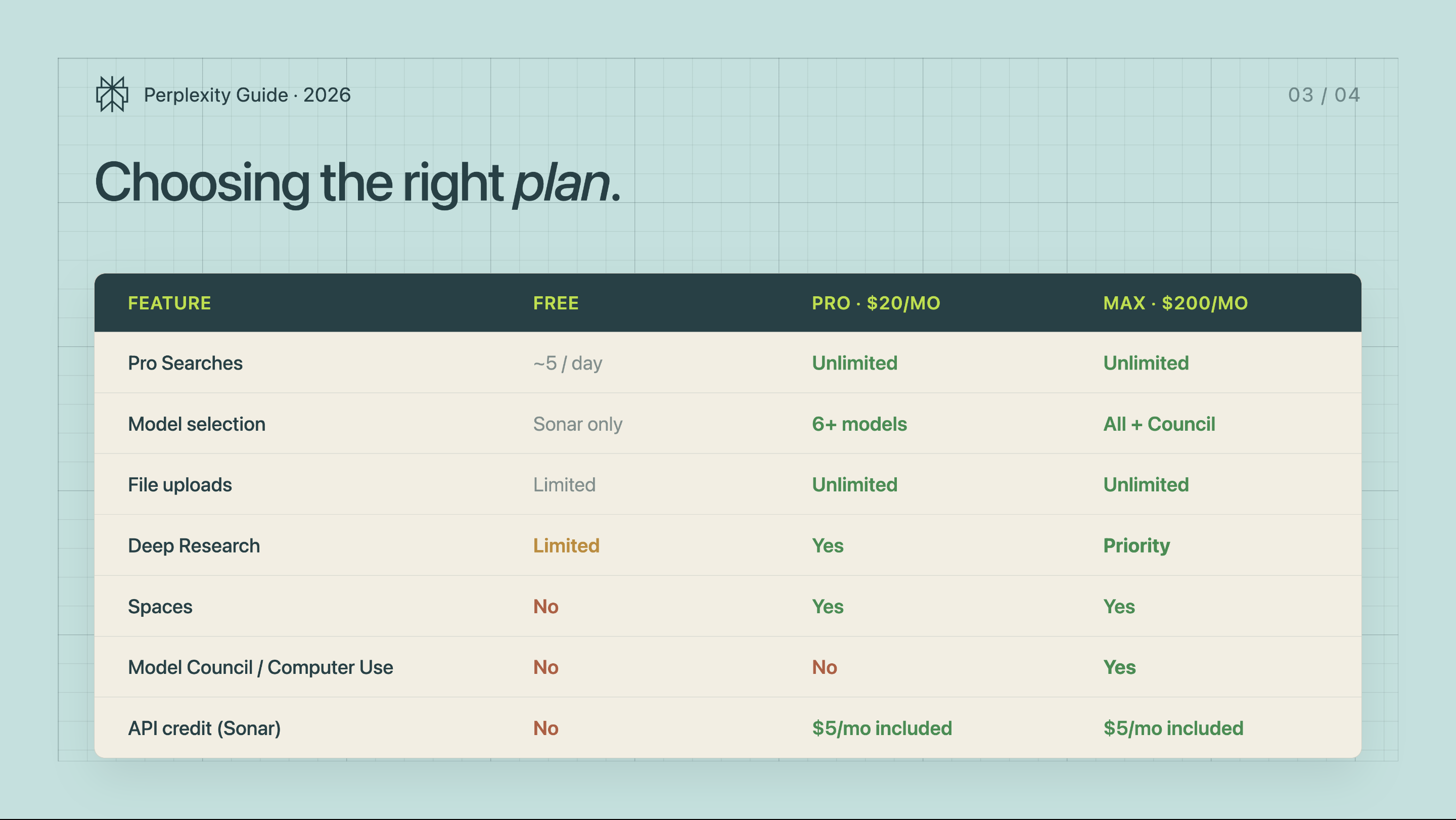
Perplexity’s annual recurring revenue reached approximately $200 million in September 2025, doubling from $100 million in March 2025 (Backlinko, January 2026). That six-month ARR doubling is what pushed the Series E valuation to $20 billion. The pricing tiers reflect a company that knows exactly where it sits: broadly free for casual users, $20/month for professionals who run multiple research workflows daily, and $200/month for power users who need frontier-model parallelism and autonomous task execution.
Enterprise Pro runs $40 per user per month and adds SSO, admin controls, shared Spaces, and compliance features. Enterprise Max at $325 per user per month extends the full Max feature set to organizations at scale.
How do you use Perplexity effectively?
Perplexity’s monthly website traffic peaked at 276.5 million visits in October 2025 and held at 239.97 million in November 2025 (Backlinko/Similarweb, January 2026), and most of those users are searching in a way that doesn’t come close to the tool’s actual capability. The core feature that changes how much you get out of Perplexity is the Focus mode selector.
By default, Perplexity searches the open web. Switch to Academic mode and it restricts retrieval to peer-reviewed papers, useful for anything where you want sources that have gone through review rather than blog posts and press releases. Social mode pulls from Reddit and similar platforms, which makes it the fastest way to get real-user opinions on a product or topic rather than marketing copy. Video mode retrieves from YouTube. Writing mode is a pure generation mode with no retrieval, for when you want the model to draft rather than research.
Beyond Focus mode, query specificity drives output quality more than anything else. “AI agents for marketing” returns a survey. “What specific workflow components do marketing teams add when moving from ad hoc AI use to a Level 3 content operation?” returns a targeted synthesis. The more specific the question, the more the retrieval and synthesis work in your favor.
File uploads unlock a different use case entirely. Upload a PDF earnings report, a contract, or a research paper, then ask specific questions about it. Perplexity retrieves from the document and cites the page number where it found the answer, which is useful for legal documents, financial filings, or technical specifications where you need to verify claims against the source.
The habits that separate effective Perplexity users from casual ones: follow up with questions to dig into any claim the initial answer makes rather than running a new search; save important research threads to Collections for future reference; use the Share button to send a thread to a colleague rather than copying the output into Slack; and enable Memory on Pro so Perplexity retains your research context across sessions.
What is Perplexity Deep Research and when should you use it?
Perplexity Deep Research launched February 14, 2025 as an autonomous multi-step research agent that reviews hundreds of sources and produces expert-level reports (TechCrunch, February 2025). A standard Pro Search runs one retrieval pass and synthesizes the results. Deep Research runs iterative sub-queries: it generates a research plan, executes each sub-query, evaluates what it found, adjusts the plan, and repeats until it has enough to write a structured report. That process takes 2–5 minutes instead of 10 seconds.
When we ran the same brief through Perplexity Deep Research and ChatGPT Deep Research (“Map the competitive landscape for AI search engines in 2026: players, market share, differentiators, and trajectory”), both returned usable reports. Perplexity’s output had better source diversity (it surfaced primary announcements alongside analyst commentary), cleaner citation linking, and more current data. ChatGPT’s output had stronger prose structure but weaker source recency on fast-moving funding and product data. The practical implication: Perplexity Deep Research is the better default when source currency matters; ChatGPT Deep Research is stronger when you care more about output structure than source breadth.
Free users can run Deep Research within daily limits; Pro subscribers get higher quotas. The daily reset means casual researchers don’t need to upgrade for occasional deep-dive tasks. If you’re running more than 2–3 Deep Research sessions per day (competitive analysis, due diligence, literature reviews), the Pro tier pays for itself on the time it saves.
What Deep Research doesn’t do: access paywalled academic journals (it finds open-access papers and summaries), execute real-time code, or gather proprietary data that isn’t publicly indexed. For research tasks involving internal documents, the Spaces feature handles that instead.
What are Perplexity Spaces and Perplexity Pages?
Spaces, launched in late 2024, are persistent collaborative research workspaces where teams can upload internal documents, set custom AI instructions, and build a shared knowledge base that Perplexity searches alongside the web (Perplexity Hub). The practical effect is that a team’s internal documentation (product specs, past research, brand guidelines) becomes searchable through the same interface as the open web, with citations pointing to the specific internal file.
The key capability most users miss: custom AI instructions in a Space let you set the persona, tone, and scope of how Perplexity responds within that workspace. A marketing team can configure a Space that always responds with their brand voice, references their style guide, and restricts responses to topics relevant to their industry. That’s a different class of tool than asking Perplexity the same question repeatedly with slightly different phrasing.
Perplexity Pages launched May 30, 2024 (TechCrunch, May 2024). After running a research thread, Pages lets you transform the output into a formatted, shareable article with structured sections, images pulled from the web, and inline citations. Published Pages appear in Perplexity’s open library and are indexed for search. For teams that publish research-driven content, Pages compresses the time between initial research and shareable output.
What’s new in Perplexity in 2025 and 2026?
Between February 2025 and April 2026, Perplexity shipped six significant features that most users haven’t encountered. Each addresses a different gap in the original product.
Deep Research (February 14, 2025) is the iterative research agent described in the section above. Free users can run it within daily limits; Pro subscribers get far more runs.
Comet Browser rolled out July 9, 2025 for Mac and Windows, November 20, 2025 for Android, and March 18, 2026 for iOS. It’s an AI-native browser: Perplexity is the default answer engine, and Comet handles browsing tasks (filling forms, navigating sites, summarizing pages) with Perplexity’s AI layer embedded. Think of it as a browser where the address bar already knows what you’re trying to accomplish.
Model Council launched February 5, 2026 and is available to Max subscribers. It runs a query through multiple frontier models simultaneously (GPT-5, Claude, Gemini, and others), then synthesizes the best elements of each response into a single answer. For high-stakes research where a single model’s blind spots could matter, running the same query through four models in parallel provides better coverage than any single model alone.
Perplexity Computer launched February 27, 2026 as a cloud AI agent at $200/month (included in Max). It can control a cloud computer environment: open browsers, fill out forms, run searches, extract data from websites, and complete multi-step workflows autonomously. It’s Perplexity’s answer to Operator-style agents: a way to automate tasks that currently require a human sitting at a keyboard.
Memory, available on Pro and above, retains preferences, past research threads, and user context across sessions. Perplexity remembers what you’ve previously researched and can surface that context in new queries without you re-explaining your background.
How does the Perplexity API (Sonar) work?
The Sonar API gives developers programmatic access to the same live web retrieval that powers the consumer product. Pro subscribers receive $5/month in API credits automatically, which covers meaningful usage before you need to add separate billing. The base endpoint is at docs.perplexity.ai.
Four Sonar models are available: sonar (fast, lightweight, best for high-volume queries), sonar-pro (stronger reasoning with broader retrieval), sonar-reasoning-pro (thinking model for complex multi-step questions), and sonar-deep-research (the programmatic version of Deep Research that returns structured research reports via API). Each trades off speed, cost, and reasoning depth differently.
The strategic case for Sonar over calling GPT-4o or Claude directly is live, cited retrieval. If you’re building a tool that needs current information (competitive monitoring, news synthesis, product research pipelines), a standard LLM API call returns a response based on training data. Sonar retrieves current web content, synthesizes it, and returns citations you can surface to users. For teams building AI content agents where research accuracy and recency are part of the value proposition, that’s the meaningful difference. You get a research layer with citations rather than a generation layer that may or may not be current.
Sonar integrates into Python and JavaScript environments using the standard OpenAI client library with Perplexity’s base URL and API key. The citation objects in the response include source URLs, titles, and snippet text, which means your application can surface citations to end users without additional processing.
For teams building lightweight research tools on top of the Sonar API without a full engineering team, The Ultimate Guide to Lovable in 2026 covers how to prototype and deploy AI-powered apps without writing backend infrastructure. And if your research-to-output workflow involves automating briefs and content handoffs, how to integrate Claude with Slack to automate marketing briefs covers the multi-tool workflow pattern that pairs well with Sonar as a research data source.
AI traffic from LLM platforms converts at 1.66% for sign-ups versus 0.15% for organic search, and Perplexity-driven traffic specifically converts at 7x the rate of direct traffic for subscription products, based on a Microsoft Clarity study of 1,277 domains (2025). That conversion rate gap positions Perplexity as both a productivity tool and a distribution channel worth appearing in. For teams thinking about the infrastructure behind AI-driven search at scale, Inside NVIDIA’s AI Ecosystem: A Practical Guide for Builders covers the model serving layer that powers products like Perplexity’s Sonar.
Is Perplexity Pro worth paying for in 2026?
Pro at $20/month pays for itself if you run more than 5 research-intensive queries per day that benefit from model choice, file uploads, or Spaces. Below that threshold, the free tier handles most use cases.
The decision by user type is fairly clean. Casual users who run 2–3 searches per day and don’t need specific model selection or file upload capacity: free works. Researchers, analysts, and content professionals who run multiple sessions daily and need Deep Research quota, model choice, and Spaces: Pro at $20/month is competitive with ChatGPT Plus and Claude Pro on price, with stronger source freshness built in. Developers who want API access to start building: Pro gives you the $5/month Sonar credit to test workflows before committing to additional API billing.
Max at $200/month is a different calculus. Model Council and Perplexity Computer are the differentiators, and they’re designed for power users with very specific needs: researchers who need multi-model synthesis on high-stakes questions, and operators who need autonomous task execution at a price below hiring additional headcount. The $200/month figure assumes you’re getting clear value from at least one of those two features. If you’re not using either, Pro handles the rest.
Perplexity’s ARR doubling in six months (Backlinko, January 2026) suggests enough users are hitting that threshold to sustain the growth. The real question is whether your specific workflow pattern matches what Pro adds. For teams building their foundational AI skills to evaluate tools like this more systematically, the complete breakdown of official AI courses from Anthropic, OpenAI, Microsoft, NVIDIA, Google, and more maps which programs cover the evaluation and workflow skills most directly.
Frequently Asked Questions
Is Perplexity AI free to use?
Yes, with limits. The free tier gives roughly 5 Pro Searches per day using the Sonar model, with limited file upload capacity and no access to Spaces or model selection. Deep Research is available free with a daily usage cap. For casual users running a few research queries per day, the free tier covers most needs. Pro at $20/month removes those limits.
How is Perplexity different from Google Search?
The fundamental difference is output format. Google returns a ranked list of links. Perplexity returns a synthesized answer with every source cited inline. 58.5% of Google searches in the U.S. now end without a click (Exposure Ninja, 2025); Perplexity’s native format is that same zero-click answer, but with citations you can verify rather than a snippet Google selected. For navigational or e-commerce queries, Google is better. For multi-source synthesis, Perplexity is faster.
What is Perplexity Deep Research?
Deep Research is an autonomous research agent that launched February 14, 2025. Unlike a standard search that runs one retrieval pass, Deep Research generates a research plan, runs iterative sub-queries across hundreds of sources, evaluates its findings, and produces a structured report. It takes 2–5 minutes and replaces 2–4 hours of manual research on complex questions. Available free with limits; Pro subscribers get far more runs per day.
Can I use Perplexity for my team?
Yes, through Spaces (Pro and above) and Enterprise plans. Spaces let teams upload internal documents, set custom AI instructions, and build a shared knowledge base that Perplexity searches alongside the web. Enterprise Pro runs $40 per user per month and adds SSO, admin controls, and compliance features. Enterprise Max at $325 per user per month extends the full feature set including Model Council and Perplexity Computer.
Does Perplexity have an API?
Yes, the Sonar API at docs.perplexity.ai. Four models are available: sonar, sonar-pro, sonar-reasoning-pro, and sonar-deep-research. Pro subscribers receive $5/month in API credits automatically. The API integrates with the standard OpenAI client library using Perplexity’s base URL, and response objects include cited source URLs for applications that surface citations to end users.
Perplexity’s growth arc tells the story: 10 million users in January 2024 to 30 million by April 2025, valuation rising from $500 million to $20 billion in 18 months. It’s a product that found genuine product-market fit in a specific niche, serving people who need synthesized, cited answers rather than a list of links to visit. The free tier is capable enough to test that fit for yourself in ten minutes.
Thinking about how tools like Perplexity fit into your team’s AI stack? Get in touch with us — we’ll help you map out which AI systems make the most sense for your workflows and how to get them running.