Shann Holmberg
Head of Product
Insights, strategies, and real-world playbooks on AI-powered marketing.
APR 24, 2026
Every Major AI Course You Can Take Right Now (By Company)
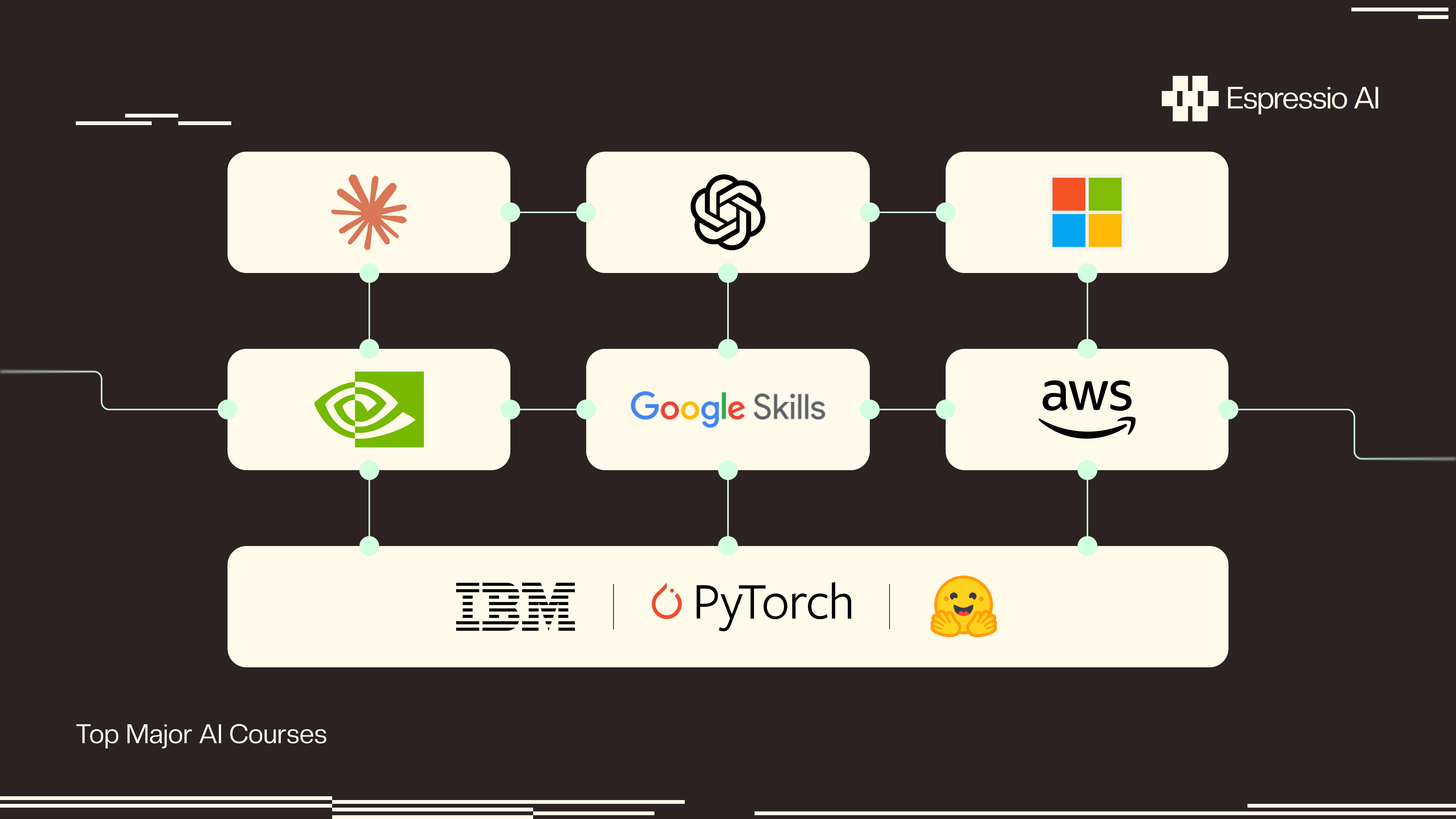
Workers with AI skills now earn a 56% wage premium over those without — up from 25% the prior year, according to PwC’s Global AI Jobs Barometer published in June 2025. The incentive to learn has never been sharper. The harder question is where to start.
Most AI course roundups organize by topic, skill level, or star rating. None of them answer the question most people actually have: what does each company teach about its own tools, and which course fits where you are right now?
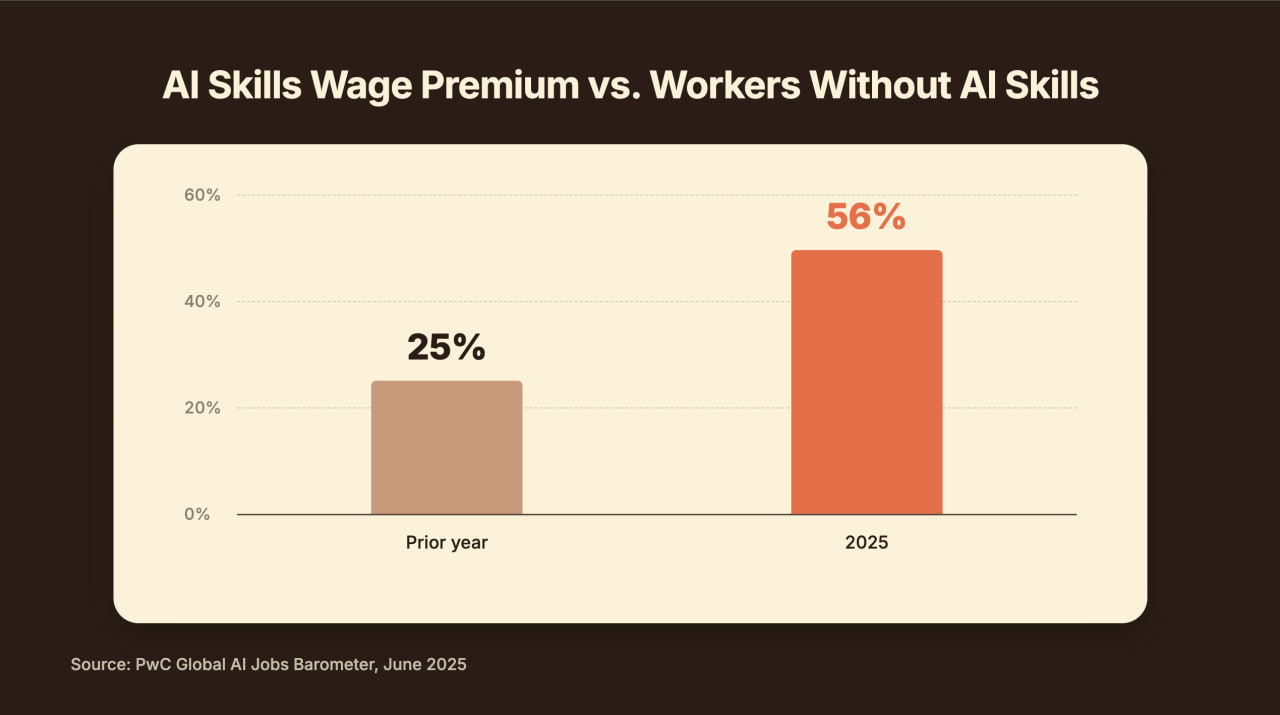
This guide covers every major company’s official AI learning program in one place: Anthropic, OpenAI, Microsoft, NVIDIA, Google, AWS, IBM, Meta, and Hugging Face. For each, you’ll find the specific courses, what they cost, and who they’re built for.
Key Takeaways
- Workers with AI skills earn a 56% wage premium — up from 25% the prior year (PwC Global AI Jobs Barometer, June 2025).
- Nine major companies now offer structured AI courses, most of them genuinely free: Anthropic, OpenAI, Microsoft, NVIDIA, Google, AWS, IBM, Meta, and Hugging Face.
- Entry-level jobs requiring AI skills have nearly tripled since fall 2025 (NACE Job Outlook 2026 Spring Update, n=185 employers).
Why learn AI directly from the companies building it?
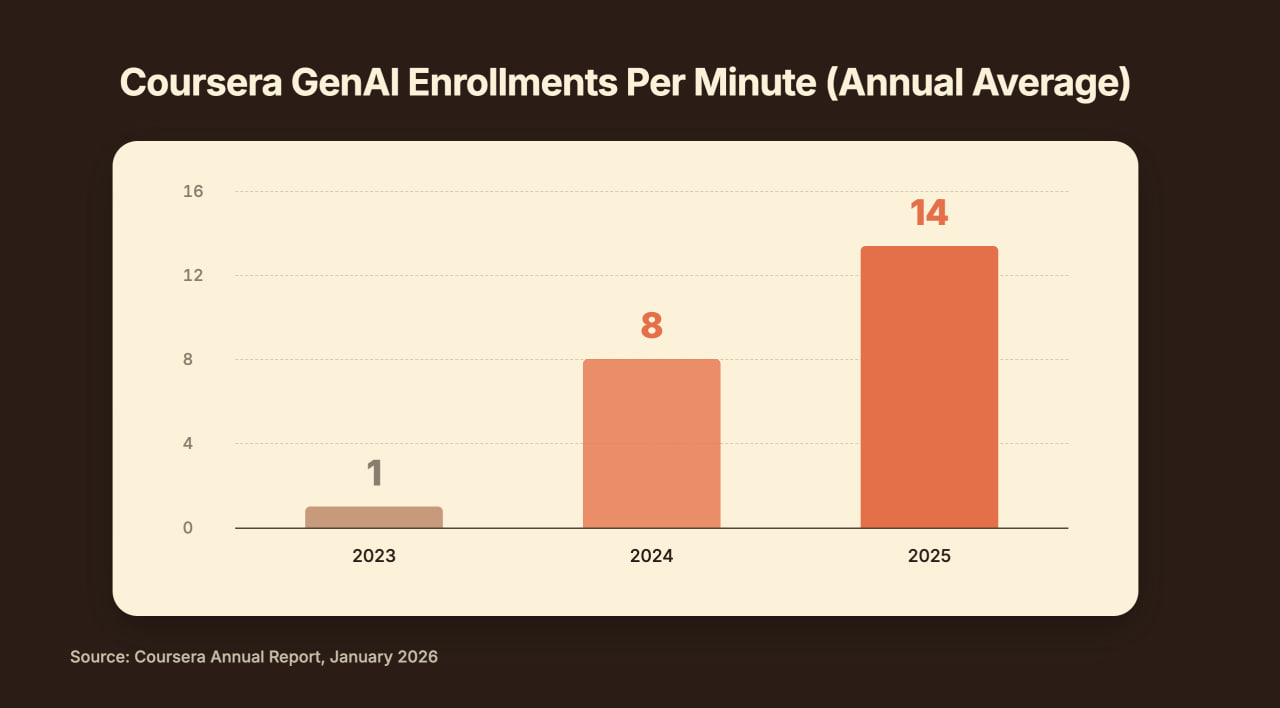
GenAI enrollments on Coursera hit 5.4 million in 2025, nearly double the prior year, with 14 enrollments per minute on an average day (Coursera Annual Report, January 2026). People aren’t waiting for a degree program to catch up. They’re learning now, from wherever the content is best.
Company-direct courses have a specific advantage third-party platforms can’t replicate: they’re built around the tools and models you’ll actually use. An Anthropic course on Claude’s API teaches it the way Anthropic’s engineers think about it. An AWS certification validates skills the way AWS hiring managers evaluate them. That alignment matters when the goal is applied knowledge, not theoretical.
Jobs requiring AI skills grew 7.5% year-over-year even as total job postings fell 11.3%, from PwC’s analysis of approximately one billion job advertisements (PwC AI Jobs Barometer, June 2025). AI and ML specialists are also among the three fastest-growing jobs globally through 2030, according to the World Economic Forum’s Future of Jobs Report 2025, which surveyed more than 1,000 employers across 55 economies.
One distinction most roundup articles skip: not all “free” AI courses are actually free. Some require a Coursera subscription ($49/month) for full access; they’re free to audit but lock assessments and certificates behind the paywall. Others are genuinely free with no account required. Throughout this guide, “free” means no payment required for full course content. Where a Coursera subscription is needed, that’s called out.
Anthropic Academy: Claude, AI Fluency, and developer courses
Anthropic offers 13 free courses at anthropic.skilljar.com and anthropic.com/learn, covering everyone from non-technical business users through to engineers building production agentic systems. All courses issue certificates of completion.
The curriculum runs on two tracks. The first is AI literacy for non-developers. The flagship course, AI Fluency: Framework and Foundations, is built around four competencies: Delegation, Description, Discernment, and Diligence. Anthropic developed it with Prof. Joseph Feller of University College Cork and Prof. Rick Dakan of Ringling College of Art and Design. A separate version, AI Fluency for Educators, is designed for faculty and instructional designers. Both run at anthropic.com/learn with no account required.
The second track is technical. Anthropic API Fundamentals covers building applications on the Claude API, seven Claude Code courses walk through the full agentic development workflow, and a dedicated Model Context Protocol (MCP) course covers the protocol for connecting AI models to external tools and data sources.
Anthropic is one of the few AI companies whose non-technical course has academic co-authors with named institutional affiliations, a peer-reviewed signal that’s rare in corporate AI training. It’s also the most systematically organized AI literacy framework from any frontier lab, which makes it a defensible default for teams without a clear internal AI training standard.
Cost: Free. No subscription required.
Best for: Business teams and professionals (AI Fluency), educators (AI Fluency for Educators), Claude API developers (API Fundamentals, Claude Code), engineers building agentic systems with MCP.
OpenAI Academy: learning from the makers of ChatGPT
OpenAI launched its certification program in late 2025 with OpenAI Academy, built around a learning experience that runs directly inside ChatGPT. The flagship AI Foundations course pairs structured content with practice loops and reflection prompts inside the model, working as guided practice with an AI tutor rather than a traditional e-learning module.
Completing AI Foundations plus a hands-on project earns an OpenAI Certification, issued via Credly by Pearson. OpenAI also offers courses through Coursera, including ChatGPT Foundations for Teachers aimed at K-12 educators. ETS is a further credentialing partner, reflecting a push toward employer-recognized credentials rather than just completion certificates.
According to OpenAI’s certification launch announcement, the program is designed to meet learners where they are regardless of technical background, which makes AI Foundations one of the most accessible entry points on this list for non-developers who want a credential tied to the most widely used AI platform in the world.
Cost: AI Foundations is free. Coursera-hosted courses require a Coursera subscription ($49/month) for full access.
Best for: Professionals at any level standardizing on ChatGPT workflows; educators; anyone seeking an OpenAI-issued credential.
Microsoft AI courses: from fundamentals to Azure AI Engineer
Microsoft’s AI learning ecosystem spans 7 or more official paths and two professional certifications, all accessible through Microsoft Learn at no cost beyond exam fees.
Two items worth flagging before you enroll. The Azure AI Fundamentals certification (AI-900) is retiring June 30, 2026, replaced by AI-901. If you’re partway through AI-900 prep, check whether your exam date falls before the cutoff. The Azure AI Engineer Associate (AI-102) was refreshed in 2025 with expanded coverage of generative AI and agentic AI patterns, so 2024 study guides don’t match the current exam structure.
The free catalog includes:
- AI Agents for Beginners: 12-lesson GitHub curriculum at aka.ms/ai-agents-beginners
- AI For Beginners: open-source GitHub course at microsoft.github.io/AI-For-Beginners
- Career Essentials in Generative AI: built with LinkedIn Learning, approximately 4 hours 18 minutes, certificate included
- Work Smarter with AI: Copilot-focused path for business users
- Microsoft Credentials AI Challenge: three free Applied Skills credentials; check current status at learn.microsoft.com/en-us/credentials/microsoft-credentials-ai-challenge
Cost: Free via Microsoft Learn. Certification exam fees apply.
Best for: Business users on Microsoft 365 and Copilot, developers building Azure AI applications (AI-102), beginners looking for structured paths (AI-901, AI For Beginners, Career Essentials).
NVIDIA Deep Learning Institute: hands-on GPU and LLM training
NVIDIA’s Deep Learning Institute offers courses completable in under a day, with one free course pass for all members of the NVIDIA Developer Program (free to join). Topics span Deep Learning, Generative AI and LLMs, Accelerated Computing, Data Science, Physical AI, and Graphics and Simulation, with instructor-led workshops available for organizations that want facilitated training.
Certifications run at two levels: NVIDIA Certified Associate (entry-level) and NVIDIA Certified Professional (intermediate). In 2026, NVIDIA added new exam tracks covering Physical AI, OpenUSD, and AI Infrastructure, all tied to NVIDIA’s push into robotics and simulation beyond language models. The full self-paced catalog is at nvidia.com/en-us/training.
For teams working with NVIDIA’s inference and model development tooling (NIM microservices, Triton Inference Server, or NeMo), DLI courses provide the most direct training on the tools they’re already using. For a broader map of how these tools fit together, see Inside NVIDIA’s AI Ecosystem: A Practical Guide for Builders.
Cost: Free (one course with Developer Program membership). Additional courses and instructor-led workshops are paid.
Best for: Developers and ML engineers working with NVIDIA GPUs, NIM, NeMo, or LLM deployment infrastructure.
Google AI courses: 26 million completions and a free skills platform
Google’s learning platforms logged more than 26 million courses, labs, and credentials completed in a single year, according to Google’s official blog (October 2025). That same month, Google consolidated all of its AI training content under skills.google, a single platform that now hosts everything from Cloud Skills Boost to Grow with Google paths.
The free catalog includes the Machine Learning Crash Course (12 self-paced modules at developers.google.com/machine-learning/crash-course), an Introduction to Generative AI short course, and AI Research Foundations from the DeepMind collection. Google also offers AI Boost Bites, 10-minute modules for learners who want to build skills in short sessions. Google AI Essentials (approximately 10 hours) is auditable free on Coursera but requires a subscription for the full certificate.
For engineers targeting professional-level recognition, the Google Professional Machine Learning Engineer certification costs $200 for the exam, requires 3 or more years of experience, and validates for 2 years.
Cost: Free (MLCC, Intro to GenAI, AI Boost Bites, skills.google paths) / Freemium (Google AI Essentials via Coursera) / Paid ($200 Professional ML Engineer exam).
Best for: All levels (AI Essentials, Intro to GenAI); ML engineers targeting certification; developers using Google Cloud AI services.
AWS Skill Builder: 600+ free courses and three AI/ML certifications
AWS Skill Builder offers more than 600 free AI and ML courses at skillbuilder.aws with no subscription required. The free tier includes hands-on labs, a SimuLearn GenAI Practitioner simulation, and the Generative AI Learning Plan for Developers, a structured multi-module path with no exam fee.
Three role-based certifications sit above the free content. The AWS Certified AI Practitioner is foundational with no experience requirement and is the most accessible entry credential on the AWS track. The AWS Certified Machine Learning Engineer Associate requires approximately one year of hands-on ML experience. The AWS Certified Machine Learning Specialty is the advanced track for experienced practitioners.
AWS also runs the AI & ML Scholars program for 2026; the challenge phase ran March 24 through June 24, 2026, targeting the AI Practitioner credential. Check aws.amazon.com/blogs/training-and-certification for the next cohort.
Cost: Free (Skill Builder courses). Certification exam fees apply.
Best for: Cloud architects and developers building on AWS; teams seeking employer-recognized cloud AI certification; beginners starting with the AI Practitioner as an entry credential.
IBM, Meta, and Hugging Face: enterprise and open-source AI training
Three companies occupy the open-source and enterprise end of AI education, each through a different format.
IBM SkillsBuild
IBM SkillsBuild offers an AI Fundamentals credential built across 6 courses totaling 10 or more hours of free content. Topics include NLP, computer vision, ML, deep learning, AI ethics, and Watson Studio. Completing the credential earns a verified Credly badge, a portable, verifiable signal for enterprise teams. IBM also offers a multi-week AI Developer Professional Certificate on Coursera (subscription required) and free watsonx foundations courses through IBM Learning.
Meta and PyTorch
Meta doesn’t operate a branded AI course platform. Its public AI training runs through the PyTorch ecosystem, which Meta created and maintains. The PyTorch official tutorials are free, cover deep learning basics through advanced model development, and are the closest thing to official Meta AI training available to the public. The Meta AI Residency Program is a competitive paid research position, not a course.
Hugging Face Learn
Hugging Face Learn offers eight courses: AI Agents, LLMs, Deep Reinforcement Learning, MCP, Diffusion Models, Robotics (the LeRobot framework), Computer Vision, and Audio. All are free. The AI Agents Course and the Deep RL Course award completion certificates. The Agents Course is strong for developers who want hands-on experience with smolagents, LlamaIndex, and LangGraph in a structured curriculum format.
Cost: IBM SkillsBuild free; IBM Pro certificate requires Coursera subscription. PyTorch tutorials free. Hugging Face Learn free.
Best for: Enterprise teams and badge-seekers (IBM); developers going deep on model architecture and training (PyTorch); ML practitioners fine-tuning open-source models (Hugging Face).
Which AI course should you take first?
96% of employers say micro-credentials strengthen candidate applications, and 28% of learners who earned one received a salary increase afterward (Coursera employer survey, January 2026). The credential matters, but only if it matches where you’re going.
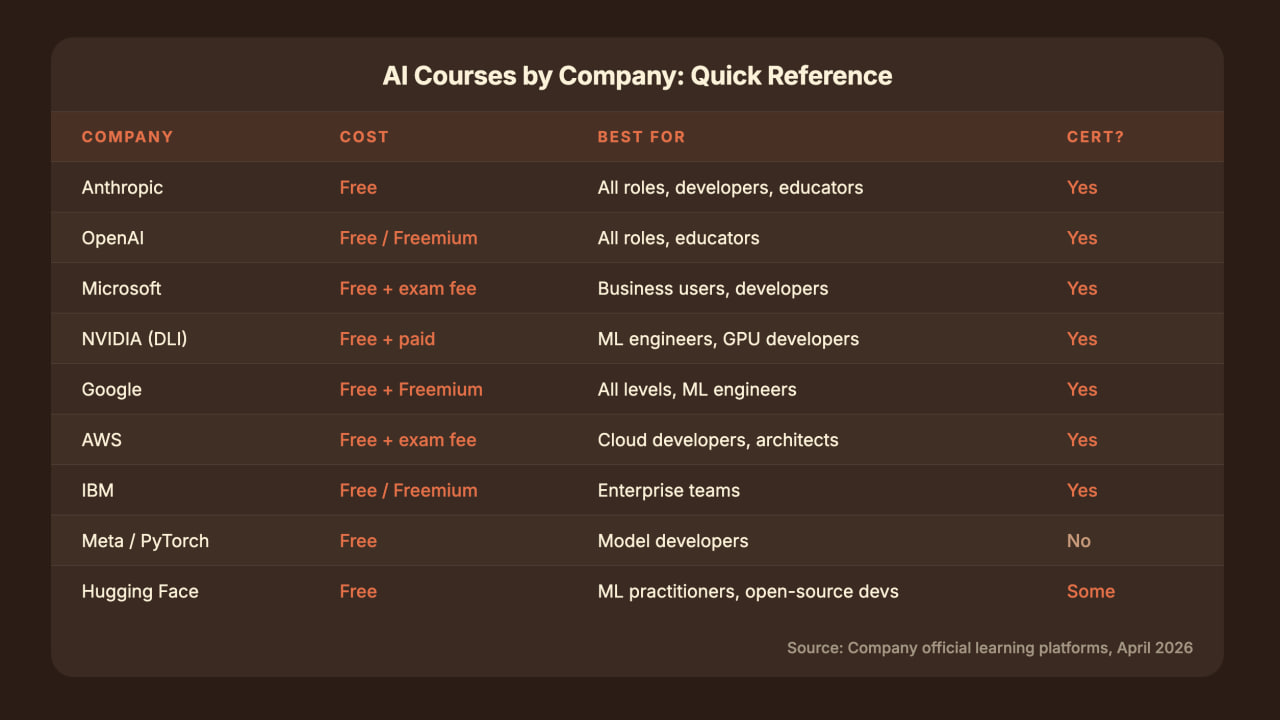
The decision framework is simpler than most guides make it:
- Building with Claude or ChatGPT APIs: start with Anthropic API Fundamentals or OpenAI AI Foundations
- Non-technical professional or educator: Anthropic AI Fluency or OpenAI AI Foundations
- Complete beginner with no coding background: Google AI Essentials or Microsoft Career Essentials with LinkedIn
- ML engineer or developer: NVIDIA DLI or AWS ML Engineer Associate
- Cloud infrastructure work: AWS (for AWS environments) or Google Professional ML Engineer (for GCP)
- Enterprise team training: IBM SkillsBuild or Microsoft AI-102
- Open-source model development: Hugging Face LLM Course or PyTorch tutorials
Start with the company whose tools you already use or intend to build with. For teams looking to build lightweight tools on top of these model APIs without writing backend infrastructure, The Ultimate Guide to Lovable in 2026 covers the no-code path from API to deployed app.
Frequently Asked Questions
Are AI courses from major tech companies actually free?
Most are, but the definition of “free” varies. Anthropic, Hugging Face, Microsoft Learn, and IBM SkillsBuild are genuinely free with no subscription required. Google AI Essentials and IBM’s Professional Certificate require a Coursera subscription ($49/month) for full access. OpenAI’s AI Foundations course is free; Coursera-hosted OpenAI courses require a subscription.
Which AI certification is most recognized by employers?
For cloud-adjacent roles, Microsoft Azure AI Engineer Associate (AI-102), Google Professional Machine Learning Engineer, and AWS Certified Machine Learning Engineer Associate appear most frequently in job descriptions, based on job advertisement analysis in the PwC AI Jobs Barometer (June 2025, approximately one billion ads analyzed). NVIDIA Certified Professional is gaining ground in ML infrastructure roles.
How long do these AI courses take to complete?
The range is wide. Google’s AI Boost Bites modules run 10 minutes each. Most foundational courses (Microsoft AI-901, IBM AI Fundamentals, Anthropic AI Fluency) run 6 to 12 hours. Google AI Essentials is approximately 10 hours. Professional certifications (Microsoft AI-102, Google Pro ML Engineer, AWS ML Specialty) typically require 40 to 80 hours of preparation including practice exams.
Do I need coding experience to take these courses?
Several are explicitly designed for non-technical learners: Anthropic AI Fluency, OpenAI AI Foundations, Microsoft’s Copilot and Career Essentials paths, IBM AI Fundamentals, and Google AI Essentials. Developer-track courses assume programming experience: Hugging Face (Python), NVIDIA DLI (Python, CUDA), Anthropic API Fundamentals (Python), and AWS ML Engineer Associate (Python, AWS SDK).
Not sure which AI skills matter most for your team? Get in touch with us — we’ll help you identify the right learning path and how AI can start working in your business today.