Kimmo Hakonen
Chief Innovation Officer
Insights, strategies, and real-world playbooks on AI-powered marketing.
APR 27, 2026
How Crypto Finance Teams Automate Accounting With AI Agents
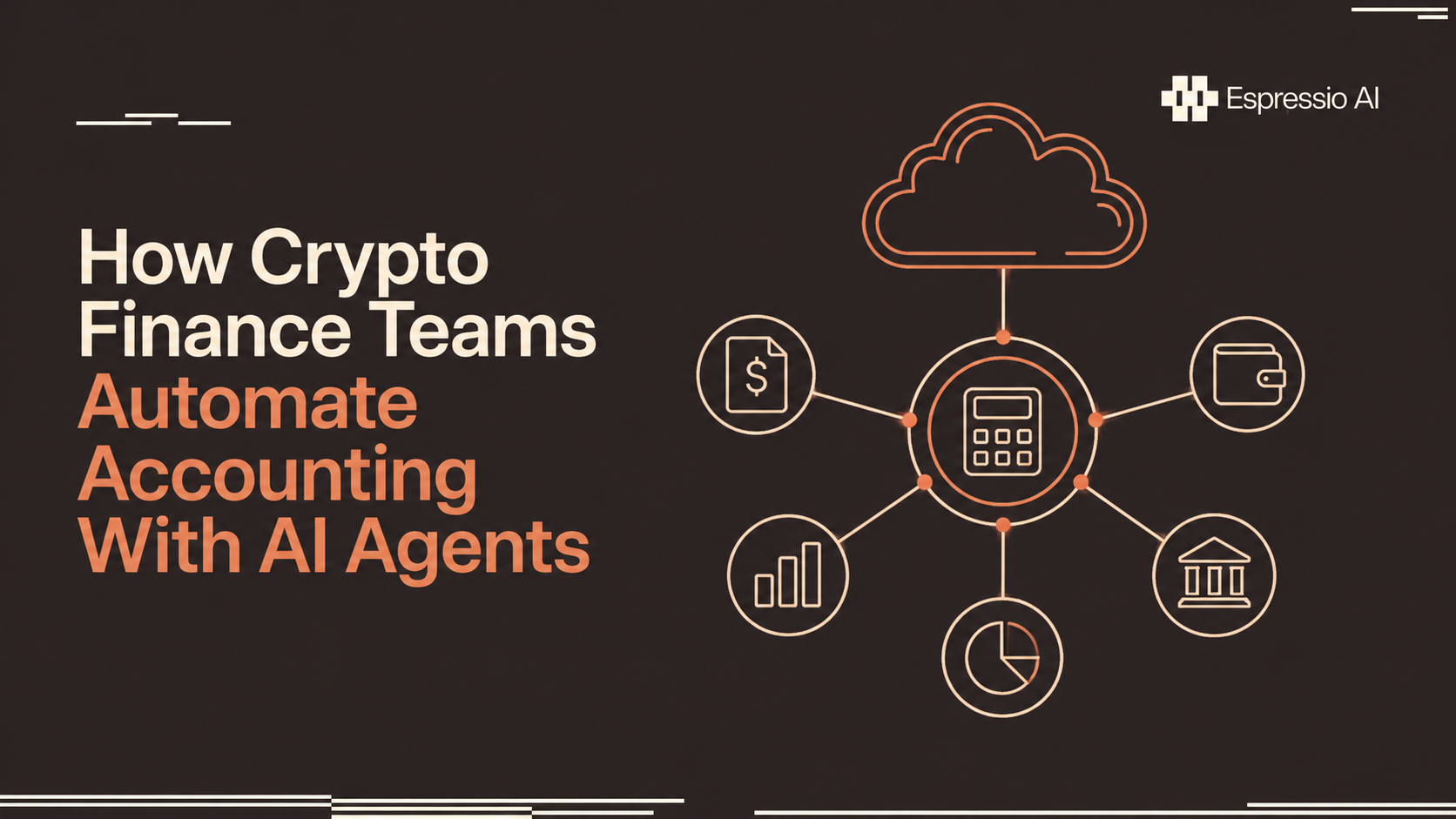
Stablecoins settled $27.6T in 2024 - surpassing Visa and Mastercard combined. That volume has become an enterprise accounting problem. Yet 42% of CFOs cite accounting and controls complexity as the top barrier to crypto treasury adoption (Deloitte CFO Signals, Q2 2025, n=200). Manual reconciliation across 200+ chains, exchanges, custodians, and off-chain ledgers doesn’t break occasionally. It breaks at scale by design.
The finance teams getting ahead of this problem aren’t throwing more staff at the data volume. They’re deploying a five-layer AI stack: on-chain and off-chain ingestion, a RAG knowledge base encoding internal accounting rules, an AI categorization agent, a human-in-the-loop approval layer, and ERP sync. This guide walks through each layer in sequence, with tool recommendations and configuration guidance at every step.
Key Takeaways
- Stablecoins settled $27.6T in 2024 - more than Visa and Mastercard combined - yet 42% of CFOs cite accounting complexity as the top barrier to crypto treasury adoption (Deloitte, 2025).
- Crypto accounting automation stacks layer on-chain ingestion tools (Cryptio, TRES Finance) with RAG knowledge bases, AI categorization agents, and human-in-the-loop approvals - cutting reconciliation time by 85% without removing human judgment.
- AI handles transaction matching, categorization, and payment prep; finance professionals make the calls on exceptions, multi-sig approvals, and audit-sensitive classifications.
Why does crypto accounting break at scale?
Stablecoins settled $27.6T in 2024, up from approximately $11.8T in 2023 (CEX.IO via CryptoSlate, 2024). Bitcoin settled $19T on-chain in 2024, up from $8.7T in 2023 (Brave New Coin, 2024). Those two numbers explain why 42% of CFOs name accounting and controls complexity as their top pain point for crypto treasury adoption (Deloitte CFO Signals Q2 2025). The data volume alone breaks any process built on bank feed logic.
Fiat accounting software was built for a specific model: a single bank feed, standardized transaction formats, batch settlement cycles. Crypto accounting has none of those properties. A mid-size crypto treasury might draw transaction data from a dozen chains, three CEX accounts, two custodians, an OTC desk, and stablecoin payment rails simultaneously.
Each source exports in a different format. Settlement runs continuously. Gas and fee treatments vary by chain and protocol. A bridge transfer looks like a withdrawal from one vantage point and a deposit from another. None of that maps cleanly to QuickBooks or NetSuite as-built.
The structural gap is a data normalization problem that requires a purpose-built ingestion layer before any accounting logic can run.
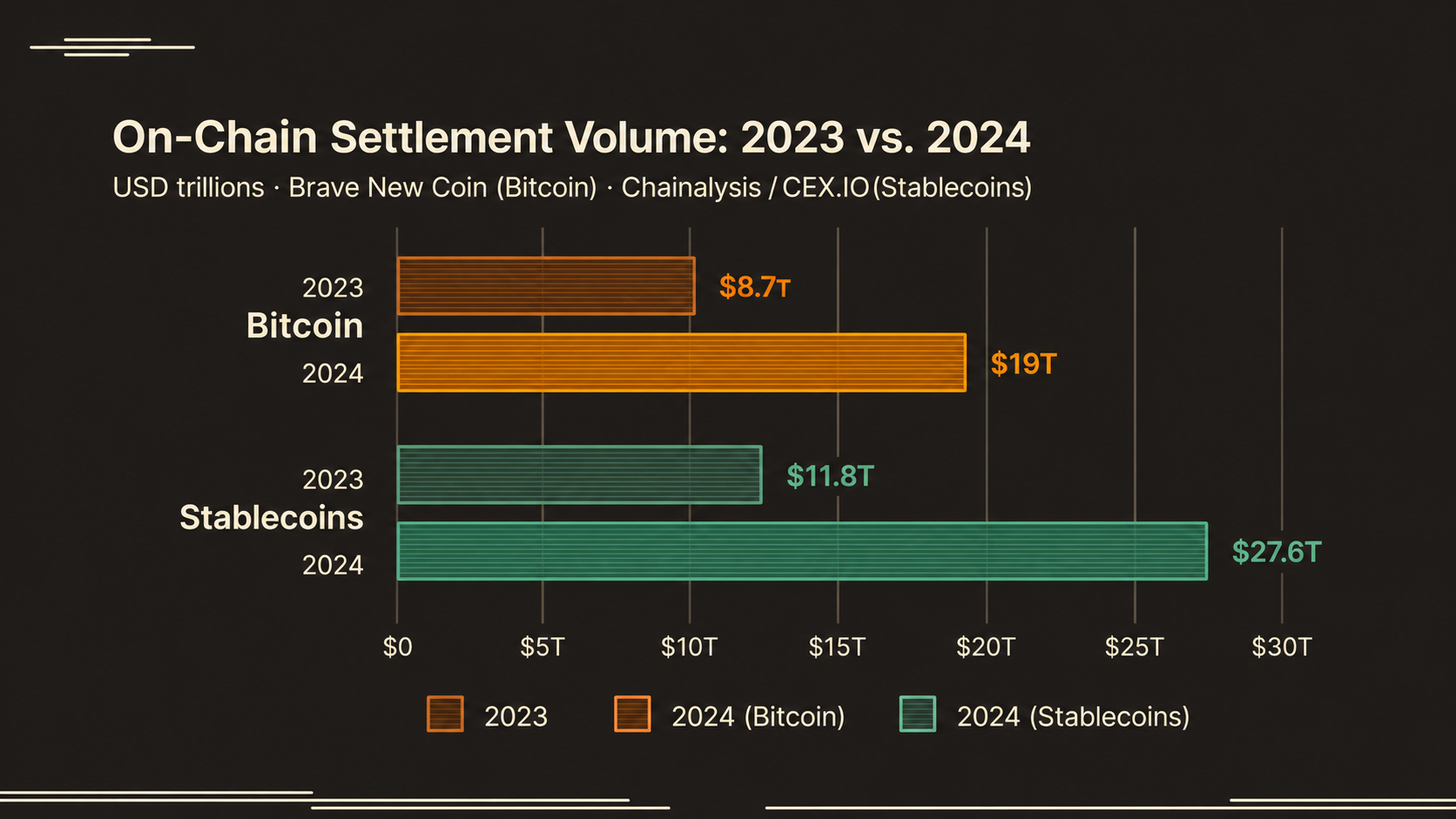
Crypto accounting requires reconciling on-chain data from multiple chains alongside CEX reports, custodian statements, OTC records, and stablecoin settlement data, all in incompatible formats on a continuous settlement cycle. Standard accounting platforms weren’t built for that data structure (Deloitte CFO Signals, 2025).
The five-layer AI accounting stack
The stack crypto-native finance teams are deploying has five sequential layers: on-chain and off-chain data ingestion, a RAG knowledge base encoding internal accounting rules, an AI categorization agent, a human-in-the-loop approval layer, and ERP sync. Human judgment sits at layer four, reviewing exceptions.
Each layer has a specific function:
-
Ingestion. TRES Finance and Cryptio connect to 200+ chains, exchanges, and custodians via API. The output is normalized transaction records with timestamps, amounts, counterparties, and chain IDs. This layer solves the format heterogeneity problem before any accounting logic runs.
-
RAG knowledge base. Your chart of accounts, tax treatment rules, DeFi protocol taxonomy, and internal policies are encoded as documents the AI retrieves from. The model reasons from your rulebook, not from generalized training data. Update the knowledge base and the categorization logic updates automatically.
-
AI categorization agent. Each transaction gets classified: trading revenue, gas expense, staking income, bridge transfer, liquidity provision. The agent assigns a confidence score and flags ambiguous cases for human review.
-
Human-in-the-loop approvals. Threshold-based routing sends auto-approvable transactions through and surfaces flagged items to a named controller. Reviewers see the AI’s suggested categorization, the confidence score, and the rule that produced the suggestion.
-
ERP sync. Approved journal entries push to QuickBooks, NetSuite, or Xero. The reconciliation loop closes without manual re-entry.
The RAG layer is the architectural choice that matters most here. An AI categorizing from open-world training data makes consistent errors at protocol-specific edge cases: wrapped token unwrapping vs. swap, bridge transfer vs. withdrawal, liquidity provision vs. token transfer. With a firm-specific RAG built from your own chart of accounts, historical categorization decisions, and DeFi protocol taxonomy, the model reasons from your rulebook. Categorization accuracy approaches that of a trained junior accountant working from the same documentation.
That architectural distinction also future-proofs the system. When a new DeFi protocol launches or a new asset class emerges, you add documentation to the RAG knowledge base rather than retraining a model. The RAG market reached $1.94B in 2025 and is projected to reach $9.86B by 2030 at a 38.4% CAGR, with financial services as the leading early-adopter vertical (MarketsandMarkets, 2025).
What tools handle on-chain and off-chain transaction ingestion?
TRES Finance and Cryptio are the primary ingestion tools for crypto-native finance teams. TRES Finance covers 200+ chains, exchanges, and custodians with 99% reconciliation accuracy via AI-matching (TRES Finance, 2025 - vendor-reported). Cryptio specializes in DeFi protocol mapping with native integration to QuickBooks and NetSuite. The practical difference between them comes down to your custody setup and the depth of your DeFi exposure.
Cryptio covers DeFi depth. It labels 100+ DeFi protocols natively, connects to QuickBooks and NetSuite out of the box, and suits teams with significant DeFi activity who are already running QuickBooks workflows. If your portfolio includes AMM positions, yield farming, or frequent bridge activity, Cryptio’s protocol taxonomy is the relevant differentiator.
TRES Finance handles institutional coverage breadth. It connects to 200+ chains and includes direct custodian APIs for Fireblocks, BitGo, and Copper: the configuration for multi-custodian institutional treasury teams running NetSuite or a custom ERP.
Most teams configure an ingestion tool and expect categorization to follow automatically. It doesn’t. Both Cryptio and TRES Finance solve data ingestion and normalization; the AI categorization agent layer sits on top. Expecting categorization from ingestion alone is the most common deployment mistake.
For teams researching chain-specific accounting treatment for new DeFi integrations before building out their taxonomy, The Complete Perplexity AI Guide for 2026 covers how Perplexity’s Deep Research feature handles protocol-specific research at scale.
How do human-in-the-loop approvals work in practice?
HITL approval layers use configurable thresholds (dollar amount, counterparty type, or transaction category) to route decisions. Only flagged transactions reach a human reviewer; the rest auto-approve and queue for ERP sync. Gartner projects 90% of finance functions will deploy AI by 2026, with fewer than 10% seeing headcount reductions (Gartner, 2024). The HITL layer is the design mechanism that makes those two projections compatible.
Reviewers don’t see a raw transaction. They see the AI’s suggested categorization, a confidence score, the rule from the RAG knowledge base that produced the suggestion, and the counterparty context. The reviewer confirms, corrects, or escalates. Every correction gets logged back into the knowledge base, tightening accuracy over time.
The multi-sig connection is direct. HITL approval is the decision point; multi-sig is the execution layer. A controller approves a flagged payment in the AI system, which triggers a webhook to the multi-sig wallet (Fireblocks, Safe, or Gnosis). The wallet executes the transaction. The approval record in the AI system becomes the audit trail for the disbursement: a clean chain of custody from flagged exception to on-chain execution.
Slack-based approval notifications are how flagged transactions surface for reviewer action in most deployments, with the exception details and one-click approve/escalate controls delivered to the controller’s workspace.
In our deployments, the threshold configuration that made controllers comfortable was a two-tier system: auto-approve routine transfers below $10K to known counterparties, route everything above to a named reviewer. Starting with a conservative threshold and relaxing it over 60-90 days as the team builds confidence in AI accuracy is the pattern that sustains adoption. Controllers who started with a $5K threshold were running at $50K within three months.
Human-in-the-loop approval design is why those two Gartner projections coexist: the AI routes exceptions to human reviewers rather than replacing the human judgment that controllers are accountable for on financial statements.
Results crypto finance teams report after deployment
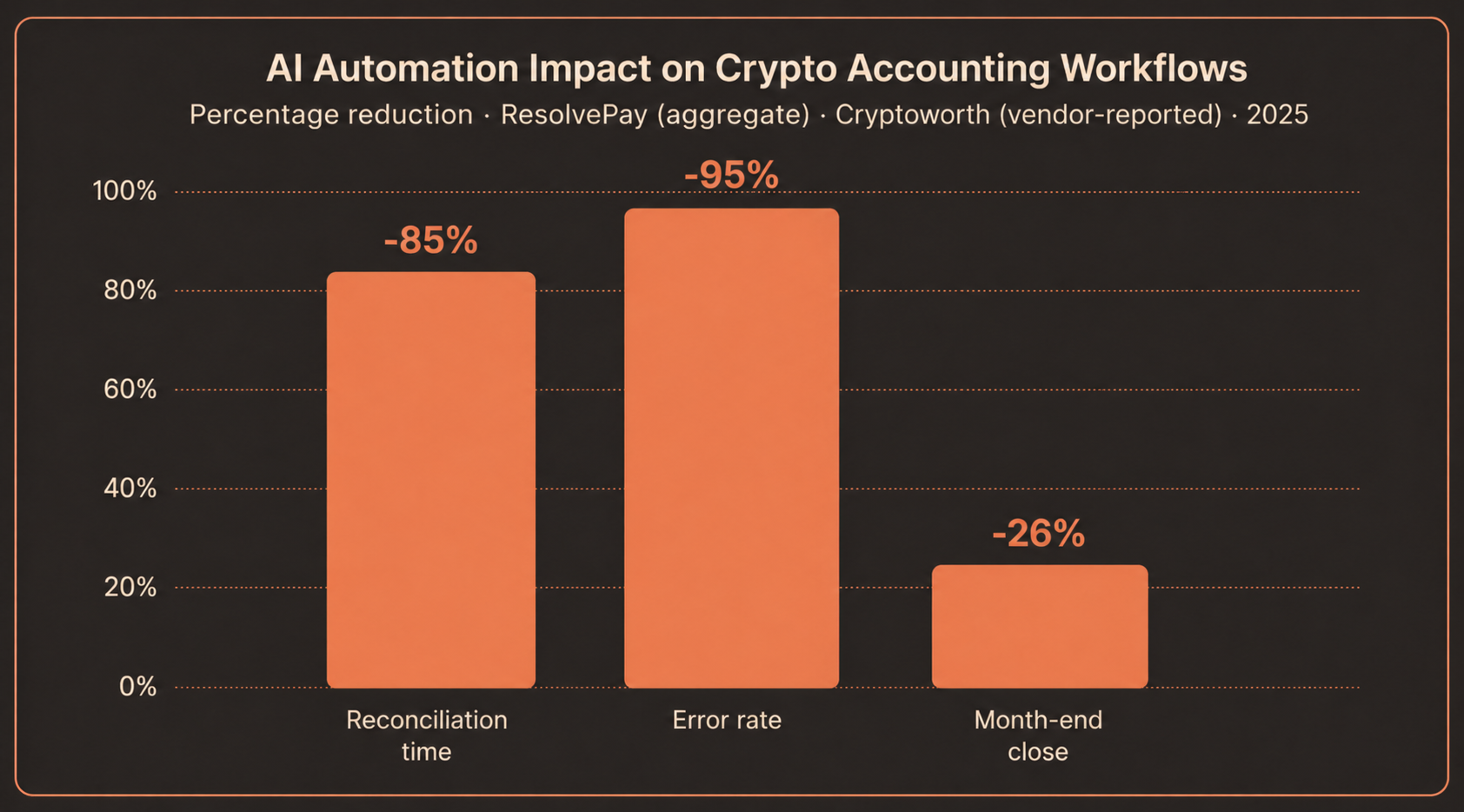
Across aggregate implementations, crypto accounting automation teams report 85% reductions in reconciliation time and 95% reductions in errors (ResolvePay, aggregated benchmark - not a controlled study). Cryptoworth’s 2025 customer data, also vendor-reported, shows month-end close compressing from 10+ days to 5 days or fewer on average. These are directionally consistent with broader finance automation literature, but treat them as order-of-magnitude estimates rather than controlled research findings.
The time savings come from automating three high-volume tasks: transaction lookup across chain explorers and CEX reports, format normalization across incompatible data structures, and multi-source matching to reconcile on-chain and off-chain records. Human time shifts to exception review and audit preparation.
The adoption data reveals where most firms are stuck. 59% of finance leaders now use AI in some form, up from 37% in 2023 (Gartner, November 2025). Only 34% have deployed AI agents specifically in accounting or finance functions (PwC AI Agent Survey, April 2025, n=308). The gap is AI in FP&A and forecasting, with manual processes still running reconciliation.
What stays human in AI-assisted crypto accounting?
Judgment-heavy decisions stay with finance professionals: novel transaction type classification for new DeFi protocols or bridging structures the AI hasn’t encountered, audit-sensitive categorizations like staking rewards vs. lending income tax treatment, counterparty sanctions screening, and multi-sig disbursement approval. AI handles pattern recognition at volume. Humans handle edge cases, policy calls, and anything that will be explained to an auditor.
Finance professionals stay; their work shifts. Gartner projects fewer than 10% of firms see headcount reductions from AI deployment. Controllers move from processing transactions to reviewing flagged exceptions, verifying automation accuracy, and doing analysis that requires judgment: variance explanations, cash flow modeling, audit support. The 60% of close week previously spent on manual reconciliation goes toward work the AI can’t produce.
The control-risk perception is what keeps most finance teams from deploying AI agents in accounting specifically. Only 34% of companies have deployed AI agents in accounting or finance, vs. 79% using AI agents broadly in their business (PwC, April 2025). Controllers tend to conflate “automate” with “remove human accountability.” HITL design refutes that equation by making accountability explicit and auditable in the workflow architecture. The approval record is a named action by a named person on a flagged item, which creates more accountability than a bulk manual journal entry.
For finance teams building the foundational AI skills to run these workflows, AI upskilling for finance teams catalogs official training programs by company.
How do you start deploying AI agents for crypto accounting?
Start with ingestion and reconciliation before adding categorization intelligence. Teams that try to deploy AI categorization before normalizing their transaction data spend the first month cleaning data instead of automating workflows. The practical sequence: ingestion tools first, validate for 30 days, then layer the RAG knowledge base and categorization agent on top.
Six steps to deploy the stack:
-
Audit your data sources. List every chain, exchange, custodian, and OTC desk that generates transactions. Incomplete source mapping produces incomplete reconciliation. Most teams discover two or three overlooked sources during this step.
-
Connect ingestion. Cryptio for DeFi-heavy teams running QuickBooks. TRES Finance for institutional custody setups using NetSuite or multi-custodian configurations. Don’t attempt to run both simultaneously at first. Pick the tool that covers 80% of your transaction volume and expand from there.
-
Build your RAG knowledge base. Start with four document types: your chart of accounts, historical categorization decisions exported from your existing accounting system, tax treatment rules by asset class and protocol, and internal policy documents. A lean RAG with high-quality documents outperforms a large RAG with inconsistent ones.
-
Configure the AI categorization agent with HITL thresholds. Set initial thresholds conservatively. A $10K auto-approval limit for known counterparties is a reasonable starting point. Configure separate thresholds for counterparty type: known exchange addresses auto-approve at higher limits than novel counterparties.
-
Run parallel for 30-60 days. AI categorizes; human verifies every decision. Every correction gets logged back to refine the RAG knowledge base. Most teams reach 80%+ categorization accuracy from day one and 95%+ by week eight as the knowledge base fills in.
-
Move to live operation. Once accuracy meets your internal threshold (typically 95%, or whatever your auditor accepts), retire the manual process for routine transactions. Keep the parallel check for novel transaction types as new DeFi protocols enter your portfolio.
How Espressio deploys crypto accounting automation for finance teams
Espressio was built from Lunar Strategy, the leading crypto marketing and growth agency in Europe. Seven years of embedded work across token launches, exchange listings, DeFi protocols, and institutional crypto treasury operations means the team deploying your accounting automation has operated inside the same environment you’re working in.
That operational background changes how the stack gets configured. A Fireblocks custody setup has different webhook behaviors than a Safe multisig. Cryptio’s protocol taxonomy for AMM positions handles the data differently from how Tres.finance processes the same transactions for institutional custody configurations. The difference between staking income and lending income affects tax treatment and line item assignment, and misclassifying it creates audit exposure that surfaces months later.
In deployment, the engagement runs from source mapping through live operation. We connect ingestion tooling to your specific custody stack: Cryptio for DeFi-heavy portfolios running QuickBooks, Tres.finance for multi-custodian institutional setups on NetSuite or a custom ERP. The HITL approval layer gets wired into your existing multi-sig payment flows via Fireblocks or Safe so approvals and disbursements share a documented chain of custody. Reconciliation automation closes against your ledger without requiring your team to manage the middleware.
The judgment-heavy decisions stay with your controller throughout: novel protocol classifications, sanctions screening edge cases, audit-sensitive categorizations. The system is designed to make those decisions faster and better documented. Automation handles pattern matching at volume across normalized transaction data. The calls that carry audit accountability stay with the people who are accountable for them.
The teams that get the most out of this stack are crypto-native ops firms where finance already understands the underlying infrastructure. That is the client profile Lunar Strategy spent seven years working with, and the profile Espressio was built to serve.
Frequently Asked Questions
Can AI replace our accountants for crypto reconciliation?
Gartner projects fewer than 10% of finance functions will see headcount reductions from AI deployment (Gartner, 2024). The role shifts from transaction processing to exception review and oversight. Controllers review flagged exceptions, approve threshold-exceeding transactions, and retain audit accountability. AI handles pattern matching at volume. The judgment stays with the accountant.
What is a RAG knowledge base in crypto accounting?
A firm-specific document store encoding your chart of accounts, tax treatment rules by asset class and protocol, DeFi protocol taxonomy, and historical categorization decisions. The AI retrieves from this store when categorizing transactions, reasoning from your firm’s rulebook rather than open-world training data. Update the knowledge base and the categorization logic updates automatically (no model retraining required).
How do multi-sig payment flows connect to AI approvals?
HITL approval is the decision point; multi-sig is the execution layer. A controller approves a flagged payment in the AI system, which triggers a webhook to the multi-sig wallet (Fireblocks, Safe, or Gnosis). The wallet executes the transaction. The approval record in the AI system becomes the audit trail for the disbursement, creating a documented chain of custody from flagged exception to on-chain execution.
Which tools integrate on-chain and off-chain transaction data?
TRES Finance covers 200+ chains, exchanges, and custodians with 99% reconciliation accuracy via AI-matching (vendor-reported, 2025). Cryptio specializes in DeFi protocol labeling with native QuickBooks and NetSuite integration. Most teams use one primary ingestion tool plus supplemental coverage for specific chains or custody providers not covered by the primary tool.
The path forward for crypto finance teams
Stablecoin settlement volume more than doubled between 2023 and 2024, and is on pace to double again. Finance teams building manual reconciliation processes to keep pace with that growth rate will fall behind; most already have.
The five-layer stack (ingestion, RAG knowledge base, AI categorization agent, HITL approvals, ERP sync) works because it places automation where it scales (pattern recognition across millions of transactions) and keeps human judgment where it can’t be automated: exception review, novel protocol classification, and audit defense.
Controllers who’ve run this stack for six months describe the same shift: less time on transaction processing, more time on analysis and forecasting. The time freed from reconciliation goes toward variance analysis, cash flow modeling, and audit preparation. That’s where a controller adds the most value, and it’s work that no ingestion tool or categorization agent can substitute for.
The entry point is ingestion and reconciliation. Build from there. For teams applying similar agentic patterns to other business operations, the architectural principles carry across functions. RAG knowledge bases, HITL thresholds, and audit-trail design are as relevant in marketing and sales operations as they are in finance.
Ready to map your crypto accounting automation?
The most common configuration mistake is expecting categorization to follow automatically from ingestion. Espressio runs this deployment sequence with crypto finance teams from source mapping through live operation. Get in touch with us to start with your transaction source audit.