Luka Mrkić
Head of BD
Insights, strategies, and real-world playbooks on AI-powered marketing.
JUN 8, 2026
How to Build an AI Content Engine for Fintech Companies

TL;DR
- A fintech-grade AI content engine grounds every claim in primary sources, runs every public draft through compliance, and keeps an SME in the loop.
- The pipeline is five stages: sources, ingest, brief, draft, review. The brief stage and the review stage are where the engine earns trust.
- Pick two content types and ship them end to end. Regulatory updates plus comparison pages is the strongest opening pair.
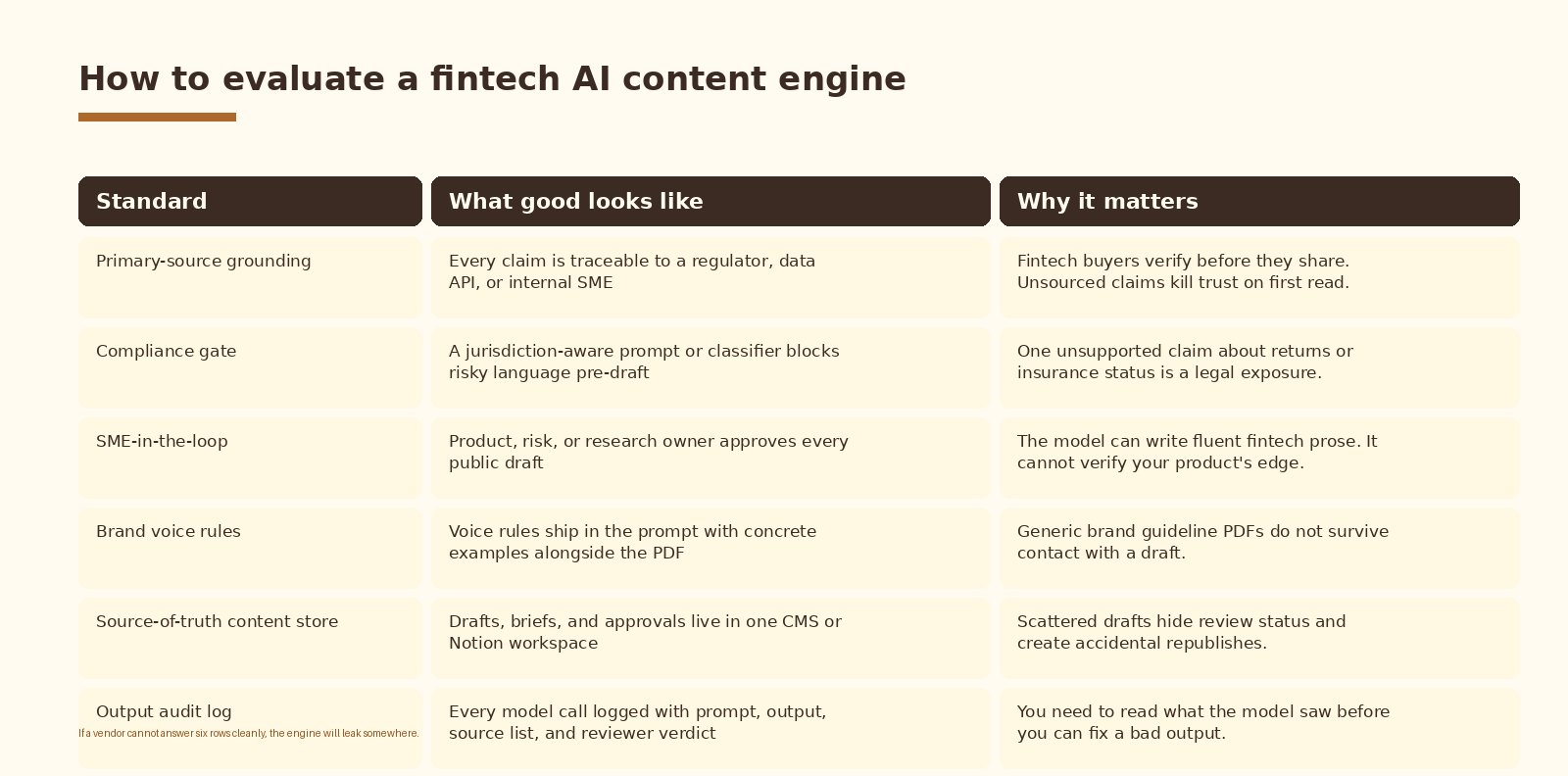
- Evaluation standards: primary-source grounding, compliance gate, SME-in-the-loop, brand voice rules in the prompt, single content store, and a full output audit log.
If you are evaluating who should build this for your team, this guide gives you both the technical blueprint and the standards to evaluate the work.
Why fintech content engines need their own playbook
Most AI content engines are tuned for SEO-volume blogs. Fintech buyers do not behave that way. They verify every claim against a regulator filing, a market data feed, or a known peer before they hand the page to their team. A generic engine that pulls from scraped web pages and ships chatty drafts gets filtered out on the first read.
A fintech-grade engine is built around three constraints generic engines ignore. Every claim must be traceable to a primary source. Every public draft must pass a compliance gate before it reaches a buyer. Every piece must carry the brand voice of a regulated business.
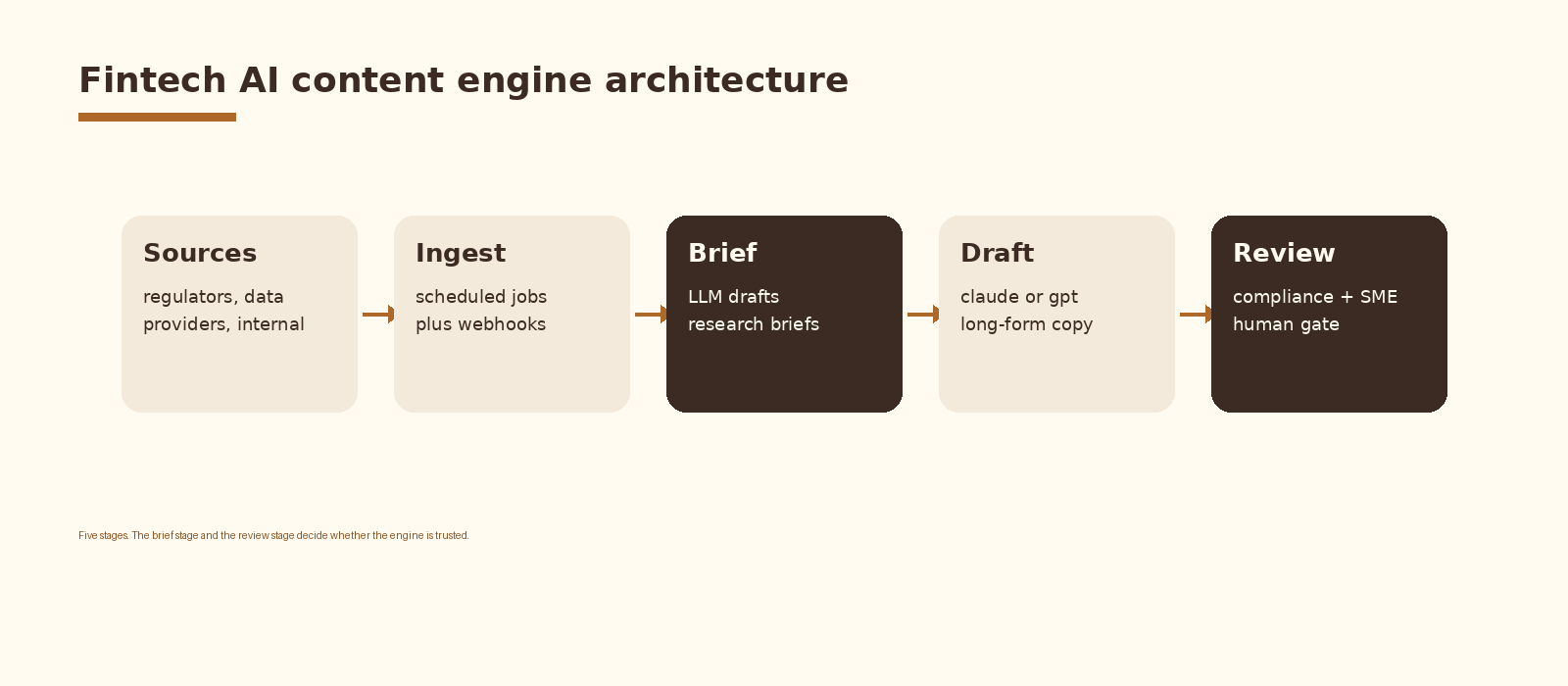
The five-stage fintech content pipeline
Treat the engine as five stages and resist merging them. Each stage has a different failure mode, and keeping them separate is what lets you replace one part without rebuilding everything else.
1. Sources
List every source that gives you a primary-data claim. Regulator releases from the SEC, FCA, FINRA, and ESMA. Macro data from FRED, Treasury Direct, and the Fed. Banking data from FDIC, Plaid, or your own data partners. Internal sources from product managers, risk owners, customer success, and research. The list is the engine’s memory; everything downstream cites back to it.
2. Ingest
Scheduled jobs pull regulator releases and data feeds. Webhooks catch internal events like new product launches, customer interviews, and risk incidents. Save everything as structured records in a warehouse such as BigQuery, Snowflake, or Postgres. The warehouse owns provenance, retrieval date, and a hash for each source.
3. Brief
Use an LLM to draft a research brief per content piece. The brief lists the audience, the question the piece answers, the primary sources cited, the angle, the rough outline, and the compliance constraints. Claude or GPT-4o handle this well when the prompt is structured. The brief is the contract between research and writing; it goes to a human reviewer before any draft is written.
4. Draft
The model writes the long-form draft from the approved brief, the source list, and the brand voice rules. Voice rules ship in the prompt with concrete examples. Drafts include inline source markers so the reviewer can trace every claim. Log every prompt and output.
5. Review
Two reviewer roles. A subject matter expert (product, risk, or research) checks the claims and the framing. A compliance reviewer checks the language against jurisdiction and product rules. An editor checks readability. Block public publish until all three pass. This is the gate that keeps the engine trusted.
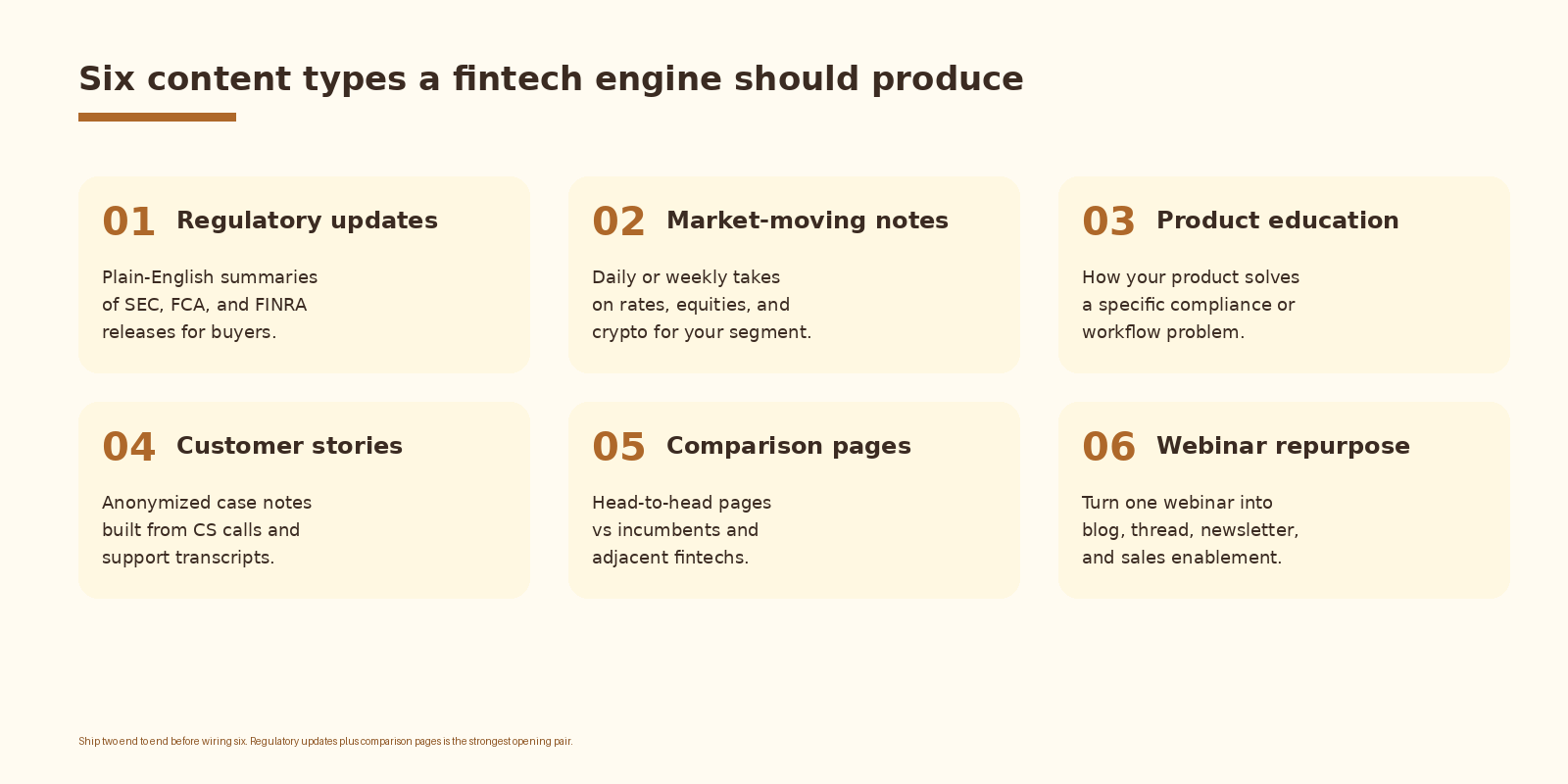
Six content types worth shipping, ranked by leverage
Most fintech teams try to wire six content types in week one and ship none of them cleanly. Pick two from this list, ship them end to end, then expand.
- Regulatory updates. Plain-English summaries of new SEC, FCA, FINRA, or ESMA releases for your buyer segment. High trust, high frequency, low risk when sourced correctly.
- Market-moving notes. Daily or weekly takes on rates, equities, credit, or crypto for your specific audience. Pairs well with a research team.
- Product education. How your product solves a specific compliance or workflow problem. Source from product managers and customer success calls.
- Customer stories. Anonymized case notes built from approved CS transcripts and support tickets. Verify every quote.
- Comparison pages. Head-to-head pages versus incumbents and adjacent fintechs. High commercial intent, requires careful claim verification.
- Webinar repurposing. Turn one webinar into a blog post, a LinkedIn thread, a newsletter section, and sales enablement copy. Highest output per hour of expert time.
The stack that earns its keep in 2026
There is no shortage of AI content tools. Most of them are point solutions that lock you into a UI. The setup below stays inside services you can wire together yourself, which keeps the data layer portable when something breaks.
- Data warehouse: BigQuery, Snowflake, or Postgres. The warehouse owns sources, briefs, drafts, and approval logs.
- Primary sources: regulator APIs and RSS feeds, FRED, Plaid, internal CRM, and a notes database from CS and product calls.
- AI layer: Claude or GPT-4o for briefs and drafts, Perplexity for source discovery, an embedding model for related-content suggestions.
- Compliance gate: a small jurisdiction-aware prompt or classifier that runs before review. It does not replace human compliance; it prevents obviously risky drafts from reaching them.
- Content store: Notion, Sanity, or your existing CMS. Drafts and approvals live in one place with version history.
- Orchestration: n8n, Make, or Zapier. Pick one and standardize. Splitting orchestration across three tools is how teams lose the plot.
- Review and audit: a Slack channel where every draft lands for SME, compliance, and editor sign-off. Sign-off writes back to the warehouse.
If you want this set up cleanly inside your fintech content operations with logging, retries, and a feedback loop into your CMS, that is the kind of work we ship at Espressio.
Generic engine versus fintech-grade engine
The fastest way to see whether a content engine fits fintech is to compare a generic SEO build against a fintech-grade one. The generic build scrapes the web, takes brand voice from a PDF, runs editor-only review, and skips compliance. The fintech-grade build cites primary sources, ships voice rules inside the prompt with examples, runs SME plus compliance plus editor review, and encodes jurisdiction rules as a prompt or classifier.
The generic build produces traffic noise. The fintech-grade build produces assets your sales team can hand to a regulated buyer without flinching.
How to evaluate the build
Whether you are scoping a vendor or auditing your own internal stack, run the engine against six standards. A build that cannot answer all six cleanly will leak somewhere within a quarter.
Common mistakes
- Shipping drafts that cite secondary blogs. Fintech buyers want the regulator, the data provider, or the internal SME. Anything else looks like a content farm.
- Treating brand voice as a PDF the writer reads once. Voice rules belong in the prompt, with concrete examples, refreshed each quarter.
- Editor-only review. The editor catches typos. The SME catches wrong claims. The compliance reviewer catches legal exposure. All three are required for a fintech engine.
- Encoding compliance only as a final human check. A pre-draft compliance prompt prevents the engine from spending budget on drafts that were never going to ship.
- Letting drafts live in three places. Scattered drafts hide review status and lead to accidental republishes.
- Skipping the audit log. You need to read what the model saw before you can fix a bad output. Anything less than full prompt-output-source logging is a sunk cost.
How to know it is working
Pick a small set of metrics, instrument them on day one, and read them weekly. Avoid promising specific targets up front. Watch how they move as you tighten sources and prompts.
- Publishable asset rate: share of drafts that pass SME, compliance, and editor review with light edits. Watch how this moves as you iterate the brief stage.
- Time from source to publish: median hours from an ingest event to a published asset. Faster is better, capped by the review gate.
- Reviewer override rate: share of drafts the SME or compliance reviewer rewrote materially. A high rate is signal that the brief or the voice rules are off.
- Compliance flag rate: share of drafts blocked by the pre-draft gate. Anything above zero is useful signal about prompt drift.
- Primary-source citation rate: share of claims in a published piece traceable to a primary source. The target is one hundred percent.
- Pipeline efficiency: drafts published per dollar of model spend per week. Useful for sizing the next build phase.
FAQ
Can a generic AI writing tool work for a fintech company?
Only for product-marketing copy that does not make claims about regulation, returns, or financial outcomes. The moment a piece touches those, generic tools leave you exposed because they cannot encode jurisdiction rules or trace claims to primary sources. A purpose-built engine is the only path that scales without legal risk.
Which LLM should we use for drafts?
Claude and GPT-4o both handle fintech vocabulary, compliance constraints, and brand voice well when the prompt is structured. Pick on team familiarity and existing contracts. The differences between them matter less than the quality of your brief stage and your source list.
How do we handle different jurisdictions?
Encode the rules as a jurisdiction-aware compliance prompt or a small classifier that runs as the last step before review. Block drafts that mention guaranteed returns, securities-like language, FDIC or insurance claims that do not apply, or any other phrase the legal team has flagged. The legal team writes the rule list once; the engine enforces it every time.
Where does the SME find time to review?
Two patterns work. Either dedicate one weekly review slot per SME and queue drafts to fit it, or rotate the SME role across the team so no single person becomes the bottleneck. The brief stage is what protects the SME’s time. A clean brief turns a forty-minute review into a ten-minute one.
Should the engine ever publish without a human in the loop?
For internal research notes and customer success summaries, yes. For anything public-facing or sales-facing in fintech, no. The cost of one wrong claim is higher than the time savings of removing the reviewer. Once your reviewer override rate sits below ten percent for a quarter, you can consider lifting the gate on lower-risk channels.
What to do next
- Pick the two highest-leverage content types from the six-card list. The default pair is regulatory updates plus comparison pages.
- Stand up the warehouse and the ingest jobs for your top three primary sources. Aim for one week to first data.
- Write the brief prompt with audience, sources, voice rules, and compliance constraints. Iterate it with one SME before scaling.
- Add the pre-draft compliance gate. Encode the legal team’s rule list. Log every blocked draft.
- Put SME, compliance, and editor review on every public draft. Track override rate weekly.
- Audit the engine against the six evaluation standards every month. Replace the weakest piece each cycle.
If you want automation like this set up cleanly inside your fintech content operations, let’s talk.
Related Espressio guides
- How to Use AI Marketing Automation for Web3 Projects Step by Step -> https://espressio.ai/blog/ai-marketing-automation-web3
- How to Integrate Claude with Notion to Build an AI Content Calendar
- How to Build an AI Content Calendar in Airtable Using GPT-4
- How to Automate SEO Content Briefs with Perplexity and Claude
- How to Integrate Claude with Amazon Web Services to Automate Content Pipelines