Luka Mrkić
Head of BD
Insights, strategies, and real-world playbooks on AI-powered marketing.
JUN 8, 2026
How to Use AI Marketing Automation for Web3 Projects Step by Step

TL;DR
- Web3 marketing automation works when your stack is wallet-aware, cohort-aware, and gated by a human reviewer on every public message.
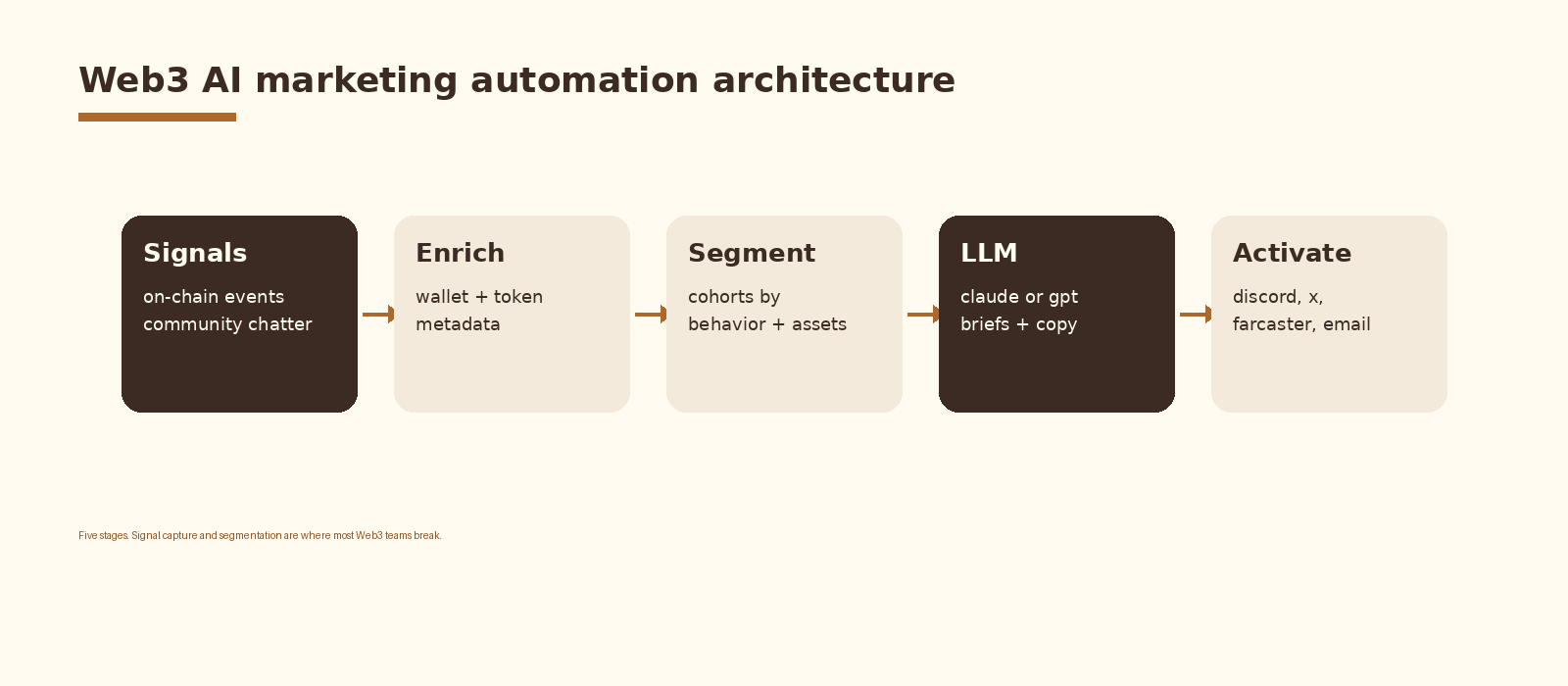
- The core pipeline is five stages: capture on-chain and community signals, enrich them, segment by behavior, draft with an LLM, activate across Discord, X, Farcaster, and email.
- Ship two automations end to end before wiring six. A clean wallet cohort engine plus a weekly community digest earns trust faster than a dashboard full of half-built flows.
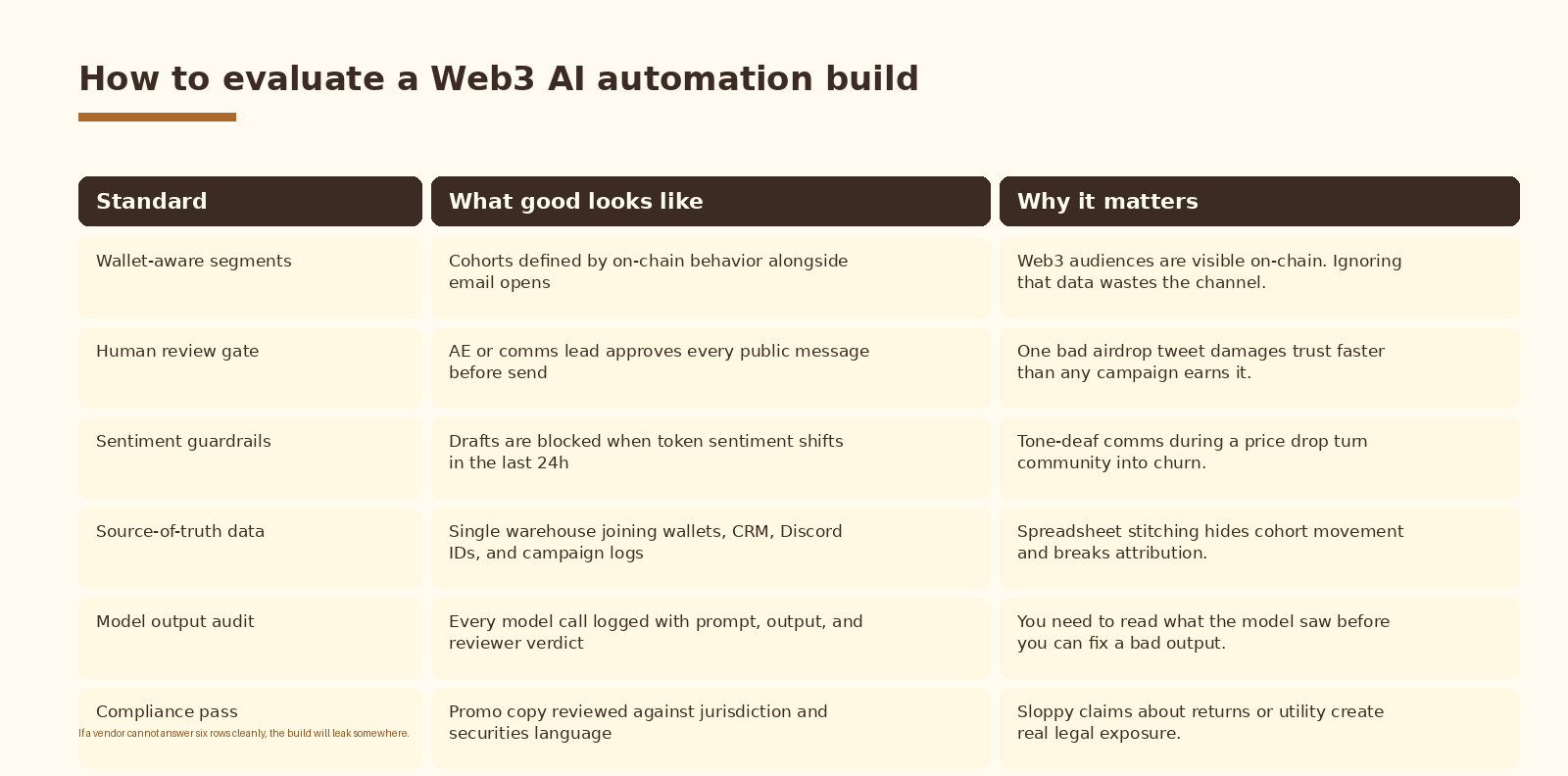
- Standards to evaluate the build: cohort logic on-chain, sentiment guardrails, source-of-truth data, model output logs, and a compliance pass on every promo claim.
If you are evaluating who should build this for your team, this guide gives you both the technical blueprint and the standards to evaluate the work.
Why Web3 marketing automation needs its own playbook
Web2 marketing automation assumes one identity per person, a known email, and a funnel that moves in one direction. Web3 breaks all three. A single buyer holds three wallets, lives across Discord, X, Farcaster, and Telegram, and votes with on-chain behavior before they ever reply to a campaign. Generic AI automation tools treat that buyer like a Web2 lead and miss the signal.
The fix is a stack that respects how Web3 audiences actually move. Wallet activity is the strongest intent signal you will ever see. Community channels are where buyers go to verify before they act. Compliance language is non-optional. An AI automation layer that ignores any of those three turns into community noise inside a week.
The five-stage Web3 AI marketing pipeline
Build the pipeline as five stages and resist the urge to merge them. Each stage has its own failure mode, and keeping them separate is what lets you swap one piece without breaking the rest.
1. Capture signals
Pull on-chain events from a node provider or indexer such as Alchemy, QuickNode, or a Dune query running on a schedule. Pull community chatter from Discord, X, and Farcaster using their official APIs. Save everything to a warehouse you control. The warehouse is the only piece you should treat as load-bearing on day one.
2. Enrich
Each wallet becomes a small record: chains active, tokens held, last seven days of activity, NFT positions, and any linked Discord or Twitter handle the user has self-disclosed. Use Nansen or Arkham for labeled wallets when budget allows. For everything else, derive labels from on-chain behavior.
3. Segment
Cohorts are the unit of value in Web3 marketing. A good cohort is a wallet pattern plus a behavior window, for example holders of token X with at least 0.5 ETH and one trade in the last thirty days. Bad cohorts collapse into a single bucket called “the community.” Generic AI tools default to bad cohorts. Build cohort logic that runs as SQL in your warehouse so you can audit it.
4. Draft with an LLM
Use Claude or GPT-4o to draft per-cohort campaign copy from a structured prompt. The prompt should include the cohort definition, the offer, your brand voice rules, the compliance constraints for your jurisdiction, and recent community sentiment. Log every prompt and output. Treat draft copy as a starting point for a human reviewer.
5. Activate
Route copy to Discord cohorts, Farcaster casts, X posts, email, and on-site banners. Use Zapier, Make, or n8n as the orchestration layer. Keep the send action behind a human approval step until your reviewer trusts the output. Track reply rate, on-chain action rate, and sentiment shift per cohort.
Six automations worth building, ranked by leverage
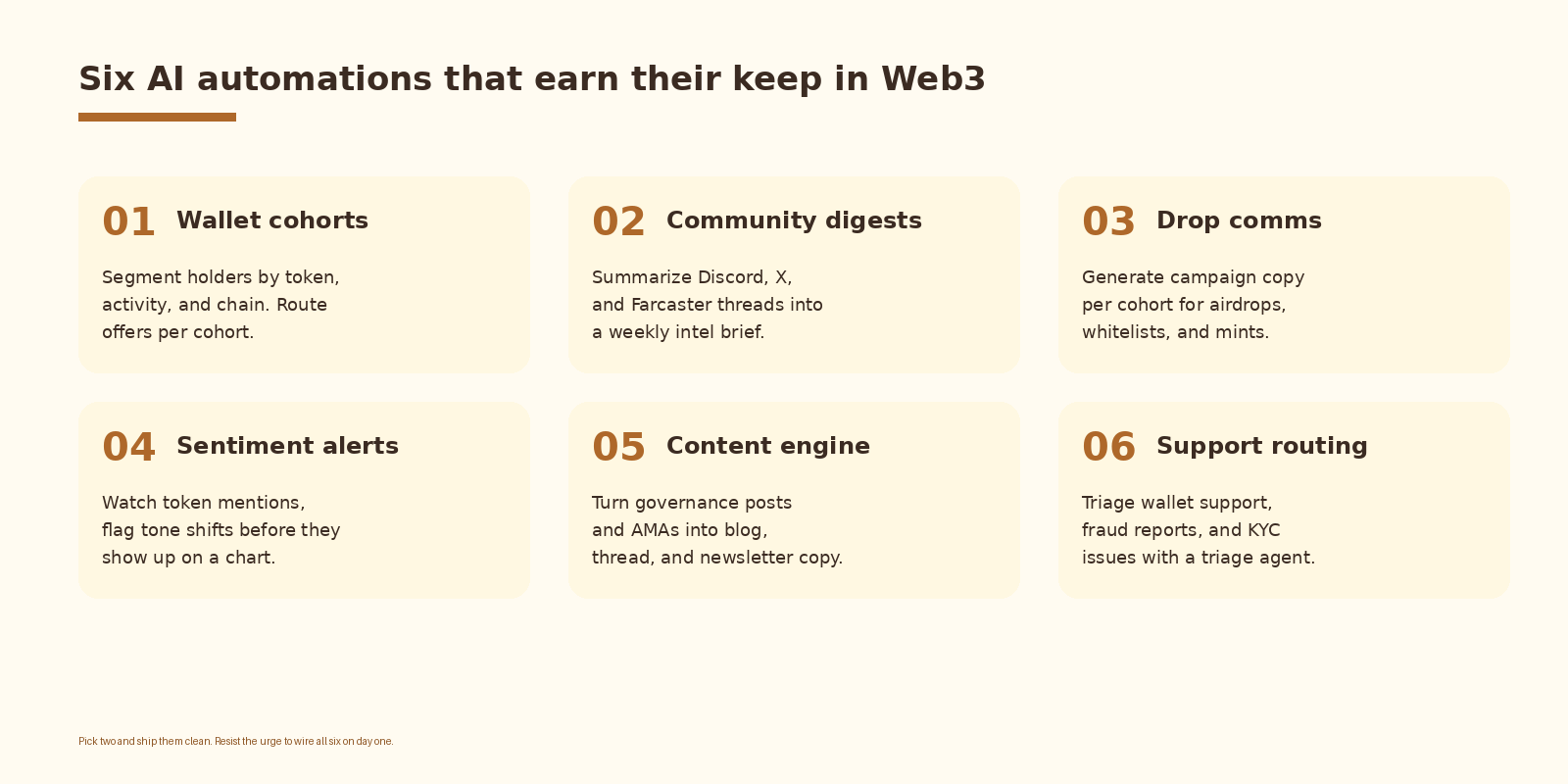
Most Web3 teams try to wire six automations in week one and ship none of them cleanly. The right move is to pick two from this list, ship them end to end, and only then expand.
- Wallet cohort engine. Segments your audience by on-chain behavior and routes per-cohort offers. This is the foundation; everything else gets better when this is solid.
- Weekly community digest. Summarizes Discord, X, and Farcaster threads into a one-page intel brief for the founding team. Buys back hours and improves every other decision.
- Drop and mint comms. Per-cohort copy for airdrops, whitelists, and mints. Pairs naturally with the cohort engine.
- Sentiment alert. Watches token mentions across channels and flags tone shifts before they show up on a chart. Pairs naturally with the digest.
- Content repurposing engine. Turns governance proposals, AMAs, and podcast episodes into blog posts, threads, and newsletter copy. High output, low risk.
- Support triage agent. Routes wallet support, KYC issues, and fraud reports to the right human. High value, harder to get right, save it for after the first two ship.
The stack that actually works in 2026
There is no shortage of Web3 marketing tools. Most of them are point solutions that lock you into a UI. The setup below stays inside services you can wire together yourself, which keeps the data layer portable when something breaks.
- Data layer: a warehouse such as BigQuery, Snowflake, or Postgres. The warehouse owns wallets, cohorts, and campaign logs.
- On-chain data: Alchemy or QuickNode for raw events, Dune for analytical queries, Nansen or Arkham for labeled wallets.
- Community data: Discord, X, Farcaster, and Telegram APIs with retention rules that respect community trust.
- AI layer: Claude or GPT-4o for drafting, Perplexity for research, an embedding model for community thread clustering.
- Orchestration: n8n, Make, or Zapier. Pick one and standardize. Splitting orchestration across three tools is how teams lose the plot.
- Activation: Discord bots for cohort DMs, Farcaster bots for casts, Buffer or Typefully for X scheduling, Resend or Loops for email.
- Review and audit: a Slack channel where every model draft lands for human approval before any public send.
If you want this set up cleanly inside your Web3 stack with logging, retries, and a feedback loop into your warehouse, that is the kind of work we ship at Espressio.
Web2 broadcast versus cohort-aware automation
The fastest way to see whether a Web3 automation build is healthy is to compare a typical Web2 broadcast against a cohort-aware send. Web2 broadcast assumes one audience, one channel, one piece of copy, and tracks opens and clicks. Cohort-aware automation assumes many wallets, many channels, per-cohort copy drafted by the model, and tracks reply rate and on-chain action rate alongside sentiment.
Reply rate and on-chain action rate are the only metrics worth chasing in Web3. Opens are noise. A wallet that swapped or staked after your campaign is the truth.
How to evaluate the build
Whether you are scoping a vendor or auditing your own internal stack, run the build against six standards. A build that cannot answer all six cleanly will leak somewhere within a quarter.
Common mistakes
- Treating the community as one audience. Cohorting by wallet behavior is the entire point. A single broadcast list collapses Web3 marketing back to Web2 mediocrity.
- Letting the model send public messages without a reviewer. One tone-deaf airdrop tweet drains community trust faster than any campaign earns it.
- Stitching cohorts in spreadsheets. The moment cohort logic lives outside the warehouse, you lose the ability to audit and reproduce it.
- Ignoring sentiment when sending promos. Tone-deaf comms during a price drop turn the channel into a churn driver. A sentiment gate on the activate step is a one-day build that saves a quarter of damage.
- Skipping the compliance pass. Promo language about returns or utility is a real legal exposure. Run every public draft through a jurisdiction prompt or a human reviewer who knows the rules.
- Running three orchestration tools. n8n, Zapier, and Make doing different parts of the same pipeline is how teams lose track of which automation owns which send.
How to know it is working
Pick a small set of metrics, instrument them on day one, and read them weekly. Avoid promising specific targets up front. Watch how they move as you tighten cohorts and prompts.
- Cohort coverage: share of active wallets that fit at least one cohort definition. Higher is better, and rising over time means your segmentation logic is learning.
- Reply rate per cohort across Discord, X, and Farcaster. Track week over week.
- On-chain action rate: share of cohort members who took the intended action (swap, stake, mint, vote) within a defined window after the campaign.
- Sentiment delta: change in average sentiment score per token mention across channels in the week of the campaign.
- Reviewer override rate: share of drafts a human reviewer rewrote materially before sending. A high rate means the prompt or the cohort definition is off.
- Compliance flag rate: share of drafts blocked by the compliance pass. Anything above zero is useful signal about prompt drift.
FAQ
Do I need a custom LLM for Web3 marketing automation?
No. Claude and GPT-4o handle Web3 vocabulary, on-chain context, and brand voice well when the prompt gives them structured data and clear rules. A custom model is overkill until you have a specific task that off-the-shelf models keep failing on.
What about anti-bot detection on Discord, X, and Farcaster?
Use official APIs and respect rate limits. Web3 platforms treat automated mass DMs as spam, the same as any other platform. The cohort-aware pattern in this guide sends fewer, better-targeted messages, which is exactly what the platforms want to reward.
Where do I host the warehouse and the model calls?
BigQuery or Snowflake are the default for the warehouse if you already pay for either. Postgres on a managed host works for smaller teams. Model calls go through the vendor APIs directly. Hosting the warehouse and the orchestration layer in the same cloud keeps latency low and makes audit logs straightforward.
How do I handle compliance for token promos in different jurisdictions?
Encode the rules as a compliance prompt or a small classifier that runs as the last step before activation. Block drafts that mention guaranteed returns, securities-like language, or unlicensed claims. Route blocked drafts to a human reviewer. The legal team should write the rule list once; the automation enforces it every time.
Should the AI layer ever post automatically without a human?
For internal digests, alerts, and cohort routing decisions, yes. For public messages to a community, no. The cost of one tone-deaf send is higher than the time savings of removing the human reviewer. Once your reviewer override rate sits below ten percent for a month, you can consider lifting the gate on lower-risk channels.
What to do next
- Pick the two highest-leverage automations from the six-card list. The default pair is the wallet cohort engine plus the weekly community digest.
- Stand up the warehouse and the on-chain ingestion job. Aim for one week to first data.
- Write the first cohort definition as SQL. Review it with the team. Iterate before any AI is involved.
- Draft the per-cohort prompt with brand voice and compliance rules. Log every prompt and output from day one.
- Put a human reviewer on the activate step. Track override rate weekly.
- Audit the build against the six evaluation standards every month. Replace the weakest piece each cycle.
If you want automation like this set up cleanly inside your Web3 marketing stack, let’s talk.
Related Espressio guides
- How to Build an AI Content Engine for Fintech Companies -> https://espressio.ai/blog/ai-content-engine-fintech
- How to Integrate Claude with Zapier for No-Code AI Marketing Automation
- How to Build a Hermes Agent on NVIDIA Cloud for Marketing Automation
- How to Build an AI Content Calendar in Airtable Using GPT-4
- How to Integrate Claude with Amazon Web Services to Automate Content Pipelines