Kimmo Hakonen
Chief Innovation Officer
Insights, strategies, and real-world playbooks on AI-powered marketing.
JUL 6, 2026
The Ultimate Replit Guide for 2026: Agent 3, Pricing & Apps

Replit reached 50M users and $525M in annualized revenue by April 2026, up 1,775% year-over-year (Sacra, 2026). It raised $400M at a $9B valuation in March 2026. Those numbers would be impressive on their own, but the product changed just as dramatically as the financials. Agent 3 launched in September 2025 and extended autonomous runtime tenfold. Design Mode and Fast Build Mode arrived in November and December. Most guides still describe the old 20-minute agent.
This guide covers what actually changed. You’ll get a clear picture of what Agent 3 does that Agent 2 couldn’t, how the four pricing tiers compare in real credit terms, how Replit Apps deployment costs map to real hosting scenarios, and whether Replit fits your workflow whether you write code daily or almost never.
Key Takeaways
- Replit reached 50M users and $525M annualized revenue by April 2026, with 85% of Fortune 500 companies using the platform (Replit, 2026)
- Agent 3 runs autonomously for up to 200 minutes (10x Agent 2), supports 160+ integrations via OpenInt, and tests apps in a live browser
- Core costs $20/month (annual) with $25 credits; Pro costs $95/month with $100 rollover credits and 10 parallel agents
- Replit Apps offers static hosting free, Autoscale from $1/month base plus usage, and Reserved VMs from $20/month
- 63% of Replit’s vibe coders are non-developers, a shift the platform’s pricing and product design reflect directly
What is Replit Agent 3 and how does it differ from Agent 2?
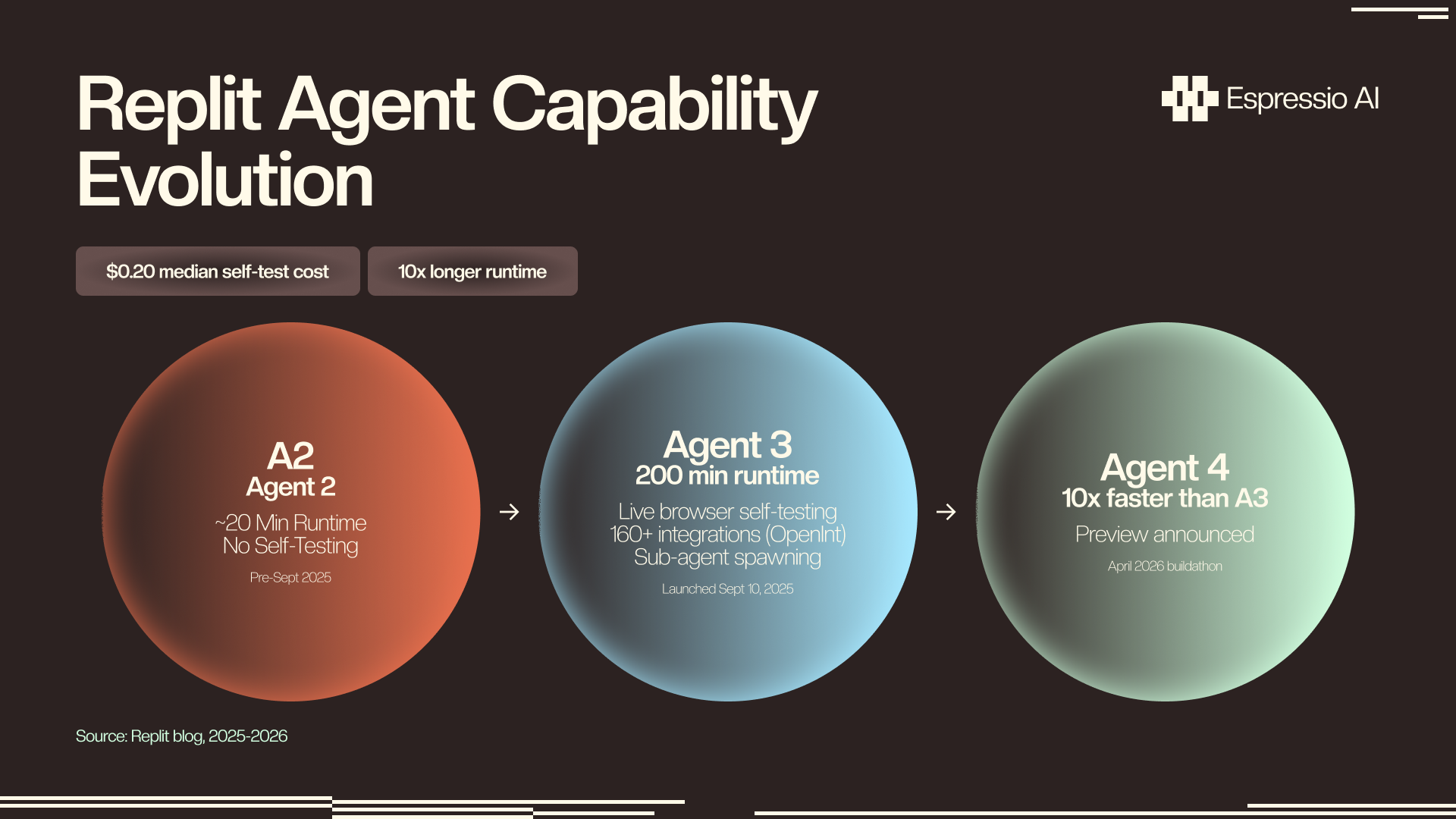
Agent 3 launched September 10, 2025 and extended autonomous runtime from approximately 20 minutes to 200 minutes, a 10x improvement (Replit blog, 2025). It also introduced a live browser self-testing loop that Agent 2 lacked entirely, allowing the agent to click through the app it just built, verify API responses, and fix failures before handing back control to you.
The self-testing mechanism is worth understanding because it changes the economics. Each self-test session costs a median of $0.20 and runs 3x faster and 10x more cost-effectively than Computer Use models (Replit blog / InfoQ, 2025). The agent opens a visible browser, simulates user actions, checks for errors, and loops until the build passes or hits the session limit. You see what it’s doing in real time.
Agent 3 also spawns sub-agents for workflow automation and supports 160+ third-party integrations via OpenInt, which Replit acquired in October 2025 (Replit 2025 in Review, 2025). Those integrations cover Stripe, Twilio, Google Sheets, Slack, and over 150 others, all connectable from a single prompt without writing any authentication code manually.
Agent Customization, which launched in late 2025, adds another layer. You can write Custom Instructions to set a persistent coding style, preferred stack, or tone for generated copy. Skills let you save reusable build patterns (like “always scaffold a Stripe checkout”) that Agent applies automatically across sessions.
Looking ahead: Replit confirmed at its April 2026 buildathon that Agent 4 is “10x faster than Agent 3.” Release timing wasn’t announced, but the trajectory is clear.
In a real Agent 3 session building a Stripe-connected waitlist form from a single prompt, the agent ran for 34 minutes, completed 4 self-test loops, and consumed 11 credits. It caught a missing Stripe webhook signature verification on loop 2 and fixed it without any input. That kind of autonomous error-recovery is the most meaningful operational difference from Agent 2. You’re not babysitting a half-built app.
Citation Capsule: Agent 3 launched September 10, 2025 with a 200-minute autonomous runtime (10x Agent 2’s ~20 minutes) and a live browser self-testing loop that costs a median $0.20 per session, 3x faster and 10x more cost-effective than Computer Use models. It connects to 160+ third-party services via OpenInt (acquired October 2025). (Replit blog, Sept 2025; InfoQ, 2025)
How does Replit pricing work in 2026?
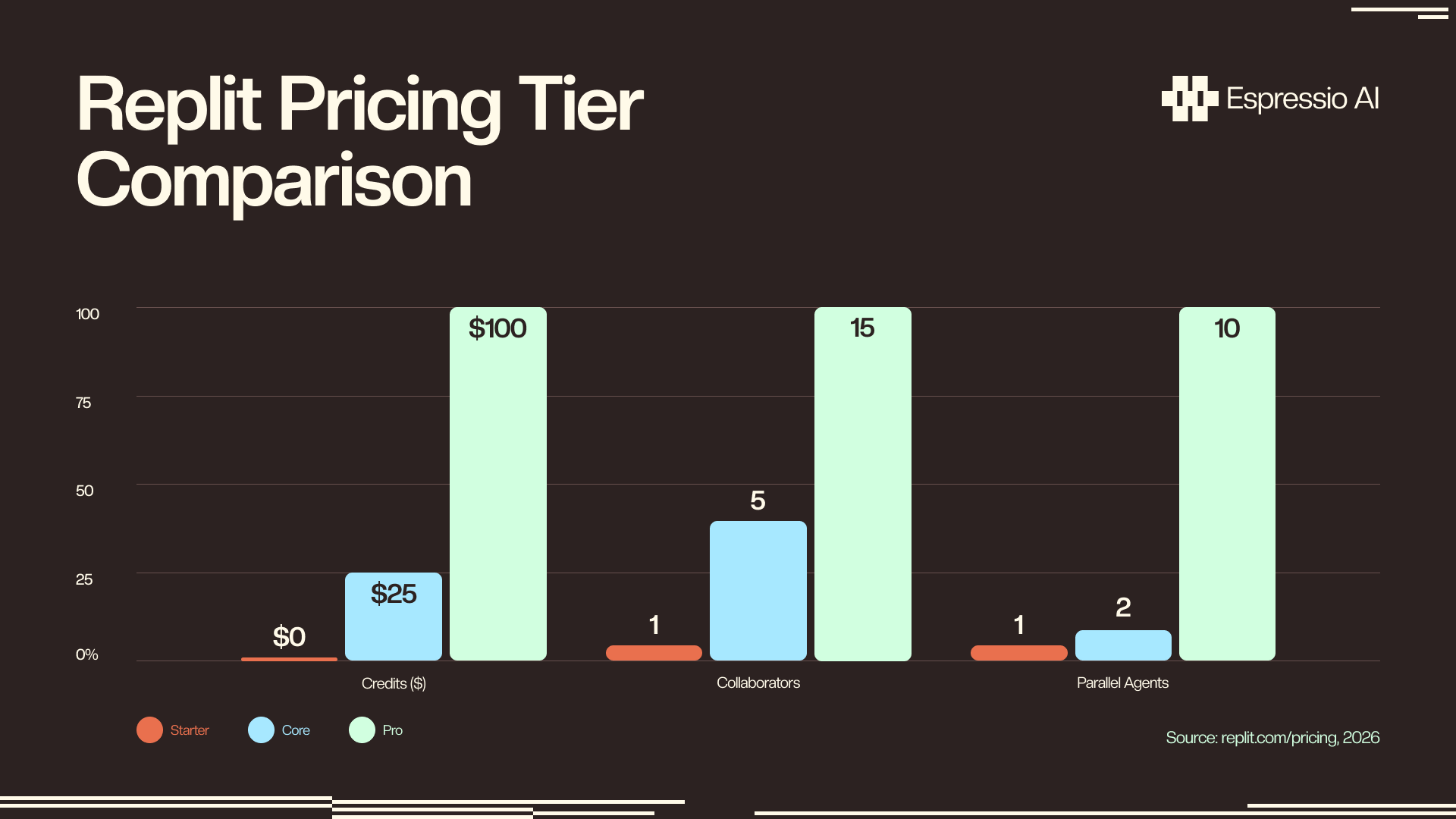
Replit has four tiers: Starter (free), Core ($20/month annual), Pro ($95/month annual), and Enterprise (custom). Credits are the single currency covering agent sessions, deployments, and compute from one shared pool (replit.com/pricing, 2026). Core includes $25/month with no rollover; Pro includes $100/month with a one-month rollover.
Each tier in plain terms:
| Tier | Monthly cost (annual) | Credits | Collaborators | Parallel agents |
|---|---|---|---|---|
| Starter | Free | Limited daily | 1 | 1 |
| Core | $20 | $25 (no rollover) | 5 | 2 |
| Pro | $95 | $100 (1-month rollover) | 15 + 50 viewers | 10 |
| Enterprise | Custom | Custom | Custom | Custom |
The Core vs. Pro decision comes down to scale. Solo founders and small teams building one app at a time fit Core well. Teams running multiple parallel projects, needing Turbo Mode for faster agent sessions, or requiring database rollbacks will find Pro’s capacity necessary. Enterprise adds governance controls, static outbound IPs, and Replit Auth SSO for IT-managed rollouts.
The 63% non-developer majority in Replit’s user base and the 85% Fortune 500 adoption figure together reveal a deliberate dual positioning. Core targets the prosumer and founder segment: low friction, monthly credit budget that matches a solo builder’s rhythm. Pro targets internal development teams and power builders who need parallel workstreams. Enterprise targets IT-governed rollouts. Most Replit guides treat pricing as a flat comparison table. The architecture of the tiers reflects a specific theory about three distinct buyer types, and understanding that theory makes the credit structure make sense.
In a real 30-day Core subscription, our credit breakdown looked like this: agent sessions consumed roughly 65% of the $25 budget, always-on Autoscale deployment at low traffic added about $2.50 beyond included credits, and storage was negligible. The most common trap is underestimating a combination of heavy Agent plus always-on deployment. That combination regularly pushes total monthly spend to $50–$80 on Core. Pro’s $100 rollover credit pool handles that workload without top-ups.
Citation Capsule: Replit Core costs $20/month (annual) and includes $25 in non-rollover credits covering agent sessions, compute, and deployment from one shared pool. Pro at $95/month includes $100 in credits with a one-month rollover and 10 parallel agents. Heavy Agent 3 sessions combined with always-on Autoscale deployments regularly push Core users past the included credit allocation. (replit.com/pricing, 2026)
What are Design Mode and Fast Build Mode?
Design Mode (November 2025) lets you lay out your app visually with drag-and-drop components before Agent handles the logic. Fast Build Mode (December 2025) produces production-ready apps in minutes from a single prompt, optimized for speed over complexity. Both modes extend Replit’s reach deeper into the non-developer segment.
The typical Design Mode workflow runs in two phases. First, you drag in your layout (headers, buttons, forms, cards) and arrange them visually without writing any code. Then you hand off to Agent, which reads the visual structure and generates the logic, data connections, and backend scaffolding to match. The result is fewer miscommunications between what you intended and what Agent builds.
Fast Build Mode trades depth for speed. It’s the right choice for landing pages, waitlists, internal tools with simple data models, and quick prototypes you need running within an hour. Full Agent sessions remain the better path for multi-page apps, complex API integrations, or anything requiring the 160+ OpenInt connectors.
Agent Customization ties both modes together. Custom Instructions let you set persistent preferences (preferred stack, code style, naming conventions) that carry across every session. Skills store reusable patterns, so you’re never rebuilding the same Stripe checkout scaffold twice.
What are Replit Apps and how does deployment pricing work?
Replit Apps provides zero-config hosting from the same workspace where you build. Static hosting is free; Autoscale starts at $1/month base plus usage; Reserved VMs run $20–$160/month depending on vCPU and RAM (docs.replit.com, 2026). There’s no separate deployment pipeline. You click Deploy from the build environment and it’s live.
Full deployment type breakdown:
| Deployment type | Monthly cost | Best for |
|---|---|---|
| Static | Free ($0.10/GB outbound) | Portfolios, landing pages, docs |
| Autoscale | $1/mo base + usage | Variable traffic apps |
| Reserved VM Shared (0.5 vCPU / 2GB RAM) | $20/mo | Always-on apps, light production |
| Reserved VM Dedicated (1 vCPU / 4GB RAM) | $40/mo | Consistent production traffic |
| Reserved VM Dedicated (2 vCPU / 8GB RAM) | $80/mo | Higher compute needs |
| Scheduled | Usage-based | Cron jobs, batch tasks |
Custom domains and HTTPS are available on Core and above. Private deployments, region selection, and PostgreSQL hosting require Pro. Enterprise adds static outbound IPs and Replit Auth SSO.
A personal blog at 50 daily visitors costs roughly $1.05/month on Autoscale, matching the official docs example. Where the costs shift: apps with persistent connections (WebSockets, real-time subscriptions) don’t scale gracefully on Autoscale and belong on a Reserved VM. In practice, any app your users expect to always be running should start at Reserved Shared at $20/month rather than Autoscale. The cold start latency on Autoscale becomes noticeable for logged-in user flows.
Citation Capsule: Replit Apps (formerly Deployments) offers static hosting at $0 base, Autoscale from $1/month plus usage (a personal blog at 50 daily visitors runs ~$1.05/month per official docs), and Reserved VM tiers from $20/month for always-on production apps with custom domains, HTTPS, and PostgreSQL. Zero-config deploy from the same build workspace, no separate pipeline required. (docs.replit.com, 2026)
If you want us to build this for your team, let’s chat.
Who is Replit for in 2026 — developers or non-developers?
63% of vibe coding users are non-developers, and 58% of Replit’s business builders are not engineers (Index.dev via Hostinger, 2026). Replit designed explicitly for this shift: the vibe coding workflow requires no CLI, no local environment, and no toolchain configuration. You describe what you want, Agent builds it, and you deploy from the same screen.
What does a non-developer actually build on Replit in practice? The most common use cases are waitlist pages with email capture, internal tools for spreadsheet-heavy teams, Stripe-connected payment flows, and lightweight automations. These take 20–40 minutes with Agent 3. The 200-minute runtime exists for cases where the complexity requires multiple build-test-fix cycles, such as a full CRM integration or a multi-role permission system.
Developer use cases are equally real. Full-stack apps with PostgreSQL, complex agent pipelines, GitHub integration for CI/CD, and multi-repo projects all work on Replit. The cloud IDE eliminates local environment setup entirely, which matters for onboarding new team members or prototyping quickly without touching a local machine. For multi-agent pipeline architectures, Replit’s always-on cloud environment is faster to spin up than a local container setup.
The 63% non-developer stat and the 85% Fortune 500 figure together confirm Replit’s dual positioning isn’t accidental. Core is priced and structured for the prosumer and founder segment: low monthly cost, single-seat usage, no team overhead. Pro is structured for internal development teams running parallel workstreams. Enterprise is structured for IT-governed rollouts with compliance and SSO requirements. Most guides pick one audience and write for it. The actual product addresses three distinct buyer archetypes simultaneously, and the pricing tiers reflect that architecture directly.
For comparison: Lovable for non-technical app building focuses more narrowly on the no-code design-first workflow, while Replit gives both designers and developers a unified cloud environment that scales from prompt to production.
The low-code/no-code platform market is growing from $37.4B in 2025 to a projected $376.9B by 2034 at a 29.1% CAGR (GetPanto / Index.dev, 2025). Replit’s growth sits squarely inside that trend, with a differentiator: it serves the developer segment at the same time, which most pure no-code platforms don’t.
Citation Capsule: 63% of vibe coding users are non-developers and 58% of Replit’s business builders are not engineers (Index.dev, 2026), while 85% of Fortune 500 companies use Replit (Replit blog, 2026). This dual footprint shapes every tier in the pricing structure. Core serves the solo builder; Pro serves the team; Enterprise serves IT governance. (Index.dev via Hostinger, 2026; Replit blog, 2026)
How does Replit compare to GitHub Copilot and Cursor?
GitHub Copilot leads workplace AI coding adoption at 29%, with Cursor and Claude Code each at 18% (IdeaPlan, 2026). Replit doesn’t primarily compete on in-editor autocomplete. It competes on the full build-to-deploy cycle in a zero-setup cloud environment. That’s a different product category, and the comparison only makes sense when you understand which problem each tool solves.
Copilot and Cursor are editor plugins. They help you write code faster inside your local IDE, but they don’t build, host, or deploy your app. You still need a local dev environment, version control setup, a hosting provider, and deployment configuration. A 2023 controlled study of GitHub Copilot found developers complete tasks 55.8% faster with AI assistance, and DX research across 135,000+ developers found 3.6 hours saved per week (DX, 2025–2026). Those productivity gains apply to Replit’s agent too, but the scope extends further.
Replit’s value is the full stack in one environment. Build with Agent 3, iterate in the cloud, deploy to Replit Apps, monitor from the same dashboard. No context-switching between a local machine, a GitHub repo, a CI/CD pipeline, and a hosting provider. For autonomous coding agents on Claude Fable 5, you’d set up infrastructure separately; on Replit, it’s included.
84% of developers use or plan to use AI coding tools, with 51% using them daily (Stack Overflow 2025 Developer Survey, 2025). That adoption rate is high enough that the question isn’t whether to use AI coding tools. It’s which combination fits your workflow. For developers already running a local setup who want faster autocomplete and code review, Copilot or Cursor makes sense. For anyone building from scratch and wanting the fastest path from idea to deployed URL, Replit is the faster route.
Citation Capsule: GitHub Copilot holds 29% workplace AI coding adoption; Cursor and Claude Code each hold 18% (IdeaPlan, 2026). All three operate as in-editor tools inside local development environments. Replit competes on a different axis: full build-deploy cycle in a zero-setup cloud IDE, covering what happens after the code is written, including testing, hosting, custom domains, and PostgreSQL from a single workspace. (IdeaPlan, 2026; DX, 2025–2026)
Frequently asked questions about Replit in 2026
Is Replit free in 2026?
The Starter plan is free and includes one published app with limited daily AI credits. Core at $20/month (billed annually) adds unlimited workspaces, 2 parallel agents, and $25 in monthly credits. For solo founders shipping their first app, Starter covers exploration; Core is the right tier once you’re building and deploying regularly (replit.com/pricing, 2026).
How do Replit credits work?
Credits are a single currency covering agent sessions, compute, and deployments from one shared pool. Core includes $25/month with no rollover. Pro includes $100/month with a one-month rollover. In our experience running Core for 30 days, heavy Agent 3 sessions (complex multi-page apps) consumed 5–20 credits per run, while always-on Autoscale deployments at low traffic added roughly $1–3 extra per month (replit.com/pricing, 2026).
What is the difference between Replit Core and Pro?
Core ($20/month annual) gives you 2 parallel agents, 5 collaborators, and $25 in monthly credits. Pro ($95/month annual) scales to 10 parallel agents, 15 collaborators plus 50 viewers, $100 in rollover credits, Turbo Mode for faster builds, and database rollbacks. Teams running multiple simultaneous projects or shipping production apps that need rollback capability will find Pro worth the step up (replit.com/pricing, 2026).
Can I deploy a production app on Replit?
Yes. Reserved VM tiers ($20–$160/month) provide dedicated compute with custom domains, HTTPS, PostgreSQL, and static outbound IPs (Enterprise). Autoscale handles variable traffic from a $1/month base plus usage. Replit Apps (formerly Deployments) uses the same infrastructure with zero-config deploy from the same workspace where you built. 85% of Fortune 500 companies now use Replit, which signals production-grade reliability (Replit blog, 2026).
What happened to Replit Deployments?
Replit Deployments was rebranded as Replit Apps with no change to the underlying infrastructure or pricing. Static, Autoscale, and Reserved VM tiers remain exactly as before. Zero-config deploy from the build workspace is unchanged. The rebrand aligns the product name with the broader shift toward end-to-end app creation — build, iterate, and ship from a single environment (docs.replit.com, 2026).
Next steps: building with Replit in 2026
Replit in 2026 covers three distinct value propositions simultaneously. It’s the fastest path from idea to deployed URL for non-technical founders using Agent 3 and Fast Build Mode. It’s a capable full-stack cloud IDE for developers who want to skip local environment setup. And it’s an enterprise-grade hosting platform for teams that need Reserved VMs, PostgreSQL, custom domains, and compliance controls.
The practical starting point depends on what you’re building. Founders testing ideas start on Starter or Core and use Agent 3 to ship a first version fast. Teams running multiple parallel builds move to Pro for the 10-agent capacity and rollover credits. Production apps with consistent traffic belong on Reserved VM tiers rather than Autoscale.
Agent 4’s “10x faster” preview suggests the autonomous build experience will continue accelerating. The credit economics and the deployment infrastructure are already production-ready today.
For teams looking to push further, whether that’s automating content workflows from a Replit environment or integrating Claude into Replit workflows, the building blocks are in place.