Luka Mrkić
Head of BD
Insights, strategies, and real-world playbooks on AI-powered marketing.
JUN 10, 2026
Claude Mythos 5 Explained: What 'Mythos-Class' Actually Means
TL;DR
- Mythos-class is the new top tier in Anthropic’s model lineup, sitting above the Opus class in capability.
- Claude Mythos 5 is the second Mythos-class model. It launched on June 9, 2026 alongside Claude Fable 5.
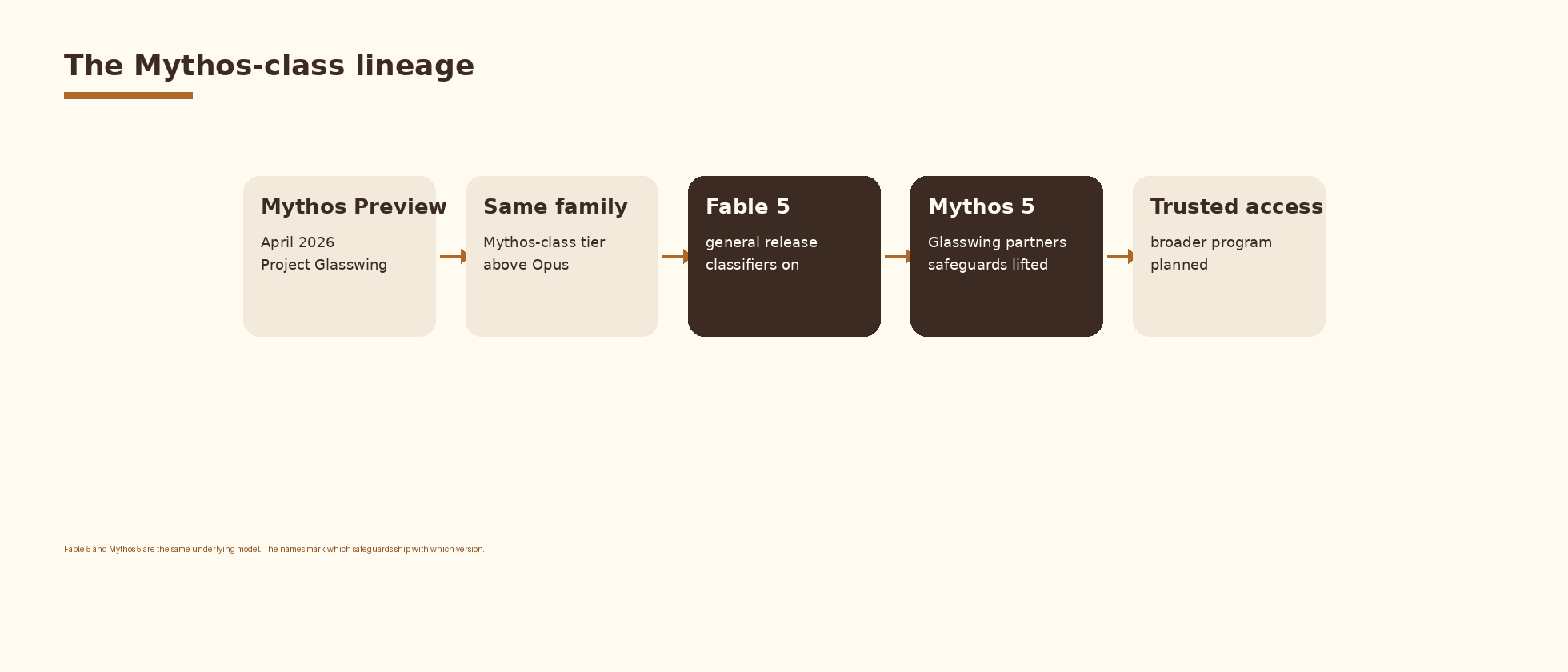
- Fable 5 and Mythos 5 are the same underlying model. Fable 5 ships with safety classifiers and is generally available; Mythos 5 has the cyber safeguards lifted and is limited to Project Glasswing partners.
- API model ID is claude-mythos-5. Same 1M-token context window, same 128k output tokens, same $10 input and $50 output per million tokens as Fable 5.
- Mythos-class models carry mandatory 30-day data retention and are not available under zero data retention.
If you are evaluating who should build production agents on Mythos-class models for your team, this guide gives you both the technical blueprint and the standards to evaluate the work.
What “Mythos-class” actually means
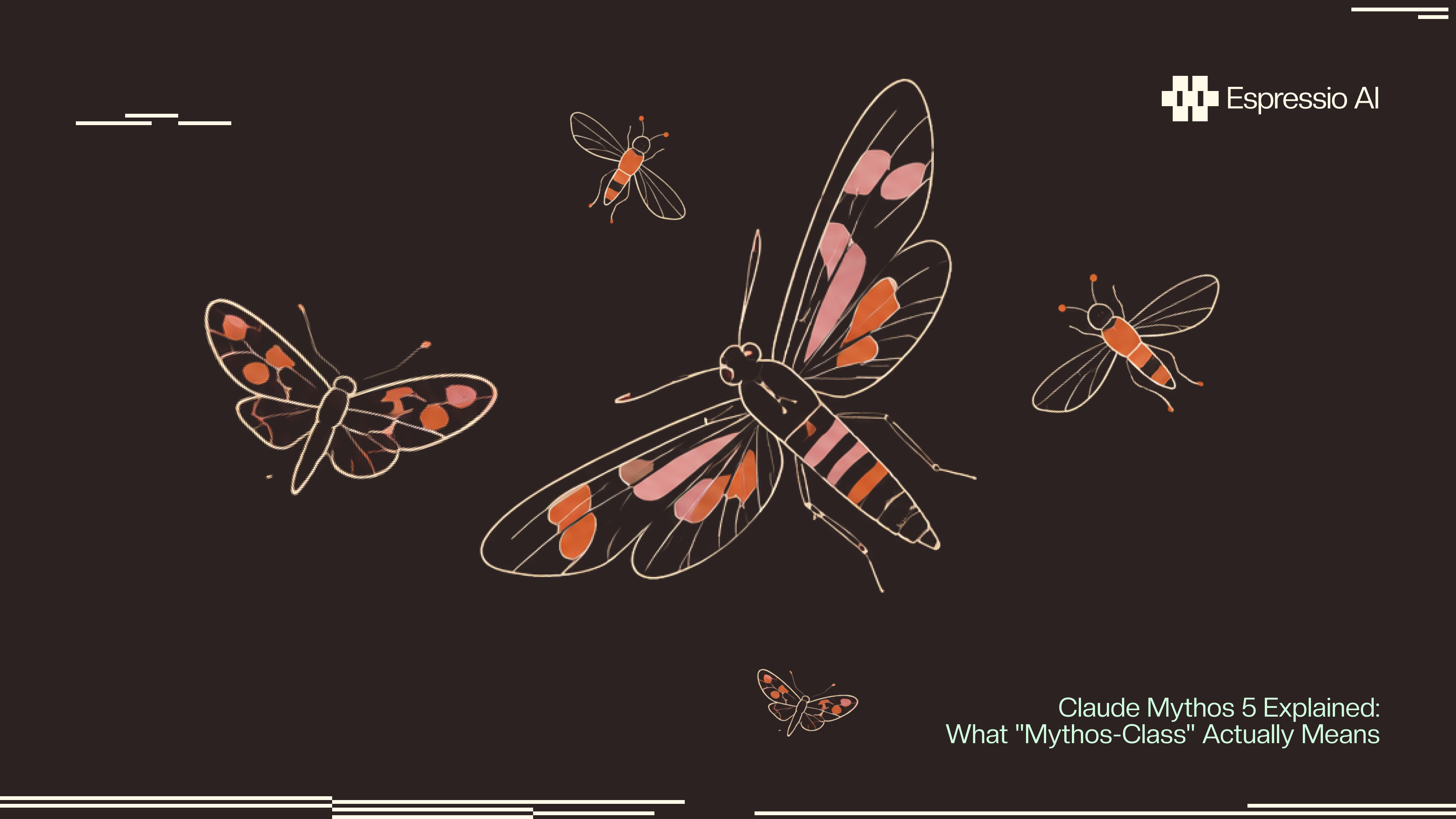
Anthropic introduced Mythos-class as a tier of Claude models that sits above the Opus class in capability. The first Mythos-class model, Claude Mythos Preview, was released in April 2026 through Project Glasswing, a limited program with cyber defenders and critical software infrastructure providers. On June 9, 2026, Anthropic released two more Mythos-class models: Claude Fable 5 (generally available) and Claude Mythos 5 (limited release).
The defining property of the tier is the gap between capability and safeguard posture. Mythos-class models cross a threshold where Anthropic considers them capable enough to warrant dedicated safety classifiers shipped alongside the model. The classifiers are how Anthropic releases Mythos-level capability to a general audience at all. Without them, the release would be limited to a much smaller group of trusted partners.
The naming convention encodes this. Anthropic writes that “Fable” comes from the Latin fabula, “that which is told,” akin to the Greek mythos. The two names refer to the same underlying model. Fable ships with the classifiers; Mythos has them lifted in some areas.
Why teams need a separate playbook for Mythos-class
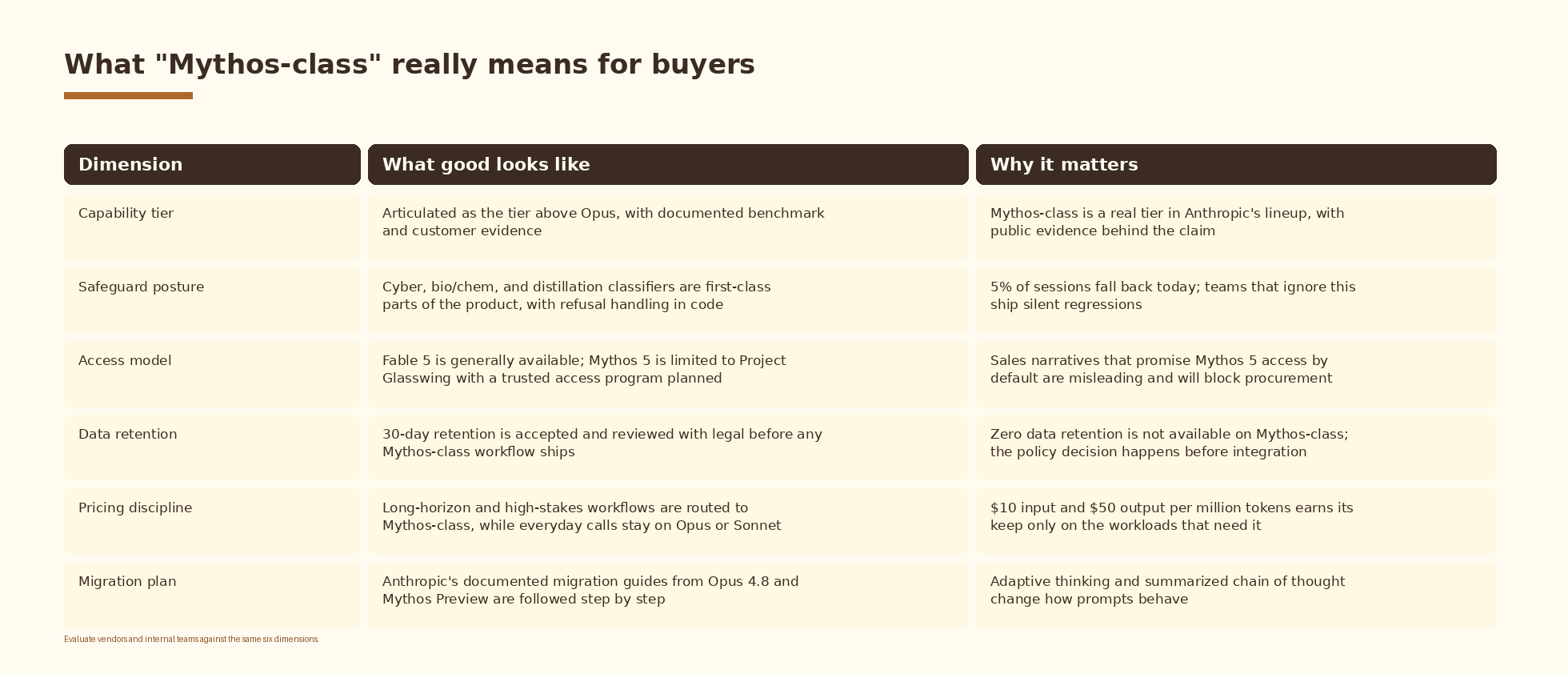
The shift from Opus to Mythos is not a routine model upgrade. Three things change in ways that require their own playbook: capability tier, safeguard posture, and access model. Teams that copy an Opus 4.8 deployment template into a Mythos-class workflow will overpay on simple calls, mishandle refusals, and confuse procurement with claims about access they cannot actually deliver.
If you are interested in building an AI systems stack like this for your team, book a call here.
Mythos 5 and the trusted access program
Anthropic states that beginning June 9, 2026, all users with access to Claude Mythos Preview, including the cybersecurity partners in Project Glasswing, can upgrade to Claude Mythos 5. Users are expected to find Mythos 5 comparable to, or somewhat stronger than, Mythos Preview in most cases, while costing substantially less.
In consultation with the US government, Anthropic plans to steadily expand access to Mythos 5. They have committed to a trusted access program where cybersecurity organizations can apply in a more systematic way, plus a separate trusted access program for biology researchers that grants access to Fable 5 with biology and chemistry safeguards removed while cyber safeguards stay in place.
Practical takeaway for buyers. If a vendor or an internal team promises Mythos 5 access as part of a product roadmap, ask which program. If the answer is not Glasswing or the trusted access program, the roadmap is making a claim Anthropic has not validated.
How Mythos 5 is different from Fable 5
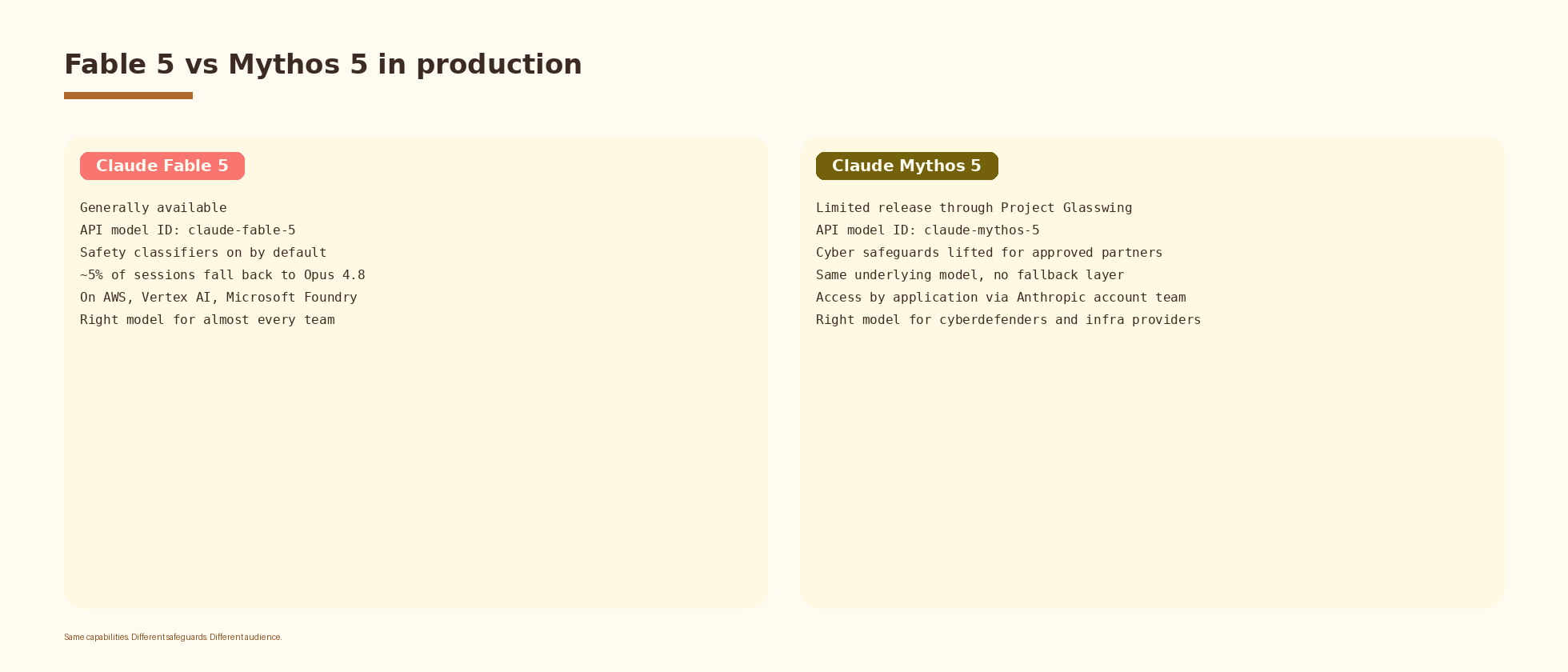
On the model itself, the two are identical. Anthropic states explicitly that Fable 5 and Mythos 5 are the same underlying model. The differences live in two places: safeguards and access.
Safeguards
Fable 5 ships with classifiers that detect potential misuse in three categories: cybersecurity, biology and chemistry, and distillation. When a classifier fires, the response is automatically handled by Claude Opus 4.8 instead. Anthropic reports that more than 95% of Fable sessions involve no fallback at all; for those sessions, Fable 5’s performance is effectively the same as Mythos 5.
Mythos 5 has the cyber safeguards lifted, which is the defining difference for cybersecurity work. The model has the strongest cybersecurity capabilities of any model in the world, per Anthropic’s announcement, and it is deployed initially through Project Glasswing as an upgrade to Mythos Preview.
Access
Fable 5 is generally available on the Claude API, Claude Platform on AWS, Amazon Bedrock, Vertex AI, and Microsoft Foundry. Mythos 5 is not generally available. It is offered in limited availability to approved customers in Project Glasswing. For access, customers contact their Anthropic, AWS, or Google Cloud account team. Customers without access to Mythos 5 can use Fable 5, the generally available Mythos-class model.
Pricing, context, and the API behaviors that matter
Mythos 5 carries the same commercial envelope as Fable 5. Pricing is $10 per million input tokens and $50 per million output tokens, less than half the price of Mythos Preview. The default context window is 1M tokens, with up to 128k output tokens per request. The API model ID is claude-mythos-5.
Mythos 5 inherits the same API behaviors Anthropic introduced with Fable 5. Adaptive thinking is the only thinking mode available, so the thinking parameter cannot be disabled, and the effort parameter is the lever for thinking depth and cost. The raw chain of thought is never returned; thinking.display defaults to omitted, and summarized thinking is available by request. Supported features at launch include the effort parameter, task budgets (beta), the memory tool, tool result clearing through context editing (beta), compaction, and vision.
Mythos 5 is also a designated Covered Model. It carries 30-day data retention and is not available under zero data retention. Workflows with strict ZDR requirements need to stay on Opus 4.8 or earlier classes until that policy changes.
What Mythos 5 actually does well
Anthropic published evidence across cybersecurity, drug design, molecular biology, and genomics that points to two themes. Mythos 5 produces novel scientific hypotheses on a consistent basis, and it operates as an autonomous research agent for long stretches without close human supervision.
Cybersecurity
Anthropic states Mythos 5 has the strongest cybersecurity capabilities of any model in the world. It is deployed through Project Glasswing as an upgrade to Mythos Preview, with cyber safeguards lifted for approved partners. The decision to release the capability to a constrained group of vetted partners is itself the operational signal: Mythos-level cyber capability is treated as dual-use and gated behind a vetted program.
Drug design
Using Mythos 5, Anthropic’s internal protein design experts accelerated aspects of the drug design process by around ten times. In one example, Mythos 5 with protein design and bioinformatics tools but no human assistance matches or beats skilled human operators. The model handles all the tasks normally completed by a scientist: choosing binding sites, selecting and running protein design tools, and recovering from failures. Nine of the 14 protein targets from this study yielded strong candidates that Anthropic is currently investigating.
Novel hypotheses in molecular biology
Anthropic describes Mythos 5 as the first model to consistently produce novel, compelling scientific hypotheses. In blinded head-to-head comparisons against Opus-class models, Anthropic’s scientists preferred Mythos’s molecular biology hypotheses around 80% of the time, and several have been advanced to experimental evaluation. One Mythos hypothesis, a novel mechanism for an E. coli protein, was corroborated in a study from a lab independently working on the same problem.
Genomics
Mythos 5 conducted novel genomics research in over a week of largely autonomous work. It assembled single-cell data for millions of cells spanning 138 animal species and designed and trained a custom machine learning model to identify cells performing the same role across distantly related organisms. With only high-level human input, the trained model outperformed a recent model published in the journal Science, while being 100 times smaller. Anthropic intends to publish the results in the coming months.
How Anthropic talks about alignment for Mythos 5
Anthropic’s automated alignment assessment found that Mythos 5’s level of misaligned behavior, including misaligned actions such as deception and cooperation with misuse, was low and similar to that of Opus 4.8. Because Fable 5 and Mythos 5 are the same underlying model, Fable 5’s level of alignment will be similar. The full assessment, along with the detailed suite of other safety and capability tests, is described in the model’s system card.
For buyers, the practical implication is that the safeguards on Fable 5 are doing two jobs at once. They prevent misuse of the model’s cyber, bio/chem, and distillation capabilities, and they manage a small percentage of sessions where the classifier coverage is broader than the model’s actual behavior. Mythos 5 lifts the cyber half of that for partners who have been vetted into Project Glasswing.
Common mistakes when discussing or deploying Mythos-class
- Treating Mythos-class as a marketing label. It is a distinct capability tier with public evidence and a documented safeguard regime. Use the language precisely.
- Promising Mythos 5 access to customers or internal stakeholders. Mythos 5 is limited to Project Glasswing today. A trusted access program is planned, but not generally available.
- Conflating Fable 5 and Mythos 5 in vendor or roadmap discussions. They are the same model but operate under different safeguards and access models. The deployment design is not the same.
- Skipping the refusal handler on Fable 5 because “Mythos doesn’t refuse.” Most teams will deploy on Fable 5 in practice, and refusals on Fable 5 return stop_reason: “refusal” as HTTP 200.
- Assuming zero data retention for Mythos-class workflows. ZDR is not available on Mythos-class. Workflows that require ZDR need to stay on Opus 4.8 or earlier.
- Pricing every workflow on Mythos-class economics. The $10 input and $50 output per million tokens only pays off on long-horizon and high-stakes work. Everyday calls belong on Sonnet or Opus 4.8.
- Ignoring the documented migration paths. Anthropic published step-by-step migration guides from Opus 4.8 and from Mythos Preview. Prompt behavior changes meaningfully.
How to know your Mythos-class adoption is working
A small dashboard goes a long way. Three signals worth tracking from week one: refusal rate by workflow (only relevant on Fable 5, included here because most production traffic runs on Fable), per-workflow token cost (how much each Mythos-class workflow consumes and what it delivers), and output quality on your own eval set (the only measure that actually answers whether the upgrade was worth it).
Add a fourth signal once you have a few weeks of data. Time saved per workflow, measured in hours of senior engineer or analyst time the model now replaces. This is where Mythos-class economics start making sense at scale. Stripe’s reported example, a 50-million-line codebase migration completed in a day where the manual path would have taken two months, is the upper bound. The real value lives in the dozens of smaller workflows where Mythos-class lifts each one from “close, but needs an hour of cleanup” to “done.”
If you want this set up cleanly in your stack
If you want a Mythos-class production stack designed and shipped cleanly inside your AI engineering org, that is the kind of work we ship at Espressio.
FAQ
What does “Mythos-class” mean?
Mythos-class is a tier of Claude models that sits above the Opus class in capability. The first Mythos-class model was Claude Mythos Preview (April 2026), followed by Claude Fable 5 and Claude Mythos 5 on June 9, 2026. The tier is defined by capability strong enough that Anthropic ships dedicated safety classifiers alongside the model.
How is Mythos 5 different from Fable 5?
Fable 5 and Mythos 5 are the same underlying model. Fable 5 ships with safety classifiers that fall back to Opus 4.8 on cyber, bio/chem, and distillation queries; Fable 5 is generally available. Mythos 5 has those cyber safeguards lifted and is limited to Project Glasswing partners, with a broader trusted access program planned.
Who can use Claude Mythos 5?
Mythos 5 is available to approved customers in Project Glasswing, including the cybersecurity partners and critical software infrastructure providers Anthropic already works with. For access, customers contact their Anthropic, AWS, or Google Cloud account team. A separate trusted access program for biology researchers is planned and will give access to Fable 5 with biology and chemistry safeguards removed.
What is the API model ID for Mythos 5?
claude-mythos-5. The Messages API behaviors for Mythos 5 are the same as Fable 5: adaptive thinking is always on, raw chain of thought is never returned, and the supported features include effort, task budgets, the memory tool, context editing, compaction, and vision.
How much does Mythos 5 cost?
$10 per million input tokens and $50 per million output tokens. That is less than half the price of Claude Mythos Preview, the model Mythos 5 replaces for Glasswing partners.
How big is the context window?
1M tokens by default, with up to 128k output tokens per request. Compaction and the memory tool are supported, which is what makes long-horizon agent work tractable at this scale.
Can Mythos 5 be used with zero data retention?
No. Mythos 5 and Fable 5 are designated Covered Models with mandatory 30-day data retention. Anthropic states this data is not used to train new Claude models or for any non-safety-related purpose, and they have instituted new privacy protections including logging all human access to the data.
What does Mythos 5 mean for life sciences research?
Anthropic plans a trusted access program for biology that gives a small number of researchers access to Fable 5 with the biology and chemistry safeguards removed (cyber safeguards stay in place). Until that program opens, biomedical researchers can use Fable 5 with the standard safeguards, which fall back to Opus 4.8 on most biology and chemistry queries today.
Is Mythos 5 the same as GPT-5.5 or comparable competitor models?
Anthropic positions Mythos-class as the top tier of the Claude lineup and shares benchmark comparisons in the launch announcement. One Anthropic customer reported that on frontier physics research, Fable 5 reached in 36 hours what GPT-5.5 landed at after four days. Specific competitor comparisons depend on the workload; the safer claim is that Mythos-class is Anthropic’s frontier offering today.
What to do next
- Decide whether your team is a Mythos 5 customer (Glasswing or trusted access) or a Fable 5 customer (most teams), and design accordingly.
- Read Anthropic’s official launch announcement and the platform docs to ground your team in the source-of-truth language before any internal rollout.
- Stand up refusal and fallback handling on Fable 5 before broader rollout, even if your first workflows do not touch the classifier categories.
- Set a 30-day retention policy decision with legal before any Mythos-class workflow ships, and route ZDR-required workflows to Opus 4.8.
- Pick one long-horizon workflow where Mythos-class economics actually pay off and instrument it with the four-metric dashboard described above.
If you want a Mythos-class deployment built cleanly inside your engineering org, with refusal handling, fallback, and observability in place from day one, let’s talk.
Related Espressio guides
- Claude API for Marketing Teams: Complete Setup Guide 2026 -> https://espressio.ai/blog/claude-api-marketing-teams
- How to Integrate Claude with Amazon Web Services to Automate Content Pipelines -> https://espressio.ai/blog/claude-aws-content-pipeline
- How to Integrate Claude with HubSpot CRM for AI-Powered Sales Follow-Up -> https://espressio.ai/blog/claude-hubspot-sales-followup
- How to Integrate Claude with Slack to Automate Marketing Briefs -> https://espressio.ai/blog/claude-slack-marketing-briefs
- How to Integrate Claude with Notion to Build an AI Content Calendar -> https://espressio.ai/blog/claude-notion-content-calendar
- How to Integrate Claude with Salesforce for Automated Proposal Generation -> https://espressio.ai/blog/claude-salesforce-proposal-generation