Luka Mrkić
Head of BD
Insights, strategies, and real-world playbooks on AI-powered marketing.
JUN 10, 2026
Claude Fable 5: The Complete Guide to Anthropic's New Mythos-Class Model

TL;DR
- Claude Fable 5 is Anthropic’s most capable widely released model, launched on June 9, 2026 as the first generally available Mythos-class model.
- Mythos-class is a new tier above Opus, defined by capabilities strong enough that Anthropic ships dedicated safety classifiers alongside the model.
- Fable 5 and Mythos 5 are the same underlying model. Fable ships with classifiers that fall back to Opus 4.8 on cyber, bio/chem, and distillation queries. Mythos lifts those safeguards and is limited to Project Glasswing partners.
- API model ID is claude-fable-5. Context window is 1M tokens, output up to 128k tokens, priced at $10 per million input tokens and $50 per million output tokens.
- Adaptive thinking is always on, raw chain of thought is never returned, and 30-day data retention is required (no zero data retention option).
If you are evaluating who should build production agents on Fable 5 for your team, this guide gives you both the technical blueprint and the standards to evaluate the work.
What is Claude Fable 5
Claude Fable 5 is Anthropic’s new flagship model, announced and made generally available on June 9, 2026. It sits above the Claude Opus 4.8 generation and is the first Mythos-class model released for general use. Anthropic positions it as the most capable widely released Claude model to date, built for long-horizon agentic work and the hardest reasoning tasks.
The name is deliberate. Anthropic explains that Fable comes from the Latin fabula, “that which is told,” akin to the Greek mythos. Fable 5 and Mythos 5 are the same underlying model. The names mark which safeguards ship with which version.
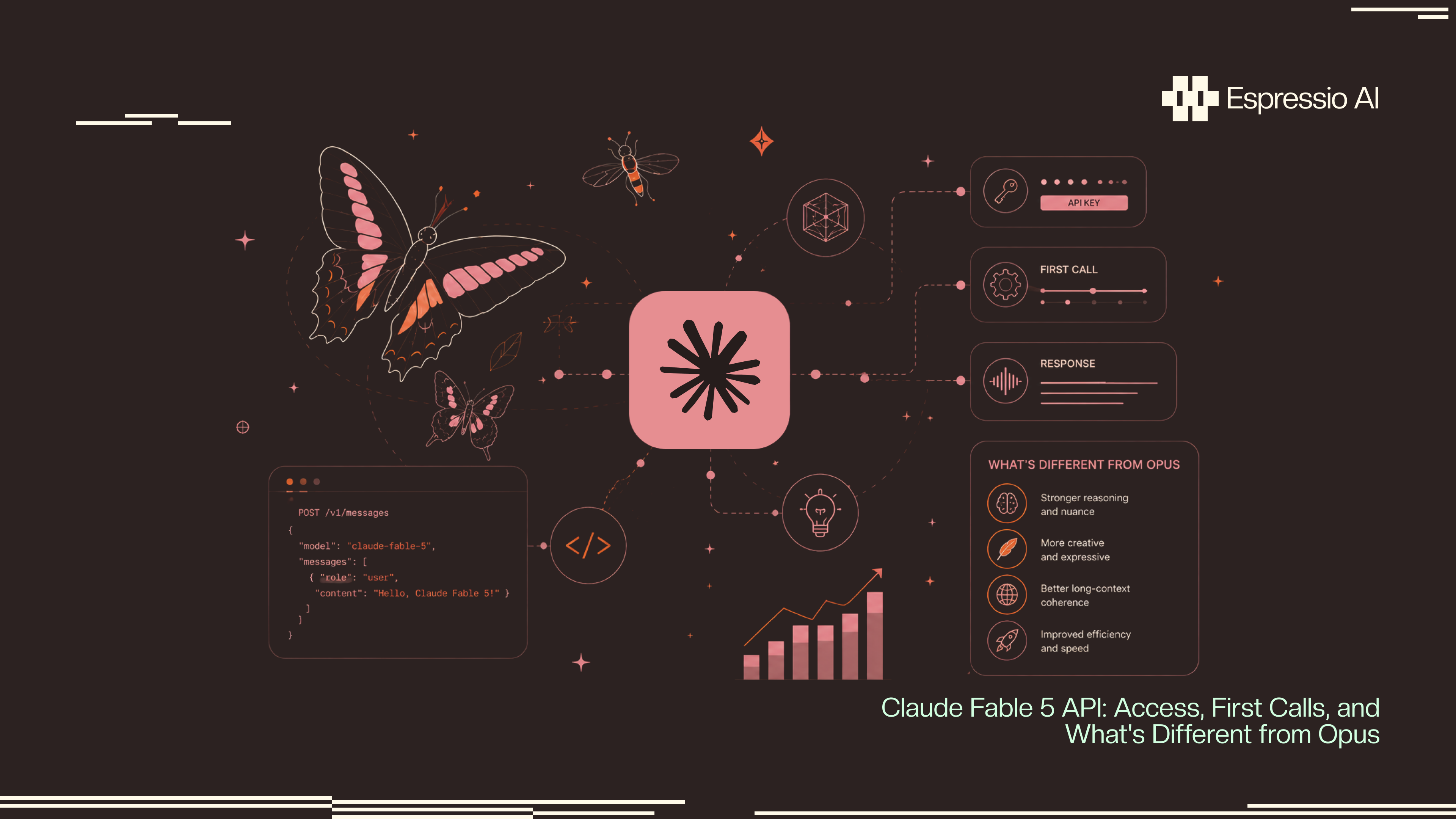
For builders, three details set the practical envelope. The API model ID is claude-fable-5. The default context window is one million tokens, with up to 128,000 output tokens per request. Pricing is $10 per million input tokens and $50 per million output tokens, less than half the price of Claude Mythos Preview, which is the model Fable 5 replaces in production workflows.
Why a new Mythos-class playbook matters
Mythos-class is the new top tier in Anthropic’s lineup, above the Opus class. Anthropic introduced the tier in April 2026 with Claude Mythos Preview through Project Glasswing, available only to a limited group of cyber defenders and critical software infrastructure providers. Fable 5 is the moment that tier becomes available to everyone else.
The reason teams need a separate playbook is that Fable 5 is the first Claude model that ships with first-class safety classifiers in front of it. Around 5% of sessions, on average, trigger a fallback to Opus 4.8. Treat that as a product behavior to design for. Designs that ignore it ship with silent quality regressions and confused users.
If you are interested in building AI agents and automation like this for your team, book a call here.
What Fable 5 actually does well
Anthropic shipped Fable 5 with benchmark and customer evidence across software engineering, knowledge work, vision, memory, and life sciences. The pattern is consistent. The longer and more complex the task, the larger Fable 5’s lead over Opus 4.8 and the rest of the Claude family.
Software engineering
Stripe reported during early testing that Fable 5 compressed months of engineering into days. In a 50-million-line Ruby codebase, the model performed a codebase-wide migration in a day that would otherwise have taken a whole team over two months by hand. On Cognition’s FrontierCode evaluation, which tests whether models can pass difficult coding tasks while meeting the standards of high-quality production codebases, Fable 5 scores highest among frontier models even at medium effort.
Cursor’s Michael Truell called it the state of the art on CursorBench and said it opens up a class of long-horizon problems that were out of reach for earlier models. GitHub’s Mario Rodriguez described it as a real step forward for the developers GitHub serves on complex, long-horizon coding tasks.
Knowledge work and analysis
On Hebbia’s Finance Benchmark for senior-level reasoning, Fable 5 has the highest score of any model with substantial gains in document-based reasoning, chart and table interpretation, and problem solving. IMC reported that Fable 5 aced their trading-analysis evaluations nearly across the board, including factual lookup, conceptual reasoning, root-cause analysis, and expected-value analysis. One AI research lead said Fable 5 is the first model to break 90% on their core analytics benchmark, a 10-point jump over Opus.
Vision
Fable 5 is the new state of the art on tasks involving vision. It can extract precise numbers from detailed scientific figures and rebuild a web app’s source code from screenshots alone. The signal that captured the most attention is that previous Claude models needed elaborate helper harnesses to play Pokémon FireRed; Fable 5 beat the game with a vision-only harness using raw game screenshots and no extra game-state information.
Memory and long context
Fable 5 stays focused across millions of tokens in long-running tasks and improves its outputs using its own notes. When Anthropic had the model play the deck-building game Slay the Spire, giving it persistent file-based memory improved its performance three times more than for Opus 4.8. Fable also reached the game’s final act three times more often. Combined with the 1M-token context window, this is the underlying capability that makes long-horizon agents tractable.
Life sciences research
Anthropic reports that internal protein design experts using Mythos 5 (the same underlying model as Fable 5) accelerated aspects of the drug design process by around ten times. The model executes the same tasks a scientist would: choosing binding sites, selecting and running protein design tools, and recovering from failures along the way. In blinded head-to-head comparisons against Opus-class models, scientists preferred Mythos’s molecular biology hypotheses around 80% of the time.
Pricing, availability, and the rollout window
Both models are priced at $10 per million input tokens and $50 per million output tokens. Fable 5 is generally available on the Claude API, Claude Platform on AWS, Amazon Bedrock, Vertex AI, and Microsoft Foundry. Mythos 5 is in limited availability for Project Glasswing partners only, with a broader trusted access program planned.
Capacity is the constraint Anthropic flagged most clearly. From June 9 through June 22, Fable 5 is included on Pro, Max, Team, and seat-based Enterprise plans at no extra cost. On June 23, Fable 5 is removed from those plans and usage will require credits, with Anthropic stating it intends to restore Fable as a standard part of subscription plans once capacity allows. On the Claude API and consumption-based Enterprise plans, Fable 5 is fully available from launch. If your team is building on Fable 5 for production, plan the API path and do not rely on the subscription window for anything serious.
One more constraint to plan around. Fable 5 and Mythos 5 are designated Covered Models, which carry 30-day data retention and are not available under zero data retention. Workflows with strict ZDR requirements need to stay on Opus 4.8 or earlier classes until that changes.
How Fable 5’s safeguards work in practice
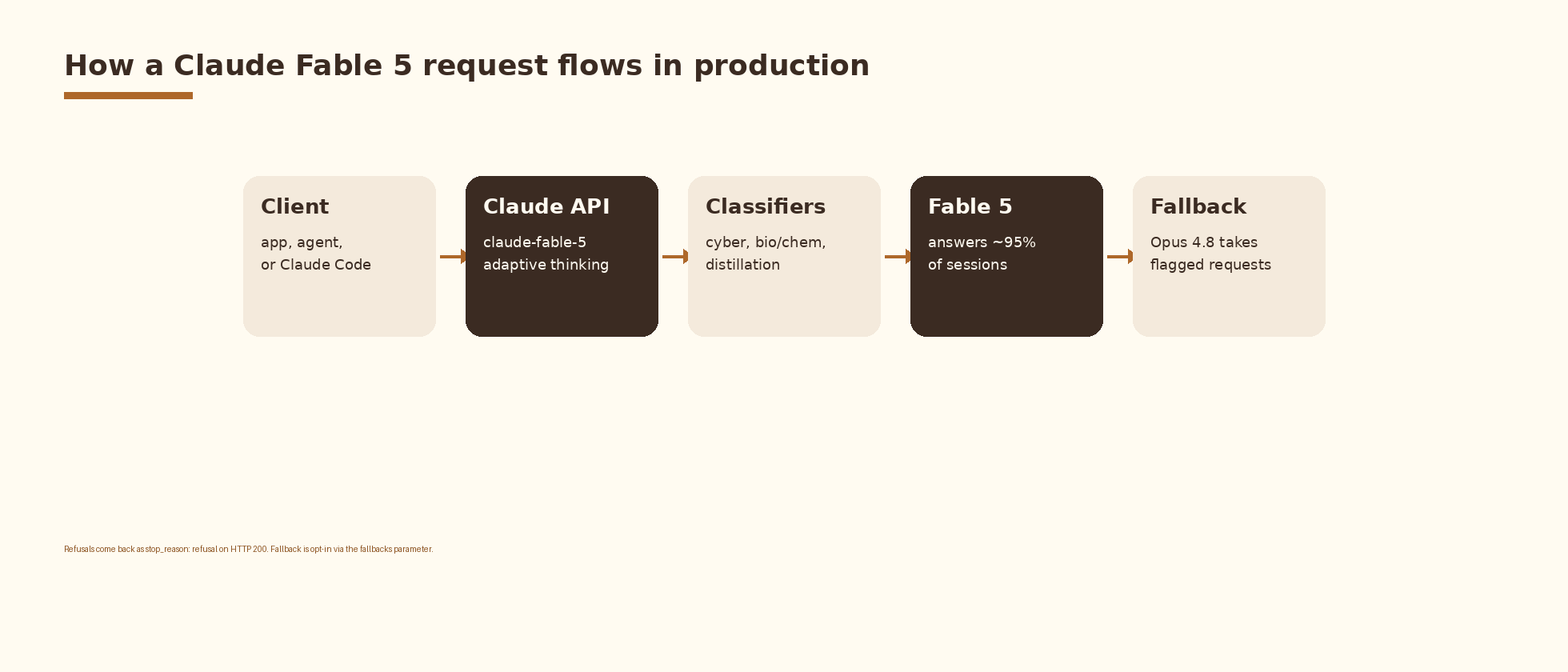
Fable 5 ships with a new set of safety classifiers. Separate AI systems detect potential misuse, including jailbreak attempts, and block the main model from responding. When the classifiers fire on a request related to cybersecurity, biology and chemistry, or distillation, the response is automatically handled by Claude Opus 4.8 instead. Users are informed whenever this happens. Anthropic states more than 95% of Fable sessions involve no fallback, and for those sessions Fable 5’s performance is effectively the same as Mythos 5.
Three classifier areas matter most when you design around them. Cybersecurity covers exploitation and offensive cyber tasks, and Anthropic reports the classifiers prevent Fable from making meaningful progress on these tasks. Biology and chemistry coverage is currently broad because Anthropic prioritized shipping safely over precision; many benign biomedical queries will fall back to Opus 4.8 until the safeguards are narrowed. Distillation coverage targets large-scale attempts to extract Fable’s capabilities to train competing models.
When to actually use Claude Fable 5
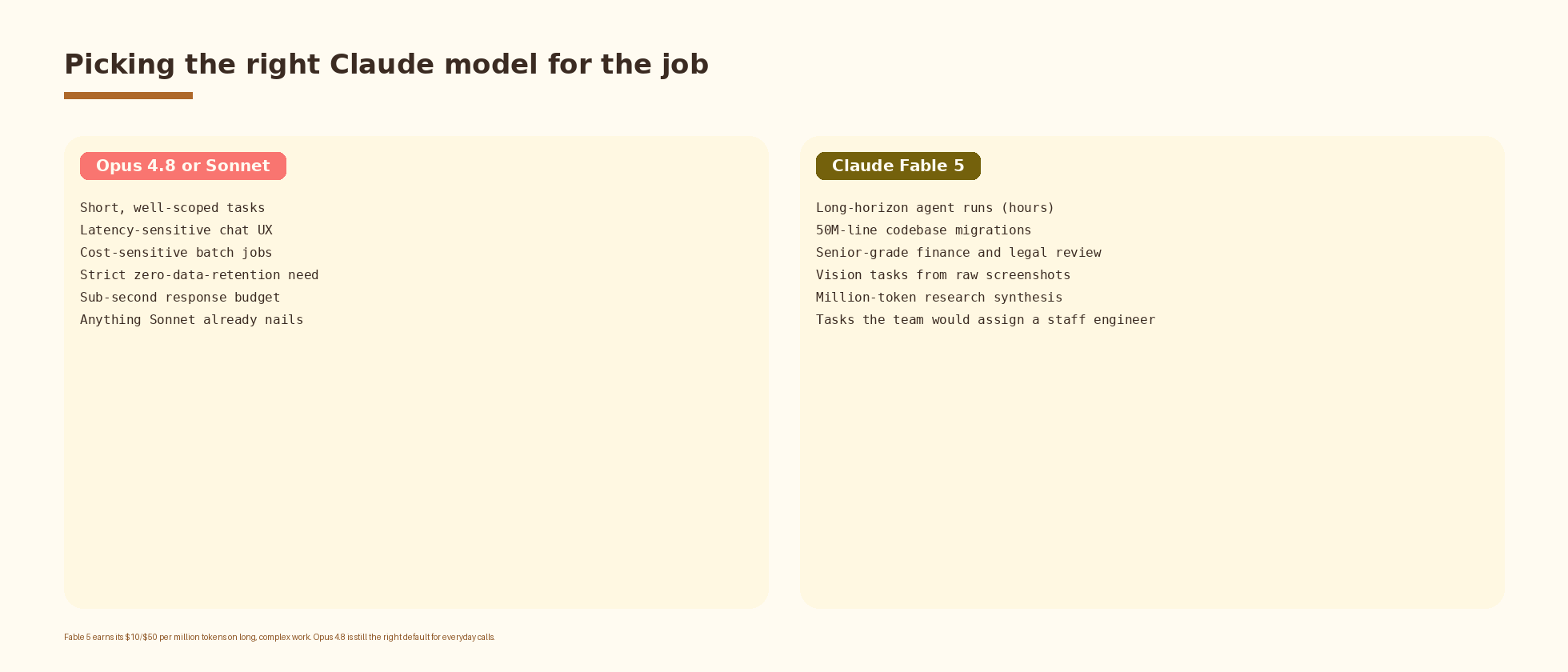
Fable 5 is not the default for every call. It is the right model when the work is long, complex, and the value of a senior-grade output outweighs the per-token cost. The most consistent signal across Anthropic’s launch evidence is that the longer the horizon, the larger Fable 5’s lead. For short, well-scoped tasks where Opus 4.8 already produces strong results, you are paying for thinking budget you do not need.
A useful rubric for routing model selection inside an agent stack: route to Fable 5 when the task would be assigned to a senior engineer, a senior analyst, or a research scientist on your team, and to Opus 4.8 or Sonnet when the task is the kind of work an intermediate teammate could complete in under thirty minutes. The token cost of getting it wrong is small; the time cost of an under-powered model on a long-horizon task is large.
Common mistakes when adopting Fable 5
- Treating Fable 5 as a drop-in replacement for Opus 4.8 in every call. The cost profile only pays off on long-horizon and high-stakes work. Route by workflow.
- Shipping without a refusal handler. stop_reason: refusal returns HTTP 200. If your client treats only HTTP errors as failures, refusals will look like empty successes to your users.
- Ignoring the 5% fallback rate. Around 5% of sessions fall back to Opus 4.8 today. Without instrumentation, regressions in classifier behavior look like product bugs.
- Setting effort to maximum on every request. Adaptive thinking is always on; effort is your lever for cost and latency. Cap it per workflow.
- Assuming zero data retention. Fable 5 and Mythos 5 carry mandatory 30-day retention. Workflows with strict ZDR requirements need to stay on Opus 4.8 or earlier.
- Building production on the subscription rollout window. Fable 5 is included on Pro, Max, Team, and seat-based Enterprise plans only through June 22; production workloads belong on the API or consumption-based Enterprise plans.
- Skipping the migration guides. Anthropic published step-by-step upgrade paths from Opus 4.8 and Mythos Preview for a reason. Prompts that worked on Opus may need adjustments for adaptive-thinking behavior.
How to know your Fable 5 rollout is working
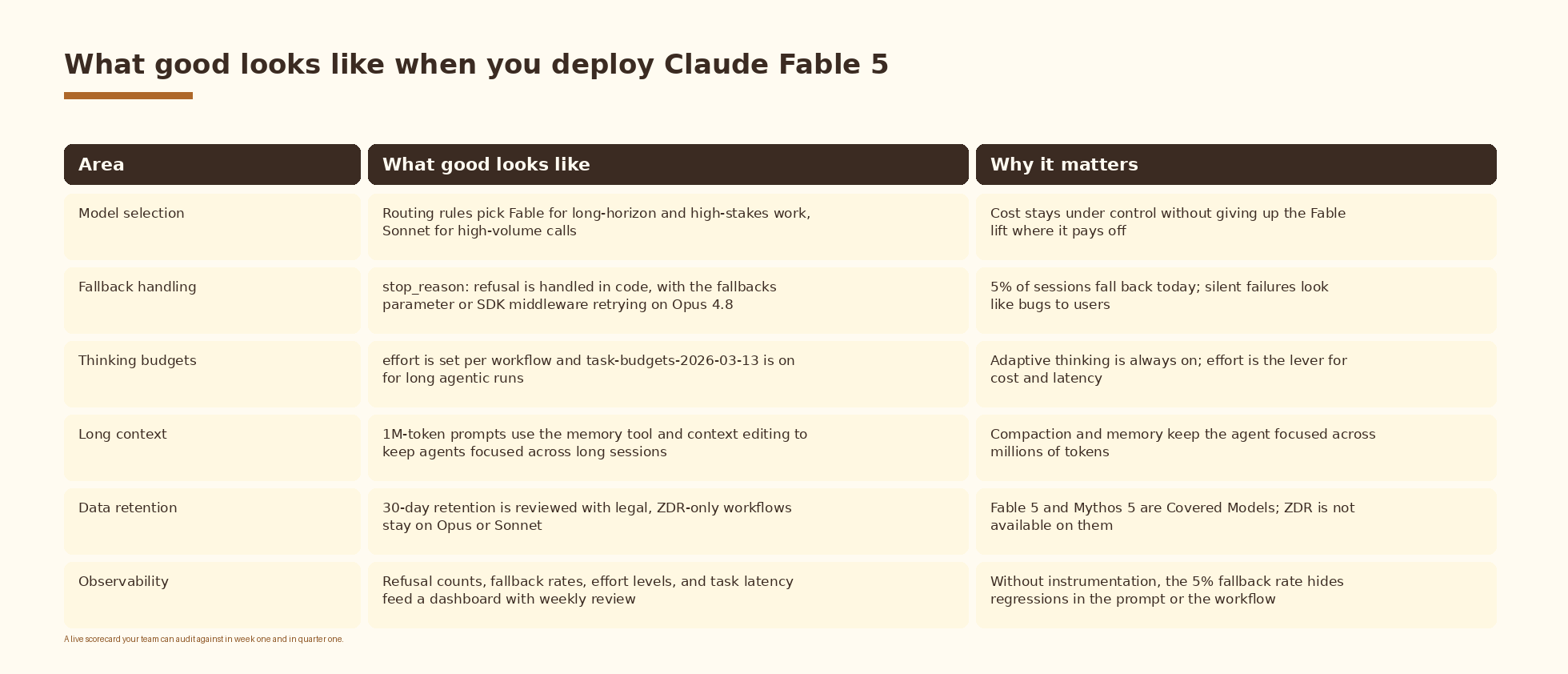
Four metrics belong on a dashboard the day Fable 5 hits production. Refusal rate by workflow tells you whether the classifiers are catching tasks your users actually want done. Fallback latency tells you whether your fallback path is keeping users in the conversation or dropping them out. Per-workflow token cost tells you whether Fable is paying for itself on the workloads where you routed it. Output quality, measured by your own eval set, tells you whether the model is delivering on the long-horizon promise.
Pair these with a weekly review of fallback samples. Read 20 to 50 actual fallback cases per week to see whether the classifiers are firing on the categories Anthropic described or on something benign that your prompt is triggering. If the rate climbs above 10% on a workflow, the prompt is likely the issue to fix first.
Fable 5 versus the rest of the Claude family
Anthropic’s lineup now spans five tiers: Haiku, Sonnet, Opus, Fable, and Mythos. Haiku and Sonnet remain the default choices for high-volume and latency-sensitive workloads. Opus 4.8 is the workhorse for complex tasks that do not require Fable’s long-horizon capabilities, and it is also the model you fall back to when Fable 5’s classifiers fire. Fable 5 is the generally available top of the stack. Mythos 5 is the same model with cyber safeguards lifted, available only through Project Glasswing.
The practical implication for a production stack is that you now have a meaningful four-way routing decision: Sonnet for high volume, Opus 4.8 for everyday complex work, Fable 5 for long-horizon and high-stakes work, and a fallback policy that respects the classifiers. Designs that pretend any one model fits everything will overspend on cheap calls and underdeliver on hard ones.
If you want this set up cleanly in your stack
If you want Fable 5 deployed cleanly inside your stack with model routing, refusal handling, fallback retries, and a dashboard your team can audit, that is the kind of work we ship at Espressio.
FAQ
Is Claude Fable 5 a successor to Claude Opus?
Fable 5 sits above the Opus class. It is the first Mythos-class model released for general use. Opus 4.8 remains the model that handles fallback when Fable’s classifiers decline a request, and it is still the right choice for the majority of everyday workflows.
What does “Mythos-class” mean?
Mythos-class is a new tier of Claude models that sits above the Opus class in capability. Anthropic introduced the tier in April 2026 with Claude Mythos Preview through Project Glasswing. The defining feature is that Mythos-class models ship with dedicated safety classifiers because their capabilities cross a threshold Anthropic considers high risk.
What is the difference between Fable 5 and Mythos 5?
Fable 5 and Mythos 5 are the same underlying model. Fable 5 ships with safety classifiers that fall back to Opus 4.8 on cyber, bio/chem, and distillation queries. Mythos 5 has those safeguards lifted and is available only through Project Glasswing partners and a planned trusted access program.
What is the API model ID for Fable 5?
claude-fable-5. The model is generally available on the Claude API, Claude Platform on AWS, Amazon Bedrock, Vertex AI, and Microsoft Foundry.
How much does Claude Fable 5 cost?
$10 per million input tokens and $50 per million output tokens. That is less than half the price of Claude Mythos Preview, the predecessor model that Fable 5 replaces.
How big is the context window?
1M tokens by default, with up to 128k output tokens per request. The memory tool and context editing are supported, which matters for agents that operate across very long sessions.
What does it mean that Fable 5 “refused” a request?
When Fable 5’s classifiers decline a request, the Messages API returns stop_reason: “refusal” as a successful HTTP 200 response, with the classifier name in the response. Around 5% of sessions trigger this today. Handle it explicitly in your client. Pass the fallbacks parameter or use the SDK middleware to retry on Opus 4.8.
Can I use Fable 5 with zero data retention?
No. Fable 5 and Mythos 5 are designated Covered Models with mandatory 30-day data retention. Workflows that require zero data retention need to stay on Opus 4.8 or earlier.
Is the chain of thought visible?
The raw chain of thought is never returned on Fable 5 and Mythos 5. Set thinking.display to “summarized” to receive readable summarized thinking. Pass thinking blocks back unchanged in multi-turn conversations on the same model.
When should I use Fable 5 instead of Opus 4.8?
Use Fable 5 for long-horizon agentic work, hours-long autonomous runs, large-scale codebase migrations, senior-grade analytical tasks, and tasks where the longer the horizon, the more value the model adds. Use Opus 4.8 for everyday complex work, latency-sensitive calls, and ZDR-required workflows.
What to do next
- Pick one workflow where Fable 5’s long-horizon capability would actually pay off and run it side by side with Opus 4.8 for a week.
- Add refusal and fallback handling to the client now, even if your first workflow does not touch the classifier categories.
- Stand up the four-metric dashboard (refusal rate, fallback latency, per-workflow cost, output quality) before broader rollout.
- Read the official migration guides from Opus 4.8 to Fable 5 and from Mythos Preview to Mythos 5 before flipping the model name in production.
- Decide your team’s policy on the subscription window through June 22 and move anything production-critical to the API or consumption-based Enterprise plans.
If you want a Mythos-class production stack designed and shipped cleanly inside your AI engineering org with routing, refusal handling, fallback, and observability built in, let’s talk.
Related Espressio guides
- Claude API for Marketing Teams: Complete Setup Guide 2026 -> https://espressio.ai/blog/claude-api-marketing-teams
- How to Integrate Claude with Amazon Web Services to Automate Content Pipelines -> https://espressio.ai/blog/claude-aws-content-pipeline
- How to Integrate Claude with HubSpot CRM for AI-Powered Sales Follow-Up -> https://espressio.ai/blog/claude-hubspot-sales-followup
- How to Integrate Claude with Slack to Automate Marketing Briefs -> https://espressio.ai/blog/claude-slack-marketing-briefs
- How to Integrate Claude with Notion to Build an AI Content Calendar -> https://espressio.ai/blog/claude-notion-content-calendar
- How to Integrate Claude with Salesforce for Automated Proposal Generation -> https://espressio.ai/blog/claude-salesforce-proposal-generation