Kimmo Hakonen
Chief Innovation Officer
Insights, strategies, and real-world playbooks on AI-powered marketing.
JUN 17, 2026
How Claude Fable 5 Automates Analyst Workflows Without Replacing Analysts
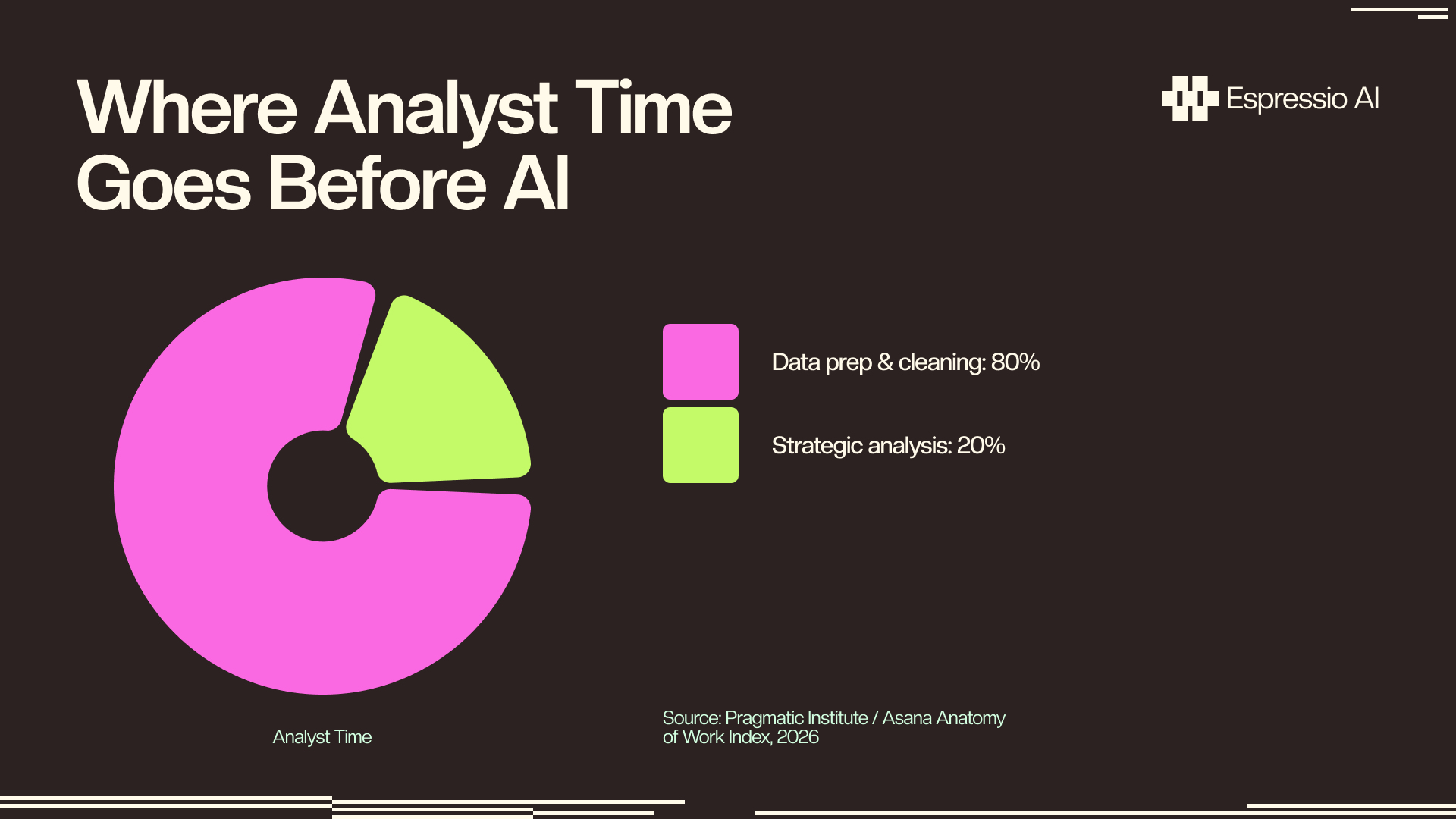
Data practitioners spend 80% of their time finding, cleaning, organizing, and reconciling data, with only 20% left for the actual analysis their role is supposed to deliver (Pragmatic Institute, 2026). That imbalance has been documented for a decade. A model now exists that’s fast enough and context-large enough to absorb that 80% at production scale.
Claude Fable 5 leads the benchmarks that matter most for analyst work, including Hex’s complex analytics suite (Anthropic, June 2026). For RevOps, finance, and growth analysts, those results carry a workflow architecture implication: where to insert the model so analysts own the decisions, not the data pulls.
Key Takeaways
- Data practitioners spend 80% of their time on prep work, not analysis (Pragmatic Institute, 2026); Fable 5 automates that layer at production scale.
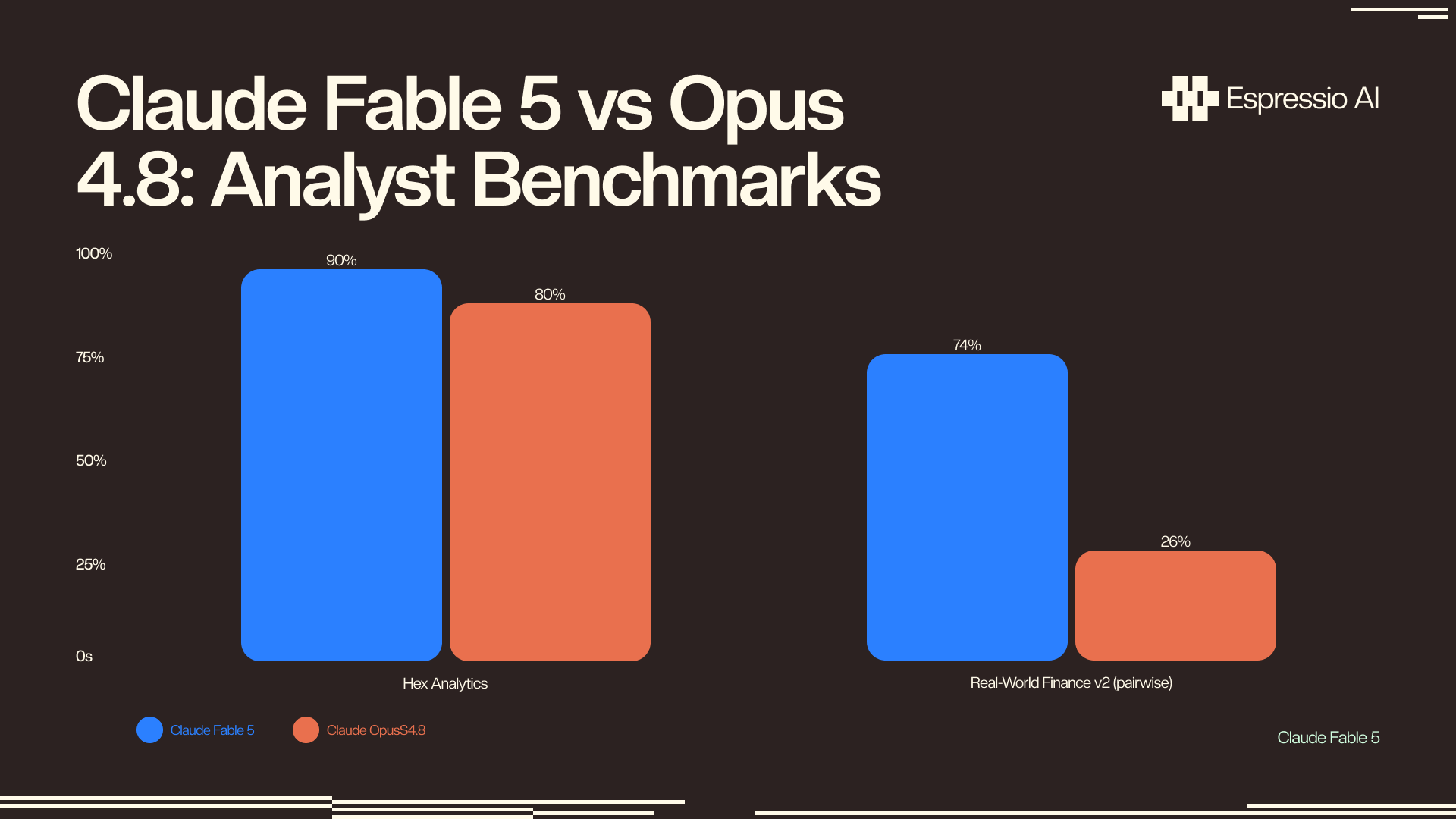
- Fable 5 is the first model to reach 90% on Hex’s analytics benchmark, a 10-point jump over Opus 4.8, and runs 25–30% faster on complex analytical tasks (Anthropic, June 2026).
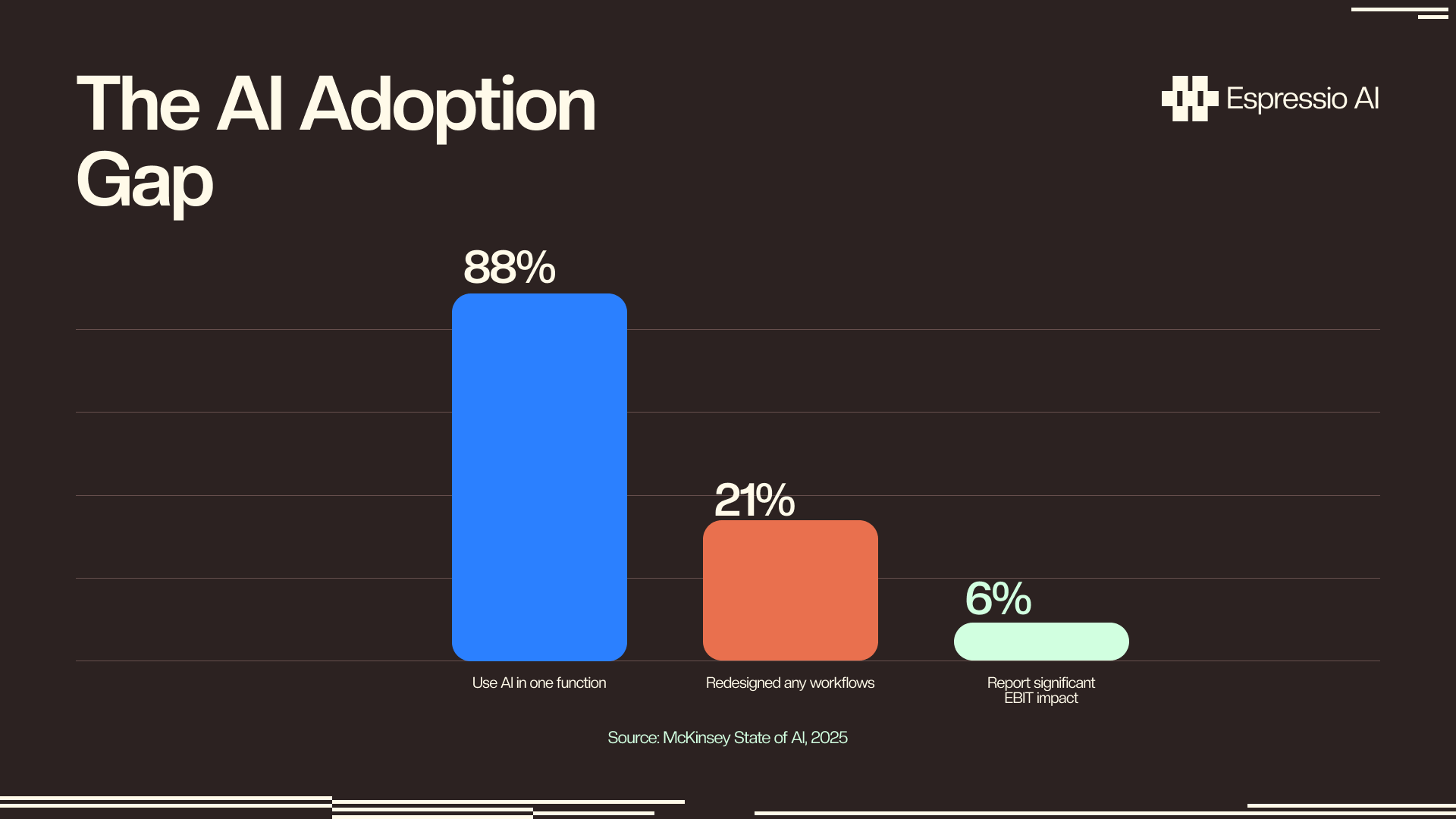
- Only 21% of organizations using AI have redesigned any workflows (McKinsey, 2025); the gap between AI adoption and actual value sits exactly where analyst time gets trapped.
- Gartner’s May 2026 analysis found that organizations amplifying analysts outperform those eliminating them; AI-driven headcount cuts do not correlate with better returns.
- Operations Research Analyst roles are projected to grow 21% through 2034; Data Scientist roles 34%, far above the 3% all-occupations average (BLS, 2024–2034).
Why do analyst workflows break down before AI enters the picture?
Knowledge workers lose 60% of their working hours to “work about work”: status updates, format conversions, cross-tool data pulls, and meetings about the data rather than the data itself (Asana Anatomy of Work Index). For analysts, this overhead is even more concentrated. The 80/20 rule in data science isn’t an exaggeration: most practitioners spend the equivalent of four working days per week collecting and normalizing inputs before they write a single line of analysis.
The five prep categories where analyst time disappears are consistent across industries: extracting data from source systems and reports, deduplicating overlapping records from multiple sources, normalizing formats and field schemas, reconciling conflicting figures across data pulls, and scheduling and coordinating data collection from stakeholders. None of these require strategic judgment. All of them take time that should be spent on interpretation.
The root cause is architecture, not analyst behavior. Prep work happens at the analyst’s desk because the systems that generate data don’t output it in analysis-ready formats. AI fixes this at the middleware layer, not the output layer. Most teams bolt AI onto the existing workflow at the end (generating the report, summarizing the findings, writing the email, scheduling the update) rather than inserting it at the input stage where the time actually goes. That’s why 88% of knowledge workers report that time-sensitive projects fall through the cracks (Asana Anatomy of Work Index).
For teams working on AI workflow automation for revenue operations, the prep layer is where the compounding ROI sits; it’s also the most overlooked place to start.
What makes Claude Fable 5 different for analytical work?
Claude Fable 5 is the first model to reach 90% on Hex’s complex analytics benchmark, a 10-point improvement over Opus 4.8 on tasks requiring multi-step reasoning over real data (Anthropic, June 2026). It runs 25–30% faster on complex spreadsheet and analytical workloads and achieves a 74% pairwise win rate over Opus 4.8 on the Real-World Finance v2 benchmark. These reflect the kind of work analysts actually do: multi-source synthesis, long-context reasoning, structured output from messy inputs, and consistent schema enforcement across recurring runs.
What changed architecturally is context window size and reasoning depth. Prior models processed long analytical tasks by losing context at the edges: the 200K-token window forced chunking on any multi-source synthesis job. Fable 5’s 1M-token context holds an entire quarterly reporting pack, a competitive intelligence set across 15 sources, a full contract portfolio, or a multi-year financial model without chunking. The analysis stays coherent from the first data source to the last.
For the practical cost architecture of running Fable 5 across analyst pipelines, including how to manage token spend on recurring document workflows, see Fable 5 token economics for production agents.
Which workflow nodes should Fable 5 own — and which should analysts keep?
Only 21% of organizations using AI have redesigned any workflows (McKinsey State of AI, 2025). The other 79% use AI as a point tool (generating outputs, summarizing reports, drafting emails, updating CRM records) without changing how work moves through the team. That’s why the productivity gains don’t compound. The model improves the last step; the first four steps still take four days.
The five nodes where Fable 5 handles prep work without analyst judgment:
- Data extraction: structured JSON from PDFs, earnings decks, CRM exports, and analyst reports (see Fable 5 vision for document-heavy analyst workflows)
- Deduplication and normalization: reconciling overlapping records from CRM, data warehouse, and third-party enrichment sources into a single schema
- First-pass synthesis: summarizing 10–15 sources into a structured briefing with anomalies and outliers flagged
- Recurring report generation: producing the weekly pipeline report, competitive update, financial variance summary, or board deck appendix from structured inputs
- Research pulls: competitive landscape briefs from multiple data sources, assembled into a template the analyst reviews
Four categories of work stay with the analyst: validation (reviewing Fable 5 output for accuracy before it informs a decision, catching errors the model doesn’t catch itself), interpretation (what the data means given relationship history, strategic priorities, and market context the model doesn’t have), decision framing (structuring the recommendation and taking accountability for it), and institutional context (anything the analyst picked up from a client call, an org change, or deal history that no data source captures).
The dividing line is judgment. Fable 5 owns the tasks that have a deterministic right answer (extract the revenue figure, deduplicate the account list, flag the outliers, or reconcile conflicting source data). Analysts own the tasks where the right answer depends on knowing things the model can’t know.
For agents that process recurring analyst documents across sessions and need to store extraction results without repeating work, the memory architecture for document-processing agents covers the four-layer store pattern that pairs with persistent file IDs.
How do you implement this without triggering team resistance?
Gartner’s May 2026 analysis is the business case the “amplify over replace” argument needed: organizations that use AI to expand analyst capacity outperform those that use it to cut headcount, and AI-driven layoffs do not correlate with better returns (Gartner, May 2026). That reframing changes the internal pitch. The workflow change isn’t a cost-cutting measure; it’s a capacity expansion that keeps the analyst role intact and makes it more strategic.
At Espressio, the first Fable 5 workflow we deployed for a RevOps analyst team was the weekly competitive intelligence pack: three hours of manual research across six data sources, formatted into a briefing template. With Fable 5 handling the data pull and first-pass synthesis, the analyst spends 25 minutes on validation, adds two context notes that Fable 5 couldn’t have known (one competitor’s sales rep poached, one pricing change picked up from a client call), and delivers the same briefing in a third of the time. The first week, the analyst caught one error in the synthesis — a misattributed product feature. That catch mattered. It’s also why the analyst is still in the loop.
The four-step audit for mapping Fable 5 to an existing analyst workflow:
- List every recurring task the analyst performs weekly
- Classify each as prep (extraction, normalization, formatting, scheduling) or judgment (interpretation, recommendation, escalation, or stakeholder communication)
- Identify which prep tasks are highest-frequency and most time-consuming; start there
- Build a review checkpoint: analyst reviews Fable 5 output before it leaves the workflow
Starting with the most mechanical prep task builds trust with the analyst team before touching anything closer to the recommendation layer. It also produces the fastest measurable time savings, which makes the ROI case internally before anyone has to fight about headcount.
What does the governance layer look like for AI-generated analysis?
Every Fable 5 workflow node needs a defined review checkpoint. Analyst accountability is the product; the model handles the mechanics. A board presentation that references a Fable 5-generated figure needs to be traceable: who reviewed it, when, from which source data.
The checkpoint model that works in practice: automated output from Fable 5, analyst spot-check before distribution, stakeholder sign-off for anything that informs a material decision, and a correction log updated when the analyst makes changes. What to log for each output: model version, input source list, output timestamp, analyst reviewer, any corrections made. The correction log is the most valuable part: over 90 days it shows you exactly where the model needs a tighter prompt and where the analyst’s judgment is adding durable value.
Most AI governance frameworks focus on hallucination risk. The real governance need for analyst workflows is provenance: can you reconstruct where every number in a quarterly report came from? Fable 5’s structured JSON output, combined with the Files API file_id logging pattern, makes full provenance achievable at minimal overhead. Each Fable 5 call references a specific file ID and produces a timestamped output, giving you a complete audit trail without custom tracking infrastructure.
For teams running recurring document workflows across multiple sessions, the four-layer memory store for agent workflows integrates directly with the Files API to log what was extracted, when, and from which source.
What does the ROI case look like without headcount cuts?
Operations Research Analyst roles are projected to grow 21% between 2024 and 2034; Data Scientist roles are projected to grow 34% over the same period, compared to 3% for all occupations combined (U.S. Bureau of Labor Statistics, 2024–2034). The analyst market is expanding, and the ROI case for Fable 5 doesn’t depend on headcount reduction.
The two ROI levers that don’t require restructuring are capacity expansion and quality uplift. Capacity expansion: a three-person RevOps analyst team running Fable 5 on the prep layer recovers roughly 2.4 analyst-equivalents of strategic capacity; the same team can cover more accounts, more reports, more deal cycles, and more pipeline coverage without adding headcount. Quality uplift: when analyst time shifts from extraction to interpretation, the error rate at the decision layer drops because the people reviewing outputs are focused on judgment, not transcription.
66% of organizations report measurable productivity and efficiency gains from enterprise AI deployment (Deloitte State of AI in the Enterprise, 2026). The ones that don’t are usually still using AI at the output stage.
For teams setting up the Claude API across analyst and marketing workflows, the Files API and prompt caching configuration covered in that guide applies directly to recurring analyst document workflows.
If you want us to build this for your team, let’s chat.
Frequently asked questions
Will Claude Fable 5 make analyst jobs obsolete?
The data says no. Organizations that amplify analysts outperform those that eliminate them, and BLS projects analyst role demand growing substantially faster than average occupations through 2034. Fable 5 automates the prep layer; analysts own the judgment layer, which is what creates value in the first place.
What analyst tasks is Fable 5 not good at?
Fable 5 handles deterministic prep tasks well. It doesn’t have relationship context, strategic priorities, or institutional knowledge; interpretation, stakeholder-specific framing, and material recommendations stay with the analyst. On the visual side, heat maps with more than 6×6 cells and radial/spider charts produce interpolated estimates with 15–25% error rates rather than precise values.
How long does it take to set up a Fable 5 analyst workflow?
The first automated prep task typically runs within one to two weeks of starting API access: a recurring data extraction or report generation. A full workflow redesign covering multiple prep nodes takes six to eight weeks. The most common slowdown is agreeing on which tasks are prep versus judgment before touching any code.
Does this require an engineering team?
Basic prompt-based extraction and document analysis require API access but not engineering. Teams setting up the Claude API for the first time can run single-document extraction workflows without infrastructure. Multi-document batch pipelines and Files API integration require engineering support; most growth-stage teams need two to four days of engineering time for a production-ready workflow.
How does Fable 5 handle confidential financial or client data?
Anthropic’s API does not train on customer data. For organizations with strict data residency requirements, Fable 5 is available on Amazon Bedrock, which supports VPC deployment and AWS data governance controls. The Files API stores documents in Anthropic’s infrastructure; teams with SOC 2 or HIPAA requirements should use Bedrock or confirm data handling terms with Anthropic directly before processing sensitive materials.
Next steps
The prep layer is where analyst time disappears, and it’s also where Fable 5 creates the most leverage. Fable 5 is the first model with the context size, reasoning accuracy, document understanding, and processing speed to absorb that layer at production scale for teams working on real financial and operational data.
Teams that redesign here end up with analysts doing higher-leverage work across more accounts, more deals, more reporting cycles, and more competitive coverage. That’s a different ROI story, and a more defensible one.
For the full token cost model governing Fable 5 analyst pipelines, including how to cut per-document costs with caching and batch processing, see Fable 5 token economics for production agents. For teams processing recurring document sets, the Fable 5 vision and PDF workflow guide covers the document extraction layer in detail.
If you want us to build this for your team, let’s chat.