Claude Fable 5.2: What's New, Pricing, and When to Upgrade
Claude Fable 5.2 launched November 9, 2026. What's new vs 5.1, the $8/$40 pricing cut, fast mode, Opus 5.5 routing, and when to upgrade in production.

On this page
- 01TL;DR
- 02What is Claude Fable 5.2
- 03Why Fable 5.2 matters now
- 04What’s new versus Fable 5.1
- 05Pricing and availability
- 06Fable 5.2 versus Mythos 5.2 versus Opus 5.5
- 07How the safeguards changed
- 08When to actually use Claude Fable 5.2
- 09Common mistakes when adopting Fable 5.2
- 10How to know your Fable 5.2 rollout is working
- 11FAQ
- 12What to do next
- 13Related Espressio guides
TL;DR
- Claude Fable 5.2 launched on November 9, 2026. It is Anthropic’s latest generally available Mythos-class model for demanding reasoning and long-horizon agentic work.
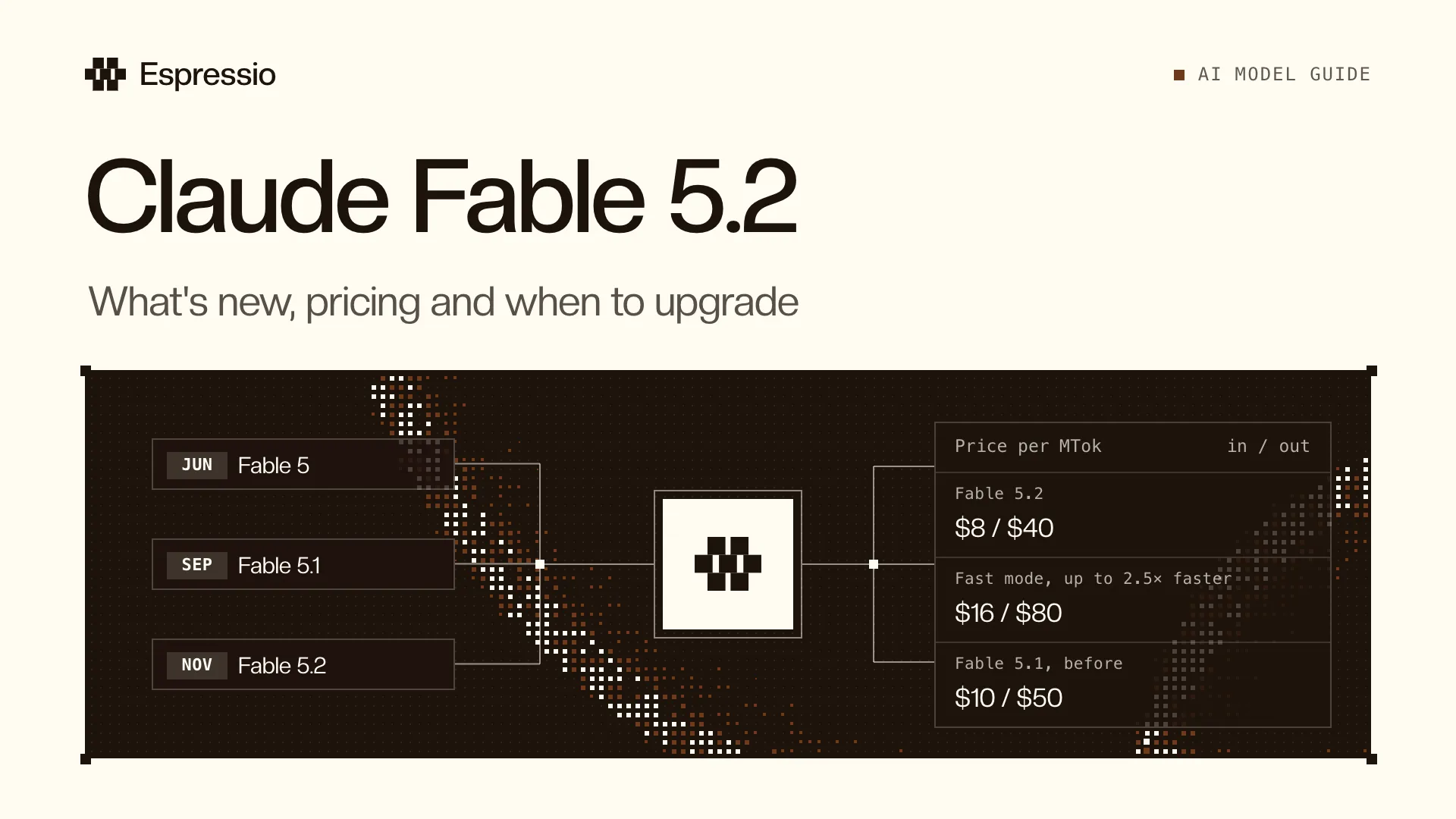
- List price dropped 20% versus Fable 5.1: $8 per million input tokens and $40 per million output tokens. Optional fast mode is $16 / $80 and can run up to 2.5× faster.
- Outputs are up to 30% faster than Fable 5.1. Anthropic also reports clearer communication and about 55% fewer unnecessary safety blocks.
- Model ID is
claude-fable-5-2. Context window is 1M tokens, max output 128K tokens. Adaptive thinking is always on; default effort ishigh. - For most coding and knowledge work, Anthropic still recommends starting with Claude Opus 5.5, then escalating to Fable 5.2 when the task is ambitious enough. Fable can also act as Advisor or Orchestrator for smaller models.
- Fable 5.2 and Mythos 5.2 are the same underlying model. Mythos remains limited to Anthropic’s Cyber and Life Sciences Verification Programs.
If you are evaluating who should upgrade your stack from Fable 5.1 (or Opus 5.5) to Fable 5.2, this guide gives you the facts from Anthropic’s launch and the standards to evaluate the work.
What is Claude Fable 5.2
Claude Fable 5.2 is Anthropic’s upgraded Mythos-class model for hard technical work: multi-hour agent sessions, deep research, large codebase migrations, and analysis that has to land as a finished document, spreadsheet or deck.
It sits above Opus 5.5 in Anthropic’s lineup for the hardest jobs. The name pairing with Mythos is unchanged from earlier Fable releases. Fable and Mythos share the same underlying model. Fable ships with cyber and biology safeguards so it can be generally available. Mythos lifts those safeguards for vetted organizations.
For builders, the practical envelope is:
| Spec | Value |
|---|---|
| API model ID | claude-fable-5-2 |
| Context window | 1M tokens |
| Max output | 128K tokens |
| Input / output price | $8 / $40 per MTok |
| Fast mode | $16 / $80 per MTok |
| Thinking | Adaptive (always on) |
| Default effort | high |
| Knowledge cutoff | June 2026 |
| Released | November 9, 2026 |
Platforms at launch: Claude apps, the Claude API / Claude Platform, Amazon Bedrock (anthropic.claude-fable-5-2), Google Cloud (Anthropic-managed and Google-managed), and Microsoft Foundry.
Why Fable 5.2 matters now
Fable 5 landed in June 2026 as the first generally available Mythos-class model. Fable 5.1 followed in September. Fable 5.2 is the third turn of that tier in five months, and the first that pairs a clear capability step with a lower list price.
Three things make this release worth a production review even if you already run Fable 5.1:
- Cost. $8 / $40 is 20% below the $10 / $50 Fable 5 and 5.1 list price. Cache reads on Fable 5.2 are $0.20 / MTok. Batch API stays at 50% off.
- Speed. Anthropic says outputs generate up to 30% faster than 5.1, with an optional fast mode up to 2.5× faster token generation for interactive work.
- Fewer false blocks. Early testing across claude.ai, Claude Code and Cowork showed about 55% fewer classifier blocks versus 5.1 (about 60% fewer in cybersecurity, 40% fewer in biology), while Anthropic says the safeguards remain as robust as 5.1.
If you are interested in building AI agents and automation like this for your team, book a call.
What’s new versus Fable 5.1
Capability claims from Anthropic’s launch
Anthropic positions Fable 5.2 as a step above Opus 5.5 on most of the capabilities it evaluated. Headline numbers from the launch post and docs overview:
| Benchmark | Fable 5.2 | Fable 5.1 | Opus 5.5 |
|---|---|---|---|
| FrontierCode 2.0 (Xhigh / best reported) | 49.1% | 32.4% | 45.5% |
| FrontierSWE v2 | 69.9% | 56.3% | 62.3% |
| AutomationBench | 51.4% | 31.4% | 42.5% |
| Terminal-Bench-Science 0.1 | 74.6% | 52.6% | 58.7% |
| WANDR (relaxed) | 82.1% | 68.7% | 72.3% |
| OSWorld 2.1 (offline, partial) | 89.3% | 83.5% | 87.2% |
| RoboDojo Sim | 64.9% | 27.6% | 39.4% |
| Humanity’s Last Exam (with tools) | 74.2% | 65.6% | 67.7% |
| Chartography (no tools) | 73.4% | 44.8% | 64.4% |
| Remote Labor Index (high effort) | 41.3% | 17.9% | 21.3% |
Scores above are Anthropic’s published figures with safeguards on unless their table notes otherwise. Treat them as launch evidence, not as a guarantee on your workload. Run your own eval set before flipping production traffic.
Anthropic also reports that at High effort, Fable 5.2 scored about level with Opus 5.5 at Max effort on FrontierCode 2.0 for roughly half the cost per task. At Medium effort on WANDR, it matched Opus 5.5’s top score for about 40% of the cost per task.
Coding, science and long-horizon agents
Launch examples Anthropic published (all from their announcement, not independent audits):
- A team of agents on an earlier Fable 5.2 build migrated a critical Anthropic production service from Python to Rust; Anthropic says the service now starts about 26× faster.
- One engineer ran Fable 5.2 for eight days with over 1,000 subagents and produced a working prototype operating system that boots on a laptop.
- A 1,000-agent team formalized Fermat’s Last Theorem in Lean in 30 hours; Opus 5.5 with the same setup completed 26% in 18 hours and barely progressed further by 30 hours.
- Fable 5.2 solved two open theoretical-physics problems involving holographic duality and black holes (preprints linked from Anthropic’s post).
- With Diode, Fable 5.2 designed three working electronic devices (voice-assistant hub, USB speakerphone, handheld virtual pet) from a one-paragraph prompt, with boards ready for manufacturing in under a day.
Early tester quotes in the launch post (Vercel, Jump Trading, Rubrik, Mozilla and others) emphasize clearer intent-following, better judgment on ambiguous systems, and stronger multi-agent coordination.
Fast mode
Fast mode is optional and priced at $16 / $80 per MTok. Anthropic says it speeds token generation by up to 2.5×. It is available on Claude Code, the Claude Platform, Claude Models on Google Cloud, and Microsoft Foundry (Anthropic hosted). Mythos fast mode stays limited to Verification Program members.
Use fast mode when latency is the bottleneck and the 2× price premium is cheaper than waiting. Do not default every production call to it.
Pricing and availability
List prices
| Mode | Input | Output | Cache read | Batch |
|---|---|---|---|---|
| Standard Fable 5.2 | $8 / MTok | $40 / MTok | $0.20 / MTok | 50% off |
| Fast mode | $16 / MTok | $80 / MTok | — | — |
| Fable 5.1 (previous) | $10 / MTok | $50 / MTok | — | 50% off |
| Opus 5.5 | $4 / $20 | — | — | 50% off |
Cache write pricing on Fable 5.2: $10 / MTok for 5-minute cache writes, $16 / MTok for 1-hour cache writes (docs).
Launch promotion on paid Claude plans
For a limited window after November 9, 2026, Anthropic is giving eligible paid subscribers extra Fable usage:
- Pro plans and standard Team seats: all Fable models included for one week (through November 16, 2026 11:59 pm PT) up to 50% of weekly usage limits, plus one Fable limit reset.
- Max, Ultra, premium Team seats, and premium legacy Enterprise seats: one to three Fable limit resets, depending on how long you’ve subscribed.
Details and eligibility cutoffs are in Anthropic’s Fable 5.2 launch offers article. Free plans and several Enterprise seat types are excluded. Production workloads still belong on the API or consumption-based Enterprise plans, not on a promotional reset.
Data retention
Claude Fable 5.2 still requires 30-day data retention and is not available under zero data retention (ZDR) unless Anthropic expressly authorizes it. That is unchanged from earlier Fable Covered Model rules.
What is new: Enterprise Frontier Safeguards (private beta with customers such as Bridgewater, Salesforce and Stripe) runs automated safety monitoring on prompts and responses stored in the customer’s own infrastructure, which Anthropic says makes monitoring compatible with ZDR. Eligible Enterprise customers can request access via their account team.
Fable 5.2 versus Mythos 5.2 versus Opus 5.5
| Fable 5.2 | Mythos 5.2 | Opus 5.5 | |
|---|---|---|---|
| API model ID | claude-fable-5-2 | claude-mythos-5-2 | claude-opus-5-5 |
| List price | $8 / $40 | Same as Fable | $4 / $20 |
| Cyber / bio safeguards | Active | Lifted for verified orgs | Standard |
| General availability | Yes | Verification Programs only | Yes |
| Anthropic’s recommended start | Escalate up when needed | Verified dual-use work | Daily driver for most coding / knowledge work |
Anthropic’s own guidance in the launch post is clear: for most coding and knowledge tasks, start with Opus 5.5. Move up to Fable or Mythos when the scope and complexity justify it, or down to Sonnet 5.5 / Haiku 5.5 when they don’t. Fable 5.2 can also sit above smaller models as:
- Advisor — Haiku, Sonnet or Opus consult it on harder subproblems.
- Orchestrator — it delegates simpler tasks to cheaper models.
That routing pattern matters more than the headline benchmarks. An all-Fable stack will overspend on short, well-scoped calls.
How the safeguards changed
Fable 5.2 still blocks high-risk cyber activities (penetration testing, exploit generation, binary-based vulnerability work) and most research-biology tasks. When a classifier fires, users get a response from Opus 4.8 for cybersecurity and Opus 5 for biology, with a notice that the model switched.
What improved:
- About 55% fewer unnecessary blocks versus Fable 5.1 in Anthropic’s early testing.
- Stronger anti-distillation protections; Anthropic says distillation harvest is down 90–99% with techniques from their recent threat report.
- Preserved thinking now applies to all accounts, which blocks distillers from editing prior context to extract reasoning.
- External predeployment testing included the UK AI Security Institute, Frontier Design and METR. Details live in the Fable 5.2 / Mythos 5.2 System Card.
Mythos 5.2 access: Cyber Verification Program for cybersecurity professionals, Life Sciences Verification Program for biomedical researchers, and Claude Security (including Mythos 5.2) for Claude Enterprise customers even outside those programs.
When to actually use Claude Fable 5.2
Use Fable 5.2 when the work looks like something you would assign to a senior engineer, senior analyst or research scientist, and when a weaker model has already failed your eval or is burning too many retries.
Good fits:
- Multi-hour autonomous coding agents and large migrations
- Ambiguous systems the model has never seen before
- Deep research that has to produce a finished artifact
- Hardware, robotics or science workflows where Fable 5.1 / Opus underperformed on your harness
- Orchestrating teams of cheaper models
Stay on Opus 5.5 (or Sonnet / Haiku) when:
- The task is short, well-scoped and already strong on Opus
- Latency and volume dominate over frontier accuracy
- You need ZDR without an Enterprise Frontier Safeguards exemption
- The workflow is classification, templated generation or light enrichment
Common mistakes when adopting Fable 5.2
- Flipping every call from Opus 5.5 to Fable 5.2. Anthropic recommends Opus as the daily driver. Promote workflows on eval evidence.
- Ignoring the 20% price cut in your cost model. If your spreadsheet still assumes $10 / $50, you will over-forecast spend and under-invest in Fable where it pays off.
- Defaulting to fast mode. Fast mode is 2× the standard price. Cap it to latency-sensitive surfaces.
- Leaving effort at
higheverywhere. Default effort on Fable 5.2 ishigh. Cap effort per workflow the way you did on earlier Fable releases. - Shipping without refusal / fallback handling. Classifier refusals still need an explicit client path, especially on Bedrock, Vertex and Foundry where server-side fallbacks may differ.
- Assuming ZDR just works. 30-day retention remains the default rule. Enterprise Frontier Safeguards is private beta, not a general ZDR unlock.
- Building production on the one-week Pro promotion. Promotional Fable inclusion ends November 16, 2026 for Pro / standard Team seats. API and consumption plans are the durable path.
How to know your Fable 5.2 rollout is working
Four metrics belong on a dashboard the day 5.2 hits production:
- Per-workflow blended cost versus Fable 5.1 and Opus 5.5 on the same eval set
- Refusal / fallback rate by classifier category
- Effort distribution (are any surfaces stuck on high effort?)
- Output quality on your own evals, not only Anthropic’s launch table
Pair those with a weekly review of 20–50 fallback samples. If refusal rates climb above your baseline on a non-cyber / non-bio workflow, fix the prompt before blaming the model.
FAQ
When was Claude Fable 5.2 released?
November 9, 2026. It is generally available the same day on Claude apps, the Claude Platform, Amazon Bedrock, Google Cloud and Microsoft Foundry.
What is the API model ID for Fable 5.2?
claude-fable-5-2 on the Claude API. On Amazon Bedrock the ID is anthropic.claude-fable-5-2.
How much does Claude Fable 5.2 cost?
$8 per million input tokens and $40 per million output tokens. That is 20% less than Fable 5.1’s $10 / $50. Optional fast mode is $16 / $80.
How does Fable 5.2 compare to Opus 5.5?
Anthropic recommends Opus 5.5 as the starting point for most coding and knowledge work. Fable 5.2 is the escalate-up model for ambitious, open-ended technical tasks. On Anthropic’s launch benchmarks, Fable 5.2 leads Opus 5.5 on most agentic coding, science and computer-use evaluations they published, often at lower cost per task at matched scores.
What is the difference between Fable 5.2 and Mythos 5.2?
Same underlying model and same list price. Fable 5.2 has cyber and biology safeguards and is generally available. Mythos 5.2 lifts those safeguards for organizations in Anthropic’s Cyber and Life Sciences Verification Programs.
Does Fable 5.2 support zero data retention?
Not by default. It requires 30-day retention unless Anthropic expressly authorizes otherwise. Enterprise Frontier Safeguards (private beta) is Anthropic’s path toward ZDR-compatible monitoring for eligible Enterprise customers.
Is adaptive thinking still always on?
Yes. Adaptive thinking cannot be turned off. Control depth, latency and cost with the effort parameter. Default effort on Fable 5.2 is high.
Can I use Fable 5.2 in Claude Code?
Yes. Fable 5.2 and its fast mode are available in Claude Code. Anthropic also reports that over 90% of changes merged into its own core codebase are now written by Claude with human guidance.
Should I upgrade from Fable 5.1 immediately?
If you already run Fable 5.1 in production, plan a canary: same prompts, same harness, side-by-side cost and quality for 48 hours at 5–10% traffic. The price cut alone is a reason to move once quality holds. Do not skip refusal handling or effort caps during the swap.
What to do next
- Pick one long-horizon workflow and run Fable 5.2 side by side with Fable 5.1 and Opus 5.5 for a week.
- Update your cost model to $8 / $40 (and $16 / $80 for any fast-mode surface).
- Cap
effortper workflow; do not inherit a globalhighdefault just because the docs default to it. - Confirm refusal and fallback handling still works on every platform you use (Claude API, Bedrock, Google Cloud, Foundry).
- If you need ZDR, talk to your Anthropic account team about Enterprise Frontier Safeguards rather than assuming Covered Model rules changed for everyone.
- Read Anthropic’s migration guide for Fable 5.2 before flipping the model ID in production.
If you want a Fable 5.2 rollout designed and shipped cleanly inside your AI engineering org, with routing, effort caps, fallback handling and a cost dashboard your team can audit, book a call.
Related Espressio guides
- Claude Fable 5: The Complete Guide to Anthropic’s New Mythos-Class Model
- Claude Fable 5 Pricing Explained
- When to Use Claude Fable 5 vs Mythos 5 vs Opus 4.8
- How to Migrate Claude Opus 4.8 to Fable 5
- Claude Fable 5 Safeguards: The Opus 4.8 Fallback Explained
- Claude Fable 5 API: Access, First Calls, and What’s Different from Opus
Sources checked on 9 November 2026 (Europe/Stockholm): Anthropic launch post, Claude Platform docs, Fable 5.2 launch offers, The Verge, VentureBeat.
Get the latest AI workflows, tools and news
Sign up for the Espressio newsletter. We want to make you AI-native.
You're on the list.
The next issue goes to your inbox.