Luka Mrkić
Head of BD
Insights, strategies, and real-world playbooks on AI-powered marketing.
MAY 15, 2026
How to Automate Your Beehiiv Newsletter with AI
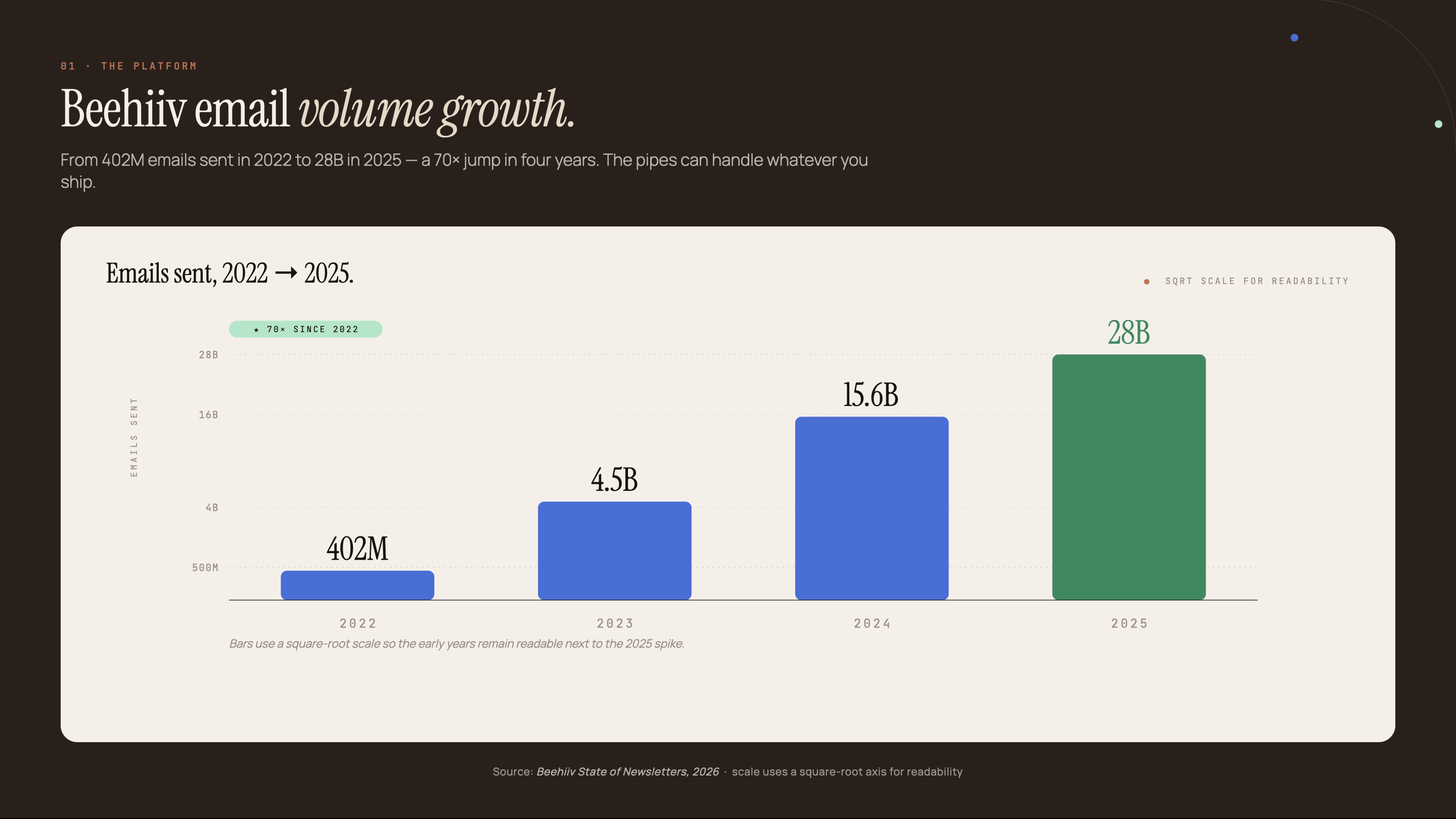
Beehiiv sent 28 billion emails in 2025 across 65,000+ active newsletters (Beehiiv, 2026). Inside that volume, automated sequences generate click-through rates nearly three times higher than standard sends, based on the platform’s own analysis of its entire email corpus.
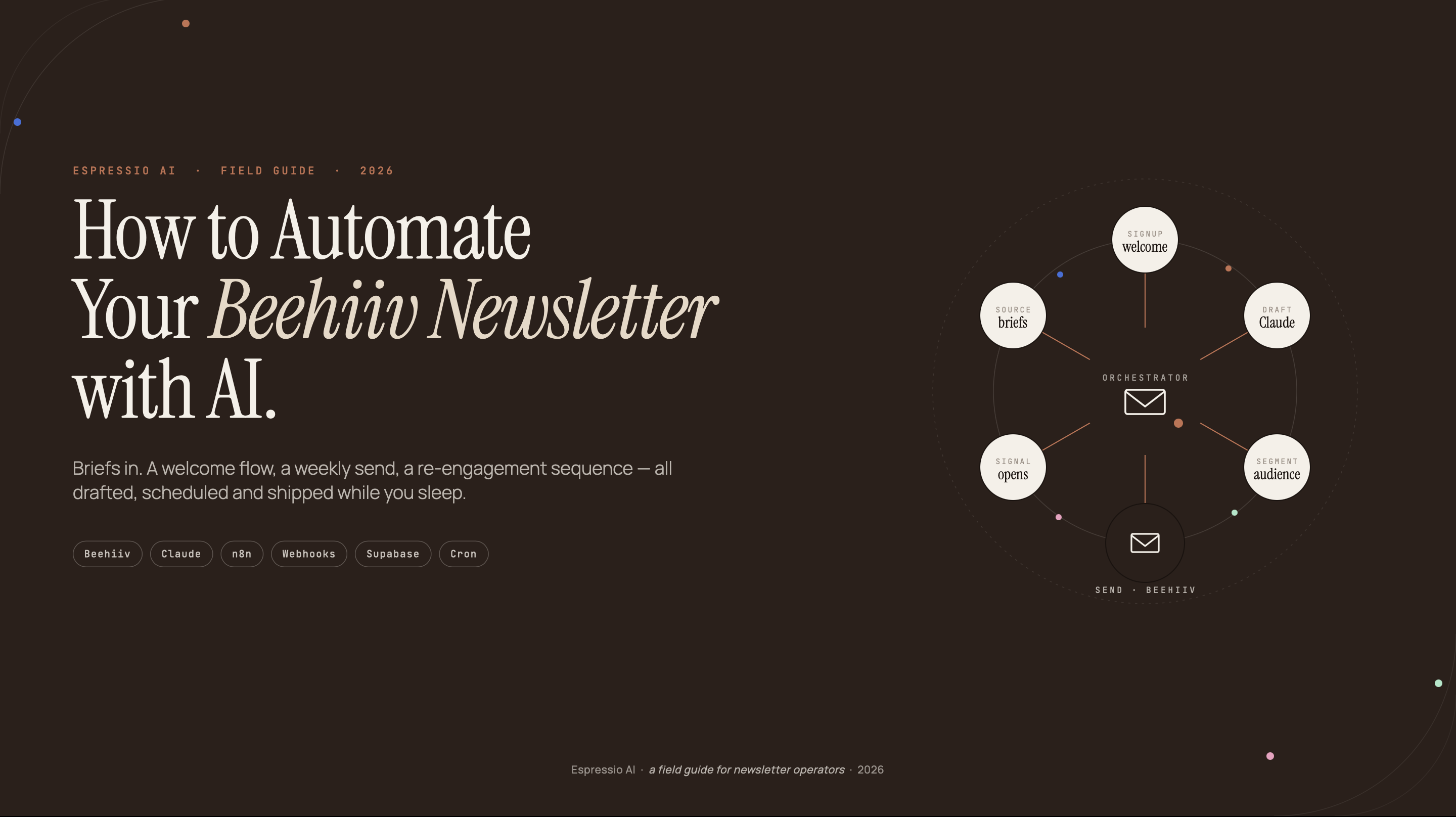
Most newsletter operators still write, edit, and schedule every issue by hand. That’s 4-8 hours per week for a single publication. This guide builds a four-layer automation pipeline: Beehiiv’s native automations as the delivery layer, Make.com as the orchestrator, Claude as the content engine, and the new Beehiiv MCP for analytics and Claude-native operations.
Key Takeaways
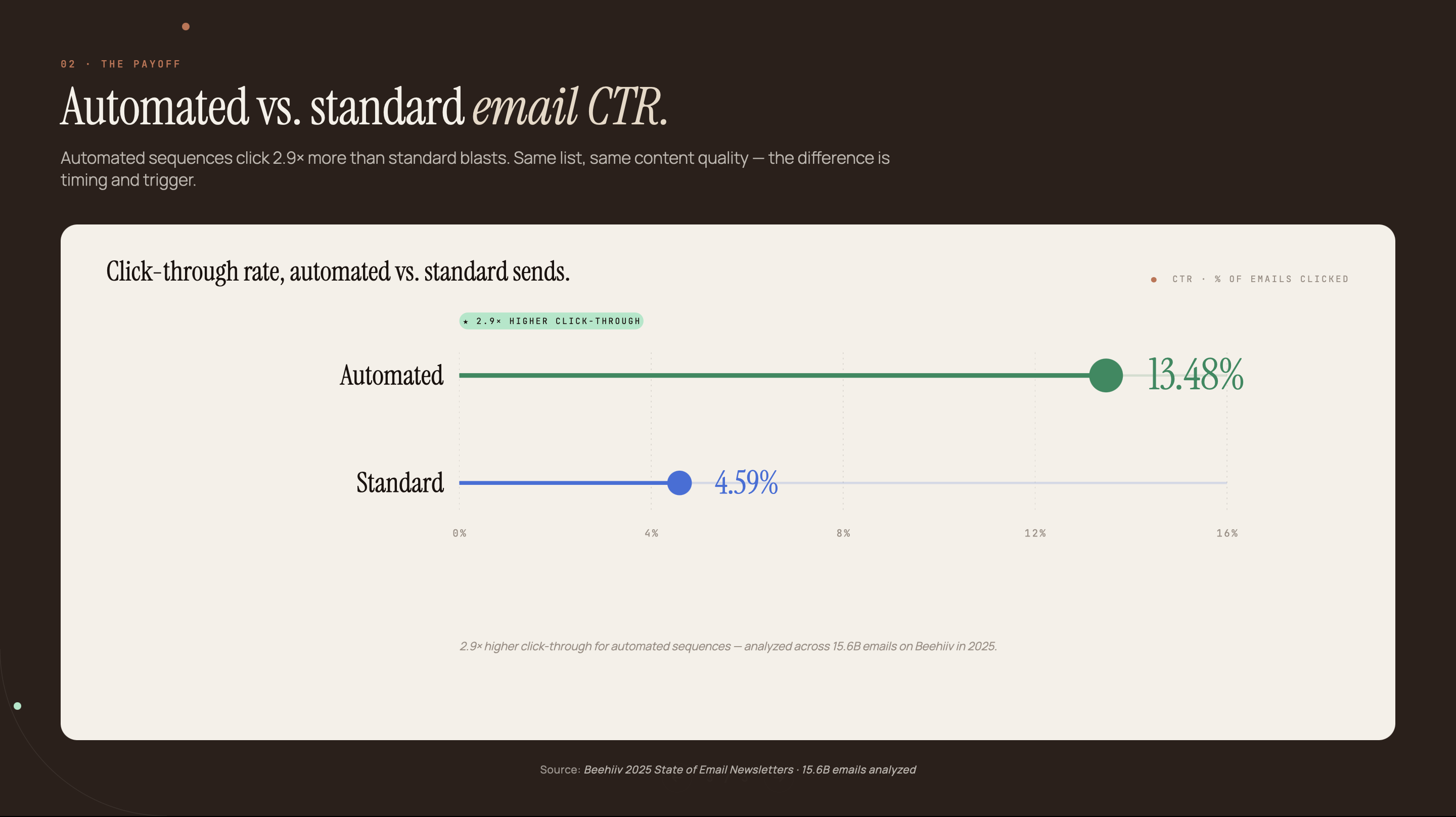
- Automated emails on Beehiiv generate 13.48% CTR versus 4.59% for standard sends, nearly 3× higher, based on 15.6 billion emails analyzed (Beehiiv, 2025)
- A full AI pipeline combines Beehiiv’s native automations, Make.com or n8n as the orchestrator, and Claude or ChatGPT as the content engine
- The Beehiiv MCP, launched March 2026, lets you run newsletter operations natively inside Claude: the first newsletter platform to support this
- Full pipeline costs under $55/mo: Beehiiv Scale ($43) + Make.com Core ($9) + Claude API usage
What does a Beehiiv AI automation pipeline actually do?
Automated emails on Beehiiv generate 13.48% click-through rates compared to 4.59% for standard sends, based on analysis of 15.6 billion emails (Beehiiv, 2025). That gap exists because automated sequences reach subscribers at the right moment: right after signup, after 180 days of silence, after a paid tier link click - not at a fixed broadcast schedule the operator decided in advance.
A four-layer pipeline handles the full workflow: the trigger layer (Beehiiv native automations) manages subscriber events; the orchestration layer (Make.com or n8n) connects external tools; the content layer (Claude or ChatGPT) drafts the actual emails; and the analytics layer (Beehiiv MCP) feeds performance back into Claude. Each layer does one job.
The tasks that stay human: final review before each send, tone adjustments, anything requiring real-world context the AI doesn’t have. Research, first-draft writing, formatting, scheduling, and post-send performance summaries all go to the pipeline. For a weekly B2B newsletter, that split reduces production time from 4-5 hours to under 45 minutes.
Beehiiv grew to 65,000+ active newsletters in 2025 (Beehiiv, 2026), with more newsletters now competing for the same subscriber inboxes.
Step 1: Set up Beehiiv’s native automations
Beehiiv’s automation builder is available on the Scale plan at $43/month and above. The Launch (free) plan gives you a single welcome email, enough to test the flow but not a functional automation system. Scale unlocks conditional branching, multi-step sequences, and the API access the Make.com and MCP integrations in later steps require.
| Plan | Price | Automations | API | Make.com | MCP |
|---|---|---|---|---|---|
| Launch | $0 (≤2,500 subs) | Welcome email only | Read/write subs | Limited | N/A |
| Scale | $43/mo | Full automation builder | Full | Full | Read-only (v1) |
| Max | $96/mo | Everything in Scale + multi-publication | Full | Full | Full |
| Enterprise | Custom | Everything + Send API | Full Send API | Full | Full |
Source: beehiiv.com/pricing, verified May 2026
To access the builder: Publications → Automations → New Automation. Four trigger types are available: new subscriber, attribute match, link click, and time delay. Every newsletter needs at least three automations running from day one.
The welcome series delivers the highest retention lift on the platform. Beehiiv’s platform data shows creators running automated welcome sequences see significantly higher 30-day subscriber retention than those relying on a single welcome email (Beehiiv, 2025). Build a three-email sequence: a warm welcome on Day 1, your three best pieces on Day 4, a direct ask for a reply or upgrade on Day 10.
The re-engagement sequence targets subscribers inactive for 180 days. Beehiiv reports that a meaningful share of inactive readers respond to a well-timed reactivation campaign (Beehiiv, 2025). A two-email sequence with a subject line like “Still want to hear from us?” brings many back before they permanently lapse.
The paid tier upsell triggers after a subscriber clicks a paid-tier link in any send. Connect it to a sequence that delivers a case study and a time-limited offer within 48 hours. Monitor all three from the Journey Overview dashboard under each automation’s analytics tab.
Step 2: Connect your AI content engine with Make.com
Marketing automation delivers $5.44 for every $1 invested over three years, with companies reporting an average 34% revenue increase (SAP Emarsys, 2025). Make.com handles what Beehiiv’s native builder can’t: pulling content from external sources, generating first drafts with an AI model, and landing a formatted post in the Beehiiv editor for review.
Beehiiv’s official Make.com integration provides two triggers (New Subscriber and Unsubscribe) and four actions: Add Subscriber, Update Subscriber, Create Segment, and an HTTP module for the Beehiiv REST API. The HTTP module is where the content pipeline runs.
To authenticate: go to Beehiiv Settings → API Keys → Generate Key. Copy the key and create a new Make.com connection using HTTP → Make an API Key Auth module. Your Beehiiv publication ID appears in every API endpoint as pub_xxxxxxxx and is visible in the Beehiiv dashboard URL.
Set up the content generation module as an HTTP POST request to https://api.anthropic.com/v1/messages (for Claude) or https://api.openai.com/v1/chat/completions (for ChatGPT). The system prompt sets newsletter voice; the user prompt delivers the topic and any research links gathered in an earlier module.
A working system prompt template:
You are the editor of [Newsletter Name], a [frequency] newsletter for [audience description].
Write in [adjective 1], [adjective 2] prose. Keep paragraphs to 3 sentences maximum.
The issue covers: [topic from trigger]. Produce: subject line, preview text, and 350-word body.
Do not include sign-off or unsubscribe instructions — those are added by the platform.
For teams already running n8n, the Beehiiv REST API works via a webhook trigger and HTTP node. Beehiiv doesn’t officially list n8n as an integration, but the REST API is fully public. The n8n workflow for research tutorial covers the authentication pattern that applies here.
96% of marketers have used or plan to use marketing automation, with 71% applying it specifically to email (SAP Emarsys, 2025). The Make.com and Claude pipeline guide covers the module connection setup in more detail, and Claude API setup for marketing teams has the key configuration steps.
Step 3: Build the full pipeline from content brief to subscriber inbox
Email marketing returns $36 for every $1 spent, among the highest ROI rates of any digital marketing channel (Litmus, 2025). A full six-step Make.com pipeline captures that return by reducing the per-issue production cost to roughly 40 minutes of human time.
The six modules run in this order:
- Schedule module (weekly trigger, or RSS module for event-triggered sends)
- HTTP request to Perplexity or Exa API: fetches 3-5 current links on the week’s topic
- HTTP request to Claude API: system prompt (brand voice) plus user prompt (topic and links from Step 2) returns subject line, preview text, and body
- Beehiiv Create Post action: status set to
draft, notpublished - Slack or Gmail notification: sends the draft URL to the editor’s inbox
- After manual publish: Beehiiv’s native automation triggers the welcome or nurture follow-up for new subscribers who signed up before or during the send window
The most important design decision is Step 4: always create a draft, never auto-publish. The review step takes 10-15 minutes, not the 3-4 hours of full production. Brand voice is the primary differentiator for any newsletter, and a single off-tone issue costs more audience trust than a missed send.
On an 8,000-subscriber B2B newsletter Espressio built this pipeline for, production time dropped from 4.5 hours per issue to 38 minutes. The human checkpoint covers subject line testing (two variants via Beehiiv’s A/B tool), one paragraph rewrite for current events context, and a spot-check of the research links. The AI handles everything before that. Issue quality improved because the editor spent time on judgment rather than drafting.
The placement of the human checkpoint matters more than most builders expect. Teams that put the review step after the Slack notification but before the Beehiiv publish action catch 90% of voice issues before they reach subscribers. Teams that skip this step and auto-publish typically revert within six issues.
For teams building a research layer before the draft step, multi-agent content research shows how to structure a multi-source research agent that feeds directly into a content generation pipeline like this one.
Step 4: Add the Beehiiv MCP for Claude-native newsletter operations
In March 2026, Beehiiv became the first newsletter platform operable natively inside Claude, ChatGPT, Gemini, and Perplexity via the Model Context Protocol (product.beehiiv.com, 2026). The MCP turns the Claude interface into a live dashboard for your newsletter: subscriber counts, open rates, CTR trends, and content performance, all queryable in natural language without switching tabs.
Most people describe the Beehiiv MCP as “connecting Beehiiv to Claude.” The more precise framing is that it reverses the data flow direction. In the Make.com pipeline, Claude receives a topic and produces content. With the MCP, Beehiiv sends performance data to Claude and Claude produces insight and recommendations. These are complementary layers in the same stack, not substitutes for each other.
What you can do with the Beehiiv MCP today (v1, read-only)
V1 lets you query subscriber counts, growth rates, and churn data by date range; pull open rates and CTR for recent campaigns and automation sequences; identify content themes with above-average engagement; and generate performance summaries for team standups. All of this happens inside Claude without leaving the conversation.
Sample prompts that work now:
- “Summarize my last four weeks of Beehiiv performance and identify the top three content themes by open rate.”
- “Which subscribers joined in the last 30 days have not opened any email? How does that compare to my 90-day average?”
- “Based on my last 10 issues, what subject line patterns drove the highest open rates?”
Setting up the Beehiiv MCP
A Scale plan is required. Enable the MCP in Beehiiv Settings → Integrations → MCP, then approve the connection in your Claude settings. The install takes under one minute.
What’s coming in v2 (write access, in development)
Paid newsletter subscriptions on Beehiiv grew 138% in 2025, from $8M to $19M in creator revenue (Beehiiv, 2026). V2 write access is designed for that monetizing layer: Claude will create segments, draft content, build email sequences, and publish drafts directly from the interface without Make.com as an intermediary.
A practical workflow available today: after Monday’s issue sends, a scheduled Make.com module calls the Beehiiv MCP to pull the performance summary, passes it to Claude for a 200-word digest, and posts the result to a Slack channel before standup.
How do you know if your Beehiiv automation pipeline is working?
Beehiiv’s platform average open rate across all newsletters in 2024 was 37.67% (Beehiiv, 2025). Automated sequences consistently outperform that baseline when they’re properly timed and targeted. Four KPIs show where yours stand.
Welcome series open rate should hit 45-55% within seven days of signup. Anything below 40% points to a subject line or timing problem; the Journey Overview dashboard breaks down per-step open rates across the full sequence so you can find the drop-off.
The automated email CTR benchmark (13.48% across the platform, per the Key Takeaways data above) is the number to beat. Below 8%, review call-to-action placement and whether the linked content delivers on the subject line’s promise. Sequences with vague CTAs (“read more”) underperform specific ones (“see the three case studies”) by a measurable margin.
30-day subscriber retention (the share of new subscribers who open at least one email in their first month) should improve once the welcome series is running, per Beehiiv platform data. Track it in the Journey Overview and set a baseline before the automation goes live.
For reactivation, target a 15-20% response rate from subscribers who haven’t opened anything in six months. Below 10% means the sequence triggers too late or the subject line isn’t giving people a reason to come back.
Find all four metrics in the Beehiiv Journey Overview dashboard, combined with the Performance Overview tab for campaign-level data. For how automation performance fits into a broader content strategy, AI content automation for B2B covers the quality gate framework that keeps automated output from degrading over time.
If you want us to build this pipeline for your newsletter stack, let’s chat.
Frequently asked questions about Beehiiv newsletter automation
Does Beehiiv have automation built in?
Yes, on the Scale plan ($43/mo) and above. Native automations support welcome series, re-engagement sequences, subscriber segmentation, and conditional branching. The Launch (free) plan limits you to a single welcome email. Most advanced automation features require the Scale plan or higher.
What tools do I need to connect AI to Beehiiv?
Make.com (or n8n) as the orchestrator, Claude or ChatGPT via HTTP request for content generation, and a Beehiiv API key from Settings. No custom code is required for the Make.com path. The Beehiiv Scale plan provides both API access and the full automation builder.
Can Claude automatically publish to my Beehiiv newsletter?
Via a Make.com pipeline, yes. The pipeline sets post status to draft, requiring human review before the issue sends. Via the Beehiiv MCP (v2, currently in development), Claude will be able to create segments, draft content, and publish directly. The v1 MCP launched in March 2026 is read-only.
How much does it cost to run this automation?
Beehiiv Scale plan: $43/mo. Make.com Core plan: $9/mo (10,000 credits). Claude API: approximately $0.15 to $0.50 per newsletter issue at standard length. Total: under $55/mo to automate a weekly newsletter fully, excluding Beehiiv subscriber fees.
Is it safe to auto-publish AI-generated newsletter content?
Not recommended. Build a human review step into every pipeline: a Slack or email notification with a draft link. Review takes 10 to 15 minutes versus 3 to 4 hours of manual production. The quality gate matters more than the time saved, especially for newsletters where brand voice is a differentiator.
The pipeline that runs itself (almost)
The four-layer stack in this guide (Beehiiv native automations for delivery timing, Make.com for orchestration, Claude for content generation, and Beehiiv MCP for analytics) brings weekly newsletter production under 45 minutes of human input per issue. The infrastructure cost is under $55 per month.
The word “almost” matters. Every send deserves a 15-minute review. Brand voice grows subscriber loyalty; protecting it stays human. The pipeline handles the rest.