How to Build a Product Launch Marketing Plan in 90 Days (6 Steps)
A product launch marketing plan in 6 steps and 90 days: team, message, funnel, profile, waves of creators and partners, mini launches. Template included.

On this page
- 01What is a product launch marketing plan?
- 02Why posting more doesn’t turn into revenue
- 03The 6 steps at a glance
- 04Step 1: Draft the team before you post anything
- 05Step 2: Sharpen the message and the offer
- 06Step 3: Build the funnel and landing page before you buy attention
- 07Step 4: Treat your X profile as a landing page
- 08Step 5: Distribute in waves with creators, newsletters, podcasts and partners
- 09Step 6: Stack mini launches instead of one launch day
- 10The 90-day product launch plan you can copy
- 11Product launch checklist
- 12Product launch marketing plan template
- 13How to measure a launch
- 14Running a 90-day launch with a lean team
- 15Frequently Asked Questions
- 16Conclusion
A product launch marketing plan is the order in which you get a launch ready and then put attention into it. It covers who does the work, what you say and to whom, where people land, and how you reach them over time. The version below has 6 steps and runs over 90 days: draft the team, sharpen the message and offer, build the funnel, fix your social profile, distribute in waves, and stack mini launches.
Most launch plans fail in the same way. The team posts a lot more, gets impressions, and sees few signups or demos. The problem is usually not the volume. It’s that the funnel behind the posts was never built.
This framework comes from Jack Haldorsson at Lunar Strategy and his X article “how we turn attention into revenue, step by step in 90 days” (9 November 2026). Jack is a managing partner at Lunar Strategy, where Shann also works. We rewrote it for SaaS, fintech and B2B growth teams, added a copyable 90-day plan, a checklist and a fill-in template, and checked every outside number against its source.
Key Takeaways
- Do the launch in this order: team, message and offer, funnel, social profile, distribution, mini launches. Paying for reach before the funnel works sends people into a leaky page.
- Map every skill the launch needs into 3 columns: plan, make and distribute. Every empty box is a gap in your funnel later.
- If you can’t fill in “[product] helps [who] get [outcome]”, you’re not ready to spend money on distribution.
- B2B buyers need many touches before they buy. Forrester counted 27 interactions per purchase decision in 2021, up from 17 in 2019.
- Your X and LinkedIn profiles are landing pages too. Fix the bio, the pinned post and the next step before a single creator sends people there.
- Run creators, newsletters, podcasts and partners in waves, and ship a mini launch every 2 weeks instead of saving everything for one launch day.
What is a product launch marketing plan?
A product launch marketing plan is a written plan for introducing a new product, feature or offer to the people most likely to buy it. A good one answers six questions:
- Who on the team does each part of the work?
- Who is this launch for, and what do they get?
- Where do people land, and what one action should they take?
- What do they see when they check your company and founder on social?
- Which outside voices will put you in front of buyers, and in what order?
- What gives people a new reason to talk about you every few weeks?
A go-to-market plan covers more ground: pricing, sales motion, packaging and the market you enter. A launch marketing plan is the part of your GTM that turns attention into users or pipeline in a set window. For a new product launch, 90 days is long enough to prepare properly and short enough to keep the team focused.
Why posting more doesn’t turn into revenue
When a launch underperforms, the first reaction is usually to post more. That rarely fixes it, because buyers don’t decide after one post.
Forrester’s 2021 B2B Buying Study found that the number of interactions buyers needed to make a decision rose from 17 in 2019 to 27 in 2021. It also found that 60% of purchases involved four or more people. So a buyer sees you many times, from several places, and often has to convince colleagues too.
Think about the last tool your team started paying for. You probably saw it in a post, then on a colleague’s screen, then in a newsletter, and only then booked a demo. A launch plan has to create those touches on purpose and make sure each one leads somewhere useful.
The 6 steps at a glance
| Step | Days | What you finish with |
|---|---|---|
| 1. Draft the team | 1-14 | A plan / make / distribute map with an owner or a partner for every box |
| 2. Message and offer | 1-14 | One audience, one “[product] helps [who] get [outcome]” line, one real reason to act now |
| 3. Funnel and landing page | 15-30 | One landing page built around one action, tested on mobile |
| 4. Social profiles | 15-30 | Company and founder profiles that work as landing pages, plus a posting rhythm |
| 5. Distribution in waves | 31-90 | Three waves of creators, newsletters, podcasts, partners and PR |
| 6. Mini launches | 31-90 | A new launch moment every 2 weeks |
Steps 1 and 2 run together, and so do 3 and 4. Steps 5 and 6 only start once the first four are done.
Step 1: Draft the team before you post anything
Most growth teams going into a launch have a founder and one or two marketers trying to do everything: strategy, design, content, posting, creators, PR and community. So everything gets done halfway.
Before the first post, map every skill the launch needs into three columns:
| Plan | Make | Distribute |
|---|---|---|
| GTM and marketing strategy | Brand and visual identity | Company social accounts |
| Which channels go first | Design and landing pages | Founder content |
| What you measure, and how | Video | Creators and newsletters |
| Launch calendar | Written content and copy | PR and podcasts |
| Community, partners and search |
Then be honest about which boxes you can cover in-house. Write a name in each box. Where there is no name, decide now: hire, bring in a partner, or drop that channel from this launch. Every empty box turns into a gap in the funnel later.
This is also where you set one goal for the launch. Pick a number the whole team can see, such as demo requests, trial signups or qualified pipeline, and a date. “Get awareness” is not a goal.
Step 2: Sharpen the message and the offer
This is where most launch marketing goes bland. Teams try to talk to founders, engineers and buyers in procurement in the same post, so the message means nothing to anyone.
Pick one audience for this push and sell the outcome: what does the user actually get? Hours back each week, a faster close, fewer errors in month-end reporting. Nobody signs up because of your architecture diagram.
Fill in this line:
[Product] helps [who] get [outcome].
For example, for an invoicing tool: “[Tool] helps finance teams at 20 to 200 person SaaS companies close the month in 3 days instead of 10.” If you can’t fill the line in, you’re not ready to spend money on distribution.
Then write the offer, the reason to act now. For SaaS and B2B that might be:
- early access for the first teams on the waitlist
- a founding-customer price that locks in for a year
- a free setup or migration for the first month
- a pilot with a clear end date and success measure
The offer has to be real. Fake scarcity gets found out quickly, and B2B buyers talk to each other.
Use the same line everywhere: the landing page, the bios, the sales deck and every creator brief. In a Gartner survey of 632 B2B buyers, 69% said what they found on a company’s website didn’t match what its salespeople told them. A launch is the easiest time to get that right, because everything is being written at once.
Step 3: Build the funnel and landing page before you buy attention
Most teams skip this step. It’s the reason good creator posts and good PR often produce very little.
Marketing is a chain of touchpoints. On X, a typical B2B launch funnel looks like this:
creator or partner post > your profile > landing page > signup or demo
On LinkedIn and in newsletters it’s similar: post or mention, profile or company page, landing page, action. If your profile isn’t set up, you lose people there. If the landing page isn’t built around one clear offer for these exact people, they drop off before they convert. One weak link drags the whole funnel down. You can have the best creators in your market, and if the landing page is weak it doesn’t matter.
What to build into every launch landing page:
- One action. A signup, a demo request or a waitlist form. Not all three.
- A headline above the fold that sells the outcome. Use your “[product] helps [who] get [outcome]” line or a sharper version of it.
- One main button, repeated down the page with the same words.
- Trust. Customer logos you have permission to use, a short quote, security or compliance details, integrations, real numbers.
- Fast, simple and built for mobile.
The last two points are backed by data. In Unbounce’s SaaS conversion benchmark, the median SaaS landing page converts at 3.8%, against 6.6% across all industries. 79% of SaaS landing page visits came from mobile devices. And pages written at a 5th to 7th grade reading level converted at 12.9%, compared with 2.1% for pages written in professional-level language.
So write the page in plain words, check it on a phone first, and have someone outside the team read it and tell you what the product does.
Citation Capsule: A product launch marketing plan should build the funnel before buying attention. B2B buyers needed 27 interactions to make a purchase decision in 2021, up from 17 in 2019 (Forrester). The median SaaS landing page converts at 3.8%, and SaaS pages written at a 5th to 7th grade reading level converted at 12.9% versus 2.1% for professional-level copy (Unbounce). Framework: Jack Haldorsson, Lunar Strategy, November 2026.
Step 4: Treat your X profile as a landing page
When a creator or partner mentions you, the next click is usually your profile, not your website. That makes your company profile and your founder’s profile landing pages too. Fix them before step 5.
On X and LinkedIn, check three things:
- Banner and bio say what you do in one line. Reuse your outcome line.
- The pinned or featured post is your best proof or your offer.
- One clear next step, such as a link to the launch landing page.
Then post every day during the launch window, from the company account and from the founder. This is where founder led marketing earns its place. People trust the people behind a product more than the logo, and a founder posting is the cheapest trusted channel most B2B teams have.
Shann runs this every day on X, where he has about 38,000 followers. Two things matter most there. Write posts people want to reply to and pass on, and stay in the replies for the first couple of hours. Our breakdown of how the X algorithm ranks posts shows why: in X’s published code, replies and shares weigh far more than likes, and early engagement matters most for smaller accounts.
Measure the right thing. Anyone can buy impressions. Track who follows and replies: are they the buyers, operators and peers in your one audience, or random accounts?
Step 5: Distribute in waves with creators, newsletters, podcasts and partners
Now you send attention into the funnel you just built.
Creators and B2B voices
One creator post is one touchpoint. Buyers need to see you from several voices they already trust, a few times, in a short window. For B2B and SaaS, “creators” means operators who post on LinkedIn and X, niche newsletter writers, YouTubers who review tools, and podcast hosts in your category.
Run them in waves:
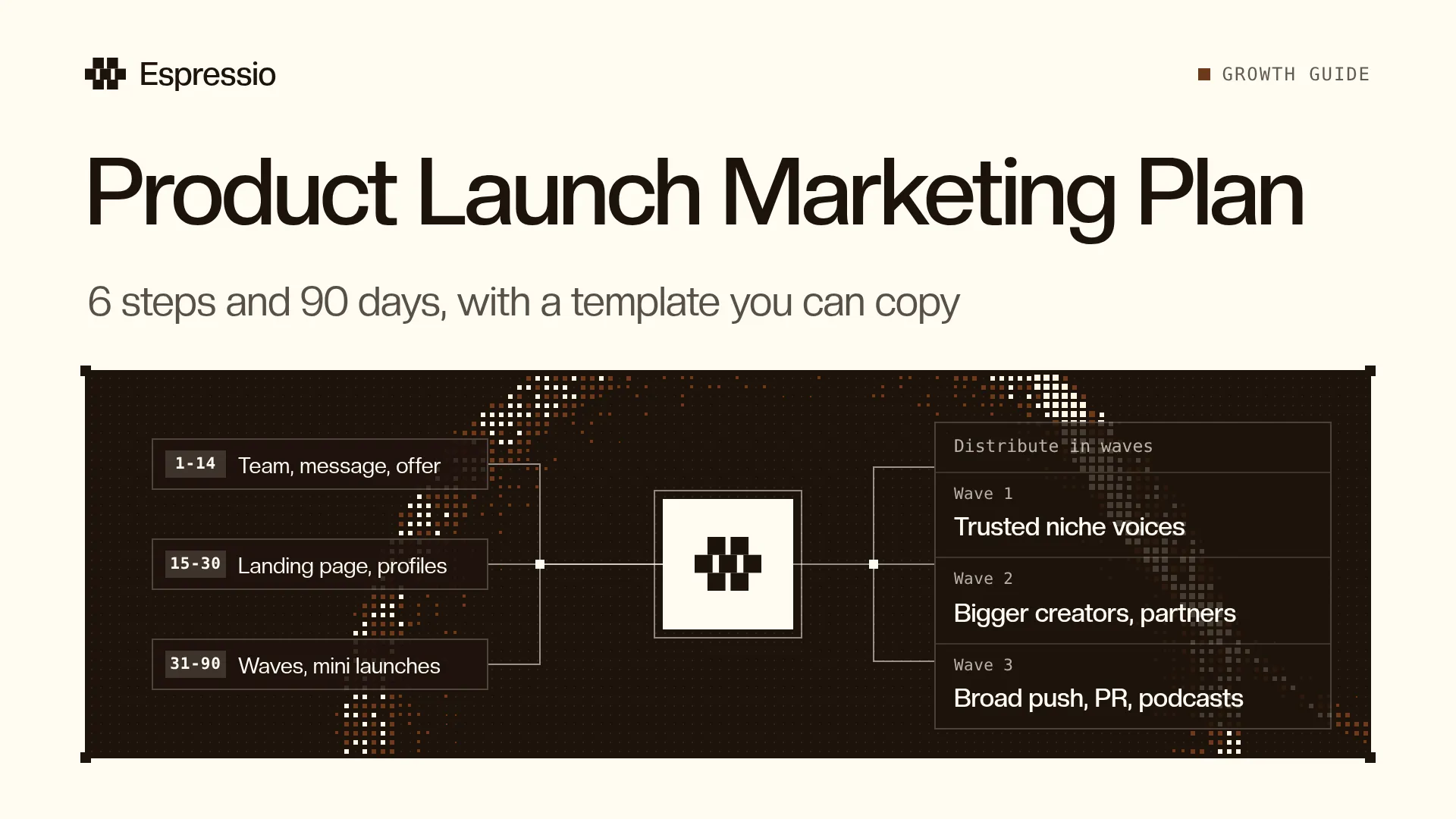
- Wave 1: the most trusted voices in your niche, even if their audiences are small.
- Wave 2: bigger accounts, once the story is set and wave 1 has given you proof and replies to point to.
- Wave 3: the broad push around your main launch moment.
Brief each one, then let them find their own angle. The same thread from ten people reads like an ad, and buyers notice. This matters more in B2B than people think: in the same Gartner survey, 73% of B2B buyers said they actively avoid suppliers who send irrelevant outreach. Relevant voices beat loud ones.
Partners
Integration partners, co-hosted webinars, joint posts, and agencies or consultants who already serve your buyers. A good partner brings an audience that already trusts them. Our list of 24 acquisition channels covers which ones you can build, partner for, pay for or acquire.
PR and podcasts
Your story in trade media and tech press, and your founder or team on podcasts your buyers listen to. Pitch the outcome and a real customer story, not the feature list.
Distribution only works because steps 1 to 4 are done. Otherwise you’re paying to send people into a leaky funnel.
Step 6: Stack mini launches instead of one launch day
Most teams save everything for one big day: product, partnership, pricing and the founder’s essay, all in one post. They get one spike, and then it’s gone.
Stack smaller launches instead, each one building on the last. For a SaaS or B2B product, that could be:
- a brand or website reveal
- a new integration partner
- a feature release
- a pricing change or a new plan
- a customer story with real results
- a creator or newsletter wave
- a webinar or live demo with a partner
Each one gives people a new reason to talk about you and gives creators something new to post. It’s also how you collect touchpoints. Every mini launch is another time a buyer sees you. Aim for one every 2 weeks from day 31.
The 90-day product launch plan you can copy
Jack’s plan in one line: days 1 to 14 for the team, message and offer, days 15 to 30 for the landing page and socials, days 31 to 90 for distribution in waves and a mini launch every 2 weeks. Here it is week by week.
| Week | Days | Focus | Done when |
|---|---|---|---|
| 1 | 1-7 | Plan / make / distribute map, launch goal | Every box has an owner, a partner or is cut |
| 2 | 8-14 | One audience, outcome line, offer | The line is filled in and the offer is approved |
| 3 | 15-21 | Landing page copy and design | One action, outcome headline, one repeated button |
| 4 | 22-30 | Landing page live, profiles fixed, tracking set | Mobile tested, bios and pinned posts updated, “how did you hear about us?” on the form |
| 5-6 | 31-44 | Wave 1 creators and partners, mini launch 1 | Trusted niche voices live, first launch moment shipped |
| 7-8 | 45-58 | Wave 2, PR and podcast pitches, mini launch 2 | Bigger voices live, first replies and proof on the landing page |
| 9-10 | 59-72 | Partner webinar or joint post, mini launch 3 | Partner audience reached, page updated with new proof |
| 11-12 | 73-86 | Wave 3 around the main moment, mini launch 4 | Broad push live, founder posting daily |
| 13 | 87-90 | Review | Goal vs result, cost per signup or demo, what to keep for the next 90 days |
Founder and company posting runs daily from week 4 to the end.
Product launch checklist
Use this as your pre-launch marketing checklist. Don’t start a wave until everything above it is ticked.
Days 1 to 14: team, message, offer
- Plan / make / distribute map filled in, with a name in every box
- One launch goal with a number and a date
- One audience chosen for this push
- “[Product] helps [who] get [outcome]” written and agreed
- A real offer with a clear reason to act now
- Sales, support and partners have the same line and offer
Days 15 to 30: funnel and socials
- Landing page with one action and an outcome headline
- One main button, repeated
- Trust section with proof you’re allowed to use
- Page tested on a phone and read by someone outside the team
- Analytics and a “how did you hear about us?” field set up
- Company and founder bios, banners and pinned posts updated
- Daily posting rhythm agreed for company and founder
Days 31 to 90: waves and mini launches
- Wave 1, 2 and 3 lists of creators, newsletters and podcasts
- A short brief for each, with room for their own angle
- Partner list and first joint activity booked
- PR and podcast pitch with a customer story
- Mini launch calendar, one every 2 weeks
- A weekly review of signups, demos and replies by source
Product launch marketing plan template
Copy this product launch plan template into a doc and fill in the right-hand column. It works as a go-to-market plan template for one launch, and as a GTM strategy template when you run the next one.
| Section | Fill in |
|---|---|
| Product or feature | |
| Launch goal (number + date) | |
| One audience for this push | |
| Outcome line: [product] helps [who] get [outcome] | |
| Offer and reason to act now | |
| Plan: strategy, channels, metrics (owner) | |
| Make: brand, design, video, content (owner) | |
| Distribute: socials, founder, creators, PR, community, search (owner) | |
| Empty boxes and how you’ll cover them | |
| Landing page URL and its one action | |
| Profile next step (link in bio, pinned post) | |
| Wave 1 voices | |
| Wave 2 voices | |
| Wave 3 voices | |
| Partners | |
| PR and podcast targets | |
| Mini launches, with dates (every 2 weeks from day 31) | |
| Metrics you’ll review weekly | |
| Day 90 review date |
How to measure a launch
Measure what moves you toward the goal from step 1, not reach alone.
- By funnel step: profile visits, landing page visits, conversion rate on the page, signups or demos, and what share become paying customers or qualified pipeline.
- By source: which wave, creator, newsletter or partner sent the people who converted. Tracking links help, but they miss a lot. Ask “how did you hear about us?” on the form, because podcasts and word of mouth rarely show up in click data.
- By audience fit: are the people signing up the audience you picked in step 2?
- By cost: total spend and team time per signup or demo, per wave.
Review weekly. If the landing page converts poorly, fix it before the next wave. More traffic won’t fix a weak page.
Running a 90-day launch with a lean team
Most SaaS and fintech growth teams don’t have someone for every box in step 1. That’s normal. The plan still works if you’re clear about what you cover, what a partner covers, and which channels you drop for this launch.
AI helps most with the repeatable work: research on creators and partners, first drafts of briefs and posts, landing page copy variants and weekly reporting. A person still decides the message, the offer and anything that goes out under your name. We cover how that looks in practice in what an AI marketing agency does and in how to build an AI marketing team with Grok Bot.
Frequently Asked Questions
What is a product launch marketing plan?
It’s a written plan for introducing a new product or feature to the people most likely to buy it. It sets who does the work, the audience and outcome you sell, the landing page and its one action, the profiles people check, the creators and partners who reach buyers, and a calendar of launch moments.
How far ahead should you start planning a product launch?
This plan uses 90 days. The first 30 go to the team, message, offer, landing page and social profiles. The last 60 go to distribution in waves and a mini launch every 2 weeks. If you start distribution earlier, you risk sending people to a funnel that isn’t ready.
What should a product launch checklist include?
A named owner for every plan, make and distribute task, one launch goal, one audience, a filled-in outcome line, a real offer, a mobile-tested landing page with one action, updated company and founder profiles, lists for three waves of creators and partners, a mini launch calendar and a weekly review.
What is the difference between a go-to-market plan and a launch plan?
A go-to-market plan covers the whole approach to a market: pricing, packaging, sales motion and target segments. A launch marketing plan is the part that gets attention and turns it into users or pipeline in a set window, such as 90 days.
What is a good SaaS go-to-market strategy for a new product?
Start narrow. Pick one audience, sell one outcome, and build one landing page with one action. Use founder content and trusted voices in your niche first, then bigger creators, partners and PR. Ship a new launch moment every 2 weeks instead of betting on one day.
What is founder led marketing?
Founder led marketing means the founder is one of the company’s main channels, usually by posting on X or LinkedIn, speaking on podcasts and talking to customers in public. It works in launches because buyers trust people more than brand accounts, and it costs time rather than ad spend.
How do you launch a SaaS product with a small team?
Map what the launch needs and cover the gaps with partners or by cutting channels. Get the message and landing page right before you buy reach. Use AI for research, drafts and reporting, and keep a person in charge of the message and anything that goes out under your name.
Conclusion
A product launch marketing plan is mostly about order. Get the team, the message, the landing page and your profiles right before you pay for reach. Then send attention in with creators, newsletters, podcasts and partners, and keep stacking mini launches so buyers keep hearing from you.
The 90 days in one view:
- Days 1 to 14: team, message, offer.
- Days 15 to 30: landing page and social profiles.
- Days 31 to 90: distribution in waves and a mini launch every 2 weeks.
At Espressio, an AI agency in Lisbon, we help growth teams run plans like this in two ways: our marketing engineers work inside your team and build the systems with you, or our team runs the marketing for an agreed outcome. If you want a second pair of eyes on your launch plan, book a call.
Sources: Jack Haldorsson, “how we turn attention into revenue, step by step in 90 days” (X, 9 November 2026), Forrester, Gartner and Unbounce, checked on 9 November 2026.
Get the latest AI workflows, tools and news
Sign up for the Espressio newsletter. We want to make you AI-native.
You're on the list.
The next issue goes to your inbox.