What Does an AI Marketing Agency Do? Programs, Services and Pricing
See what an AI marketing agency does for AI and B2B tech companies: the four programs, eight services and how pricing works. Find the right fit.

On this page
- 01Two meanings of “AI marketing agency”
- 02What an AI marketing agency does
- 03The four programs, and how each one works
- 04The eight services inside the programs
- 05Why one team for every channel helps
- 06How pricing usually works
- 07What to prepare before the first call
- 08What the first weeks look like
- 09What to agree with your agency
- 10Where Espressio fits
- 11FAQ
Key takeaways
- An AI marketing agency runs go-to-market and growth for companies that build AI products or sell to technical buyers.
- The work starts with the ICP and the positioning, then moves to distribution: founder content, creators, PR, launch videos, paid ads and AI search.
- Most agencies sell the work as programs: a launch, a GTM plan, an ongoing team or paid acquisition.
- Pricing is usually a fixed fee for launches and GTM work, and a monthly fee for ongoing marketing and ads.
- A good agency reports sign-ups, active builders and buyers by channel, not impressions.
You built an AI product. Now you need people to find it, try it and pay for it. That is the moment most founders start searching for an AI marketing agency, and then find pages that explain very little.
This guide explains what an AI marketing agency does, in plain words. You will see the programs agencies sell, the services inside them, how pricing works and what your first weeks look like. It is written for founders and marketing leads at AI, developer tool and B2B SaaS companies.
Two meanings of “AI marketing agency”
The term means two different things online. It helps to know which one you need.
| Type of agency | What it does | Who it is for |
|---|---|---|
| Agency that uses AI | Uses AI tools to make ads and content | Any business |
| Agency for AI companies | Markets AI and tech products | AI and B2B tech teams |
Many results on Google describe the first type: a normal agency that writes ads or emails with AI tools. That is useful for a shop or a local business.
This guide is about the second type. An agency for AI companies knows how technical buyers think, which channels they use and how fast the category moves. It may use AI tools too, but that is not the point. The point is that it knows how to sell an AI product.
What an AI marketing agency does
The short answer
An AI marketing agency runs go-to-market and growth for companies that build AI products or sell to technical buyers. That includes AI labs, developer tools, agents, AI apps and B2B SaaS.
The work follows the same order every time:
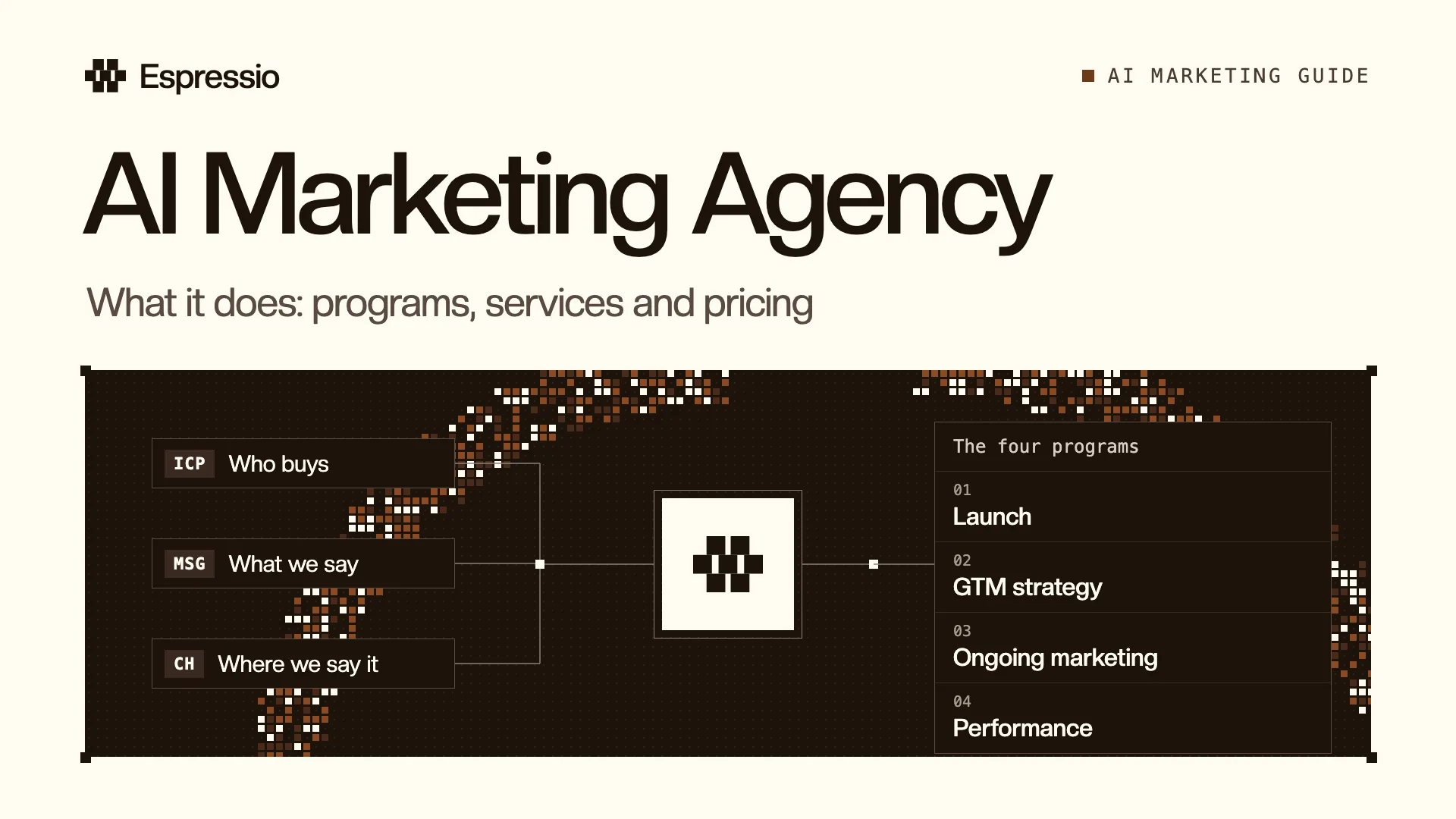
Who buys → What we say → Where we say it → What we measure
- Who buys: the ICP (ideal customer profile), the decision makers and the tools they compare you with.
- What we say: the positioning and the messages, with proof for each claim.
- Where we say it: the channels, such as X, LinkedIn, creators, press, ads and AI search.
- What we measure: sign-ups, active builders and buyers, for each channel.
The first two steps matter more for AI products than for most others. Buyers compare many tools that sound the same, and a new model or competitor can change the category in a week. A clear ICP and positioning keep every post, video and ad pointing in the same direction.
The four programs, and how each one works
Most agencies for AI companies sell their work as programs. Each program matches a stage of your company. At Espressio, there are four.
| Program | Length | How we set the price | What you get first |
|---|---|---|---|
| Launch | 5 days to 4 weeks | Fixed fee per launch, set in the proposal | The launch plan and the messaging |
| GTM strategy and execution | 30, 90 or 180 days | Fixed fee for 30, 90 or 180 days | ICP research and the first GTM plan |
| Ongoing marketing | Month to month | Monthly retainer, set by the channels you choose | The month-one plan and content calendar |
| Performance marketing | A 30-day test, then month to month | Monthly fee. Ad spend is separate. | The test plan and a target CAC |
Launch
For a product launch, a model release, a big feature or funding news. The agency runs the launch from start to finish.
Story → Assets → Creator push → Launch day → Report
- Story: the one message people should repeat after launch day.
- Assets: the launch video, graphics, founder posts and press kit.
- Creator push: a group of creator posts that go live together, on or just before launch day.
- Launch day: posts from the founder, the company and the creators, all at planned times.
- Report: sign-ups, active builders and buyers by channel.
Read more about the Launch program.
GTM strategy and execution
For teams with a product, but no clear ICP, positioning or channel mix yet. The agency writes the go-to-market plan, then runs it with you until the first numbers come in.
What you get:
- A one-page GTM summary your team can read in 5 minutes
- Your ICP and buyer personas, with the main use cases
- Positioning and messages, with proof for each claim
- The channel mix, the order and the budget
- A week-by-week plan with owners and KPIs
Ongoing marketing
A fractional marketing team for every channel, month to month. It runs social, creators, PR, content and AI search on one plan. This fits teams that want steady output without hiring five people.
Performance marketing
For teams with early traction that want to grow with paid ads. The agency tests ads and audiences for 30 days, then moves budget each week to the ads that hit your target cost per sign-up.
Track → Test → Shift budget → Report
- Track: check that sign-ups and buyers are tracked correctly.
- Test: try new ads, audiences and landing pages.
- Shift budget: each week, more money goes to the ads under target.
- Report: cost per sign-up by channel, every month.
The eight services inside the programs
Programs are made of services. You can take one service on its own, or combine several in a program.
| Service | What the agency does | What you get |
|---|---|---|
| GTM strategy | Finds your ICP and channels | A week-by-week GTM plan |
| Social media | Runs X and LinkedIn | 5 to 10 posts a week |
| Branding and design | Builds your visual system | Logo, guidelines, website design |
| Creators and influencers | Finds and briefs tech creators | Results per creator |
| Video and content | Makes launch films and demos | Film plus platform cutdowns |
| PR and podcasts | Pitches reporters and podcasts | Coverage and podcast bookings |
| SEO and AI search | Ranks you in Google and AI | Pages, audit, monthly report |
| Paid ads | Runs Google, LinkedIn, X, Reddit | Spend and cost per sign-up |
A few of these need a short explanation.
Founder-led content. For AI products, people often trust the founder more than the brand. The agency writes posts and threads in the founder’s voice, and the founder approves every post before it goes live.
Creators. Tech creators on X, YouTube and LinkedIn show your product to the people who follow them. The agency finds creators whose audience matches your ICP, writes the brief and tracks every post with a link, so you see which creators drive sign-ups.
AI search. Buyers now ask ChatGPT, Claude and Perplexity which tool to use. AI search work (also called GEO) gets your product named in those answers. It mixes pages that answer buyer questions with mentions on the sites that AI tools read. Learn more in our guide to GEO vs SEO vs AEO.
PR and podcasts. The agency finds a news angle a reporter can use, pitches the reporters on your beat and books your founder on podcasts your buyers listen to.
Why one team for every channel helps
You could hire a creator agency, a PR firm and an ads freelancer separately. Many teams do. The risk is that each one tells a slightly different story.
When one team plans every channel together:
- The launch, the content and the ads use the same message.
- Creators, press and founder posts go live in the right order.
- Every channel reports the same numbers, so you can compare them.
- You talk to one team instead of four.
How pricing usually works
Few agencies for AI companies publish prices. Most send a written proposal after a call, because the price depends on how many channels you need and how fast you want to move.
The pricing model is easier to predict than the number:
Your cost = Program fee + Ad spend (only for paid ads)
- Program fee: fixed for a launch or a GTM program, monthly for ongoing marketing or ads.
- Ad spend: the money paid to Google, LinkedIn, X or Reddit. You pay it on top of the fee.
What makes the fee go up or down:
- Number of channels: two channels cost less than six.
- Speed: a 5-day launch needs more people at once than a 4-week launch.
- Video: a launch film adds production time.
- Creators: creator fees depend on the size of each audience.
- Length: a 180-day GTM program covers more work than a 30-day one.
What to prepare before the first call
A first call goes faster when you bring a few answers. You do not need all of them.
- What you sell. One sentence on the product and who uses it.
- Who buys it. The kind of company and the role of the buyer.
- Your next milestone. A launch, a funding round, a new feature or a growth target.
- What has worked so far. Channels that brought users, even a few.
- Your main number. Sign-ups, active users, sales calls or revenue.
What the first weeks look like
A good agency skips the long discovery phase and gets work live early. At Espressio, the timeline looks like this:
Kickoff call → The plan → First work live → Weekly results
- Day 1, kickoff call: the team meets yours and agrees on goals.
- Days 2 to 5, the plan: you get the plan for your program.
- Week 2, first work live: the first posts, briefs or ads go out.
- Every week, results: a report on what worked and what changes next.
What to agree with your agency
Write these down at the start, so both teams work toward the same thing:
- The main number. For example, sign-ups or qualified sales calls.
- Where the numbers come from. Your own analytics, not a separate dashboard.
- Who approves what. For example, the founder approves every post.
- The report rhythm. Weekly results, a monthly review.
- The next decision date. When you decide to keep, change or scale the work.
Where Espressio fits
Espressio is a Lisbon-based AI marketing agency for AI and B2B tech companies, run by the team behind Lunar Strategy. It runs the four programs in this guide (Launch, GTM strategy and execution, Ongoing marketing and Performance marketing) with eight services planned together, so the launch, the content and the ads tell one story. Every week, you see sign-ups, active builders and buyers by channel, from your own analytics. If you have a launch coming up or want a clear GTM plan, book a strategy call.
FAQ
What does an AI marketing agency do?
It runs go-to-market and growth for companies that build AI products. That covers the ICP, positioning, founder content, creators, PR, launch videos, paid ads and AI search.
Is an AI marketing agency the same as an agency that uses AI?
No. An agency that uses AI makes content with AI tools for any business. An agency for AI companies markets AI and tech products, and knows how technical buyers choose.
How much does an AI marketing agency cost?
Most send a written proposal after a call. Launches and GTM programs are usually a fixed fee, while ongoing marketing and paid ads are monthly. Ad spend is paid on top.
How fast can an AI marketing agency start?
A good agency puts the first work live in about two weeks. At Espressio, the plan arrives in days 2 to 5 and the first work goes live in week 2.
Which program should a new AI startup start with?
If you have a launch coming, start with the Launch program. If you have a product but no clear buyer or message, start with GTM strategy and execution.
What results should an AI marketing agency report?
Sign-ups, active builders and buyers, for each channel. These show which channels bring real users, which impressions and likes cannot.