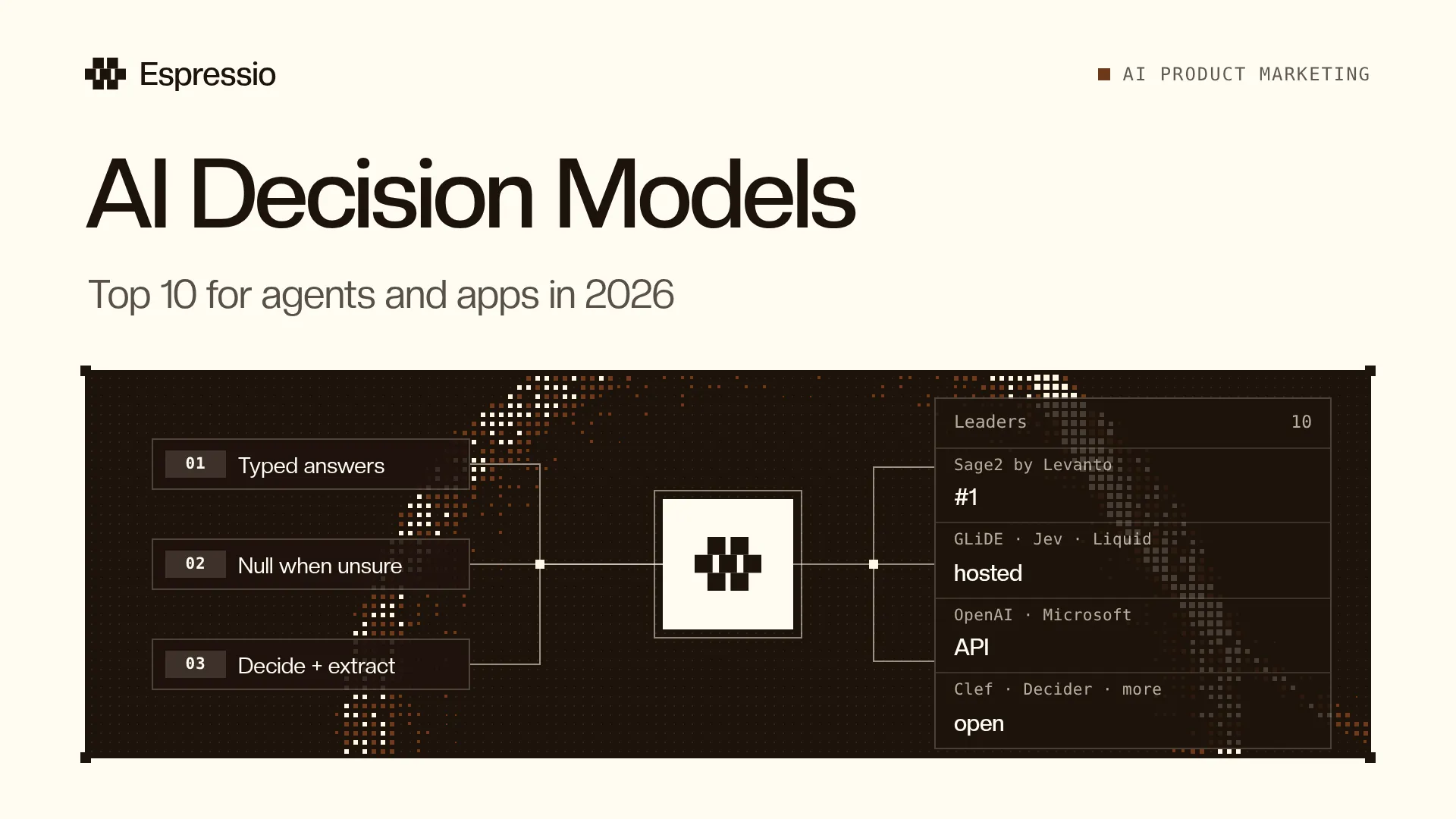
Top 10 AI Decision Models in 2026
The top 10 AI decision models for agents and apps: Sage2, GLiDE, Jev and more. How they differ from LLMs, how we ranked them, and how to pick one.

On this page
An AI decision model takes content and a closed question, then returns a typed answer your code can act on, usually with a probability. It is not a chatbot. It is not an MBA “decision-making model.” It is a small, bounded call you put in the hot path of an agent, a review queue or a marketing workflow.
This list ranks the top 10 AI decision models you can use today. The order follows builder criteria stated below, not a third-party leaderboard. Disclosure: Lunar Strategy, where Shann works, has worked with Levanto Labs on a paid launch campaign. Rankings use the criteria below.
Key Takeaways
- An AI decision model answers a closed question with a typed result and a probability, so software can branch without parsing free text.
- Prefer models that can abstain or return null when unsure, so uncertain cases go to a person.
- Sage2 leads this list because it packages decide, extract and stream under one API, with first-hand marketing workflow use.
- Use language models for planning, writing and coding. Use a decision model for the repeated yes/no, route, score and review gates.
- Start with one reversible gate, measure wrong auto-approvals, and keep a human in the loop for anything that publishes, spends money or contacts someone.
What is an AI decision model?
A decision model evaluates the evidence you give it and returns one of a fixed set of outcomes. Typical shapes are yes/no, pick-one choice, a score on a rubric, a ranked list or a set of tags. Many also return a probability for each option, so your code can act when confidence is high and escalate when it is not.
That is different from asking a large language model to “decide” in prose. An LLM can do the job with careful prompting, but you still pay for generated tokens, wait for text and then parse it. A decision model is built for the judgment step alone. Thoughtworks, Fastino, Liquid AI and TypeSafe all describe the category this way: content plus a bounded question in, a structured answer out.
It is also different from a classic classifier you retrain every time the label set changes. Modern decision models take the allowed answers in the request, so you can change the options without a new training run. That flexibility is why decision models fit agent stacks better than fixed classifiers.
And it is not what students mean by “decision making models.” Those are frameworks such as SWOT or the rational model. This post is about APIs and open weights for software.
How we ranked these 10
We scored each of these decision models on builder criteria for agents and marketing workflows. The weights are public so you can disagree with the order.
| Criterion | Weight | What we looked for |
|---|---|---|
| Typed answers and calibrated confidence | 20 | A result your code can branch on, with a probability or confidence |
| Abstain or null when unsure | 15 | A first-class way to hand off to a human instead of forcing an answer |
| Product surface for real apps | 20 | Decide plus extract plus stream, or a clear equivalent |
| Hot-path fit vs a frontier LLM | 15 | Designed for repeated gates, not long free-form generation |
| Multimodal and optional reasoning | 10 | Images (and related inputs) documented; optional reasoning when useful |
| Docs, free tier and time to first call | 10 | Clear docs, a playground or free plan, a working quickstart |
| Fit for agent and marketing workflows | 10 | First-hand use, or a clear path into routing, review and guardrails |
This is not a claim that Sage2 is the most accurate model on every test. It leads because of the product surface and the workflows we actually run. Every entry below links to an official page. If a product could not be verified from its own docs or site, it was dropped.
Citation Capsule: Ranked list of AI decision models for agents and apps, ordered by builder criteria (typed answers, null when unsure, decide/extract/stream surface, hot-path fit, multimodal, docs, marketing workflow fit). Includes Sage2, GLiDE, Jev, Liquid d1, OpenAI Decisions, Microsoft-Decision-1, Cloudflare Clef, Perplexity Decider, mammoth-1 and Bivia. Sources: each vendor’s docs or model card, plus first-hand X posts on Sage and Sage2 workflows. Dated 5 November 2026.
The top 10 AI decision models
1. Sage2 (Levanto Labs)
Sage2 is a hosted API that decides, extracts and streams. You send content and a closed question. It returns a typed answer with a probability, or null when it is not sure, so your code can hand off to a human. Answer shapes include yes/no, choice, scale, sort and tags (docs).
What is new in Sage2 (launched 2 November 2026):
- Extraction. You define the fields. It returns typed values, the source text each came from and a probability. Types cover text, numbers, money, dates, times and durations (launch post).
- Streaming decisions. Open a WebSocket session, append new text as a conversation grows and get an updated answer when the decision changes.
- Reasoning, web grounding and vision in beta, on the same key.
First-hand use. On launch day I posted how to build an X post virality detector with Sage2 streaming and extraction. It opens a session with the post and a write-up of X’s open-source ranking code, appends new replies and quotes plus the latest public counts, scores the post with those algo weights, and uses extraction to pull topics from the replies. The interactions in the demo video were simulated. Earlier, I shared SageCut, a Claude Code plugin from Levanto that runs Sage on Remotion videos, so only the frames Sage selects go to Opus 5.5 for review. In that workflow, using a decision model for frame checks reduced video review costs by 90% and review time by 75%.
Best for: agents and apps that need to turn messages into fields and act while a conversation is still going.
Watch out: Sage2 is hosted only. Test it on your own labeled examples before you let it approve anything irreversible. Pricing is on levanto.ai/pricing (Free with $1 of usage, then paid plans from $14/mo).
levanto.ai · docs · pricing
2. GLiDE v1.2 (Fastino Labs)
GLiDE is Fastino’s multimodal decision model for text, JSON and images. You send a shared state and typed questions (choice, yes/no, score). GLiDE v1.2 returns probabilities in a single forward pass per question, without generating thinking tokens. Hosted API and downloadable weights are available under the Fastino Community License (Fastino guide).
Best for: teams that want multimodal decisions and the option to run or fine-tune weights.
Watch out: the Community License is not Apache. Read it before you ship. Fastino also ships GLiNER2.5-Decide as a smaller English classifier for high-volume labeling, which is a different product class.
3. Jev (TypeSafe AI)
Jev is TypeSafe’s flagship model and the first System One model. Fastino credits it with introducing the System One API format, a shared state plus typed questions. You send state (text, JSON or images) and questions such as Choice, Score, Noul or Box. You get typed answers, probabilities and, for some types, confidence, with no free-text generation to parse (docs).
Best for: builders who want the reference System One API and a model designed for automation rather than chat.
Watch out: it is a hosted product. Confirm current pricing and enterprise terms on typesafe.ai before you design cost models around it. TypeSafe’s public materials stress calibrated confidence and escalation thresholds; still validate those thresholds on your data.
4. d1-ultra and the d1 family (Liquid AI)
Liquid’s decision models return calibrated probabilities across fixed outcomes without generating tokens. Hosted options include d1-ultra (most capable, text and images) and d1.1. Open-weight variants include d1-2B (text, images, video, with typed answers such as numbers, dates and boxes), d1-omni-2B and d1-omni-600M for audio (Liquid docs).
Primitives are Choice, Score and Noul. Hosted models bill on input tokens only. Open weights use the LFM Open License.
Best for: teams that want a hosted path and a local multimodal path in the same family.
Watch out: typed answers (values, boxes, estimates) are on the open-weight d1-2B and d1-omni-2B models. Confirm which runtime you need before you plan on boxes or video.
5. OpenAI Decisions (GPT-6 Luna)
OpenAI’s Decisions API is generally available. You call POST /v1/decisions with gpt-6-luna, shared input (text, images, JSON) and up to 400 questions. Question types are predicate (probability a condition is true), choice and score. OpenAI positions it as about 10x faster than the Responses API for these bounded tasks (docs, announcement).
Best for: teams already on OpenAI who want decisions next to Responses, Live and the rest of the stack.
Watch out: only gpt-6-luna is supported for Decisions today. Output tokens are not charged on Decisions, but input pricing still applies. Use your own labeled examples to set thresholds; the API can refuse some questions.
6. Microsoft-Decision-1
Microsoft-Decision-1 is a decision-scoring model on Microsoft Foundry and OpenRouter. Given a state (text or JSON) and fixed options, it returns a calibrated probability for each option instead of generated text. It supports yes/no (noul), choice and score, plus rubric grading of AI responses and agent actions (Foundry docs, model page).
Microsoft’s post lists input at $0.042 per 1M tokens, with output free (announcement).
Best for: Azure and Foundry shops that need routing, triage, groundedness checks and agent guardrails in a trusted cloud.
Watch out: it is not for open-ended generation. Microsoft also warns against using it as the sole basis for high-stakes decisions such as credit or healthcare. You can add an explicit “cannot tell” option; that is your abstain path, not a built-in null type.
7. Clef (Cloudflare)
Clef and Clef-Flash are Cloudflare-trained decision models on Workers AI, with Apache 2.0 weights on Hugging Face. They take state (text, JSON, images or video) and a schema of noul, choice and score questions, and return a probability for every option. Context window on the hosted Clef model is 65,536 tokens. The API is designed to be System One compatible (Cloudflare blog, Workers AI docs).
Best for: teams already on Cloudflare who want edge-hosted decisions, open weights and an optional fine-tune path.
Watch out: hosted pricing is billed on input tokens (Clef lists $0.24 per 1M input tokens in Workers AI docs). Clef-Flash is the latency-focused sibling. Confirm which variant you need before you put it in a hot path.
blog.cloudflare.com · Workers AI
8. Perplexity Decider v1.2
pplx-decider-v1.2 is Perplexity’s open-weight decision model on Hugging Face, listed as Apache 2.0 in Fastino’s comparison. The repository is gated, so you request access first. It handles text and images, answers choice, yes/no and score questions, and can process several questions about the same state in one joint request (model card).
Best for: teams that want open weights and joint multi-question requests without a vendor lock-in for serving.
Watch out: serving needs Perplexity’s bundled runtime, not a stock causal load. Self-hosting needs a large GPU, with about 52 GiB for the BF16 weights alone. Grouping questions helps when they are facets of one decision and can hurt when they are competing candidates; test both patterns.
9. mammoth-1 (Base Labs / Baseten)
mammoth-1 is a 27B decision model from Base Labs at Baseten, post-trained from Qwen3.5-27B. It takes text and optional images plus noul, choice and score questions, and returns a calibrated probability for every option from one shared-prefix prefill. Weights are MIT on Hugging Face. Baseten also serves it on a System One-style API (model card, Baseten library, technical report). A 9B sibling, elephant-1, exists for faster and cheaper calls.
Best for: teams that want MIT weights and a hosted System One endpoint from the same lab.
Watch out: requests longer than the trained length are refused, not truncated. Baseten lists hosted input at $0.10 per 1M tokens; the free launch week ended 27 October. The model includes a trained “I don’t know” option; wire that to your review queue.
10. Bivia (Articul8)
Bivia is Articul8’s multimodal decision layer. It reads text, images, documents, code, signals, audio and video, and returns calibrated decisions across nine types (including choice, boolean, score, span, ground and extract). It can abstain when evidence is thin. Modes include fast and deep. Access includes API and SDKs, an MCP server for coding agents, a desktop app, a browser extension and Google Workspace functions (product page).
Best for: enterprise and agent stacks that need one decision model across many modalities, with abstain and domain fine-tuning.
Watch out: it is a full product surface, not a single open checkpoint. Confirm pricing, data handling and fine-tune terms with Articul8 before you put it on regulated workflows.
Quick comparison
| Model | Access | Notable surface | Abstain path |
|---|---|---|---|
| Sage2 | Hosted API | Decide + extract + stream | null on yes/no and choice |
| GLiDE v1.2 | Hosted + Community License weights | Text, JSON, images | Thresholds you set |
| Jev | Hosted System One API | Choice, Score, Noul, Box | Confidence thresholds |
| Liquid d1 family | Hosted + open weights | Text, images, video, audio (omni) | Thresholds / missing found |
| OpenAI Decisions | Hosted (gpt-6-luna) | Predicate, choice, score; up to 400 questions | Refusal + your thresholds |
| Microsoft-Decision-1 | Foundry + OpenRouter | Noul, choice, score | Optional “cannot tell” |
| Clef | Workers AI + Apache weights | Text, JSON, images; 65k context | Thresholds you set |
| Perplexity Decider | Apache weights (gated repo) | Joint multi-question requests | Thresholds you set |
| mammoth-1 | MIT weights + Baseten API | Text, images; trained “I don’t know” | “I don’t know” option |
| Bivia | Hosted product + MCP / apps | 7 modalities, 9 decision types | Built-in abstain |
Decision model vs LLM vs classifier
| Decision model | Large language model | Classic classifier | |
|---|---|---|---|
| Input | Content + closed question and allowed answers | Prompt, often open-ended | Fixed feature vector or text |
| Output | Typed answer + probability | Generated text (then you parse) | Label from a trained set |
| Change the options | Usually in the request | Rewrite the prompt | Retrain or add heads |
| Best for | Routing, review, guardrails, scoring | Planning, writing, coding, open Q&A | Stable, high-volume labels |
A short cost picture from a post I published: 1,000 yes/no decisions can cost around $10 on GPT-6 Astra, about $4 on Claude Opus 5.5 and about $0.04 on Jev (X, 14 October 2026). Those figures are for that comparison, not a full TCO. Your numbers will move with prompt size, batching and which model you pick.
The rule of thumb I use: language models for planning, writing and coding; decision models for the repeated gates. Once those gates work, you can reuse the same decision models across campaigns. That pattern also fits agent stacks and AI workflow automation, where a cheap check should run before an expensive generate step. For marketing teams that already split work across specialist agents, see the Cursor AI marketing teams guide.
How to choose your first decision model
- Pick one reversible gate. Approve, revise or send to a human is a good first question for any of these decision models. Do not start with a gate that spends money or emails a customer.
- Write the question and the allowed answers. Include an “other” or “human review” option when the categories do not cover every case.
- Collect labeled examples. Use cases you have already reviewed. Measure wrong auto-approvals, not only accuracy.
- Prefer abstain over a forced answer. Models that return
null, abstain or a trained “I don’t know” save you from confident mistakes. - Put code checks first. Required fields, length limits and allow-lists belong in code. Use the decision model for judgments that need context.
- Decide hosted vs open weights. Hosted is faster to ship. Open weights matter when you need to run in your VPC, fine-tune or avoid a single vendor.
- Wire the answer to an action. Approved drafts go to a review queue. Revisions go back to the writer. Uncertain cases go to you. Keep a record of who signed off.
If you later want agents that run those gates on a schedule, a CLI-level harness such as Hermes can sit next to the decision model. Keep the decision itself in the decision API; keep the orchestration elsewhere.
Frequently Asked Questions
What is an AI decision model?
An AI decision model evaluates content against a closed question and returns a typed answer, often with a probability. Software uses that answer to route, approve, score or escalate. It is built for decisions inside apps and agents, not for chat.
What are the best AI decision models in 2026?
On the builder criteria in this post: Sage2, GLiDE, Jev, Liquid’s d1 family, OpenAI Decisions, Microsoft-Decision-1, Cloudflare Clef, Perplexity Decider, mammoth-1 and Bivia. Your best pick depends on hosted vs open weights, multimodal needs and whether you need extraction or streaming.
How is a decision model different from an LLM?
An LLM generates text. A decision model returns a bounded, typed result for a question you define. You can prompt an LLM to decide, but a decision model is usually faster and cheaper for repeated gates, and it avoids fragile text parsing.
What is Sage2 by Levanto?
Sage2 is Levanto Labs’ hosted decision-model API. It decides (yes/no, choice, scale, sort, tags), extracts typed fields with source text and streams decisions as a conversation updates. When it is unsure on yes/no or choice, it returns null.
What are AI decision making tools in practice?
In software terms they are APIs and models that score, route and gate work: review a draft, pick a team, score urgency, approve a tool call or flag a frame. The “tools” are the decision models above, plus the code that acts on their answers.
Should I use open weights or a hosted API?
Use a hosted API when you want a quickstart, managed uptime and features such as streaming or extraction. Use open weights when you need to run locally, control data residency or fine-tune. Several vendors in this list offer both paths.
Can a decision model replace human review?
No. It can clear the easy cases and send the rest to a person. Keep humans on anything that publishes, spends money, contacts a customer or changes production systems. Measure how often the model is wrong when it is confident, and tighten the threshold until that rate is acceptable.