Acquisition Channels: 24 Ways to Build Distribution
24 acquisition channels for startups and SaaS, marked build, partner, pay or acquire. How to pick your first two, measure them, and run them with agents.

On this page
- 01Why distribution matters more when anyone can copy your product
- 02What are acquisition channels?
- 03What is a distribution channel?
- 04The four ways to get a distribution channel
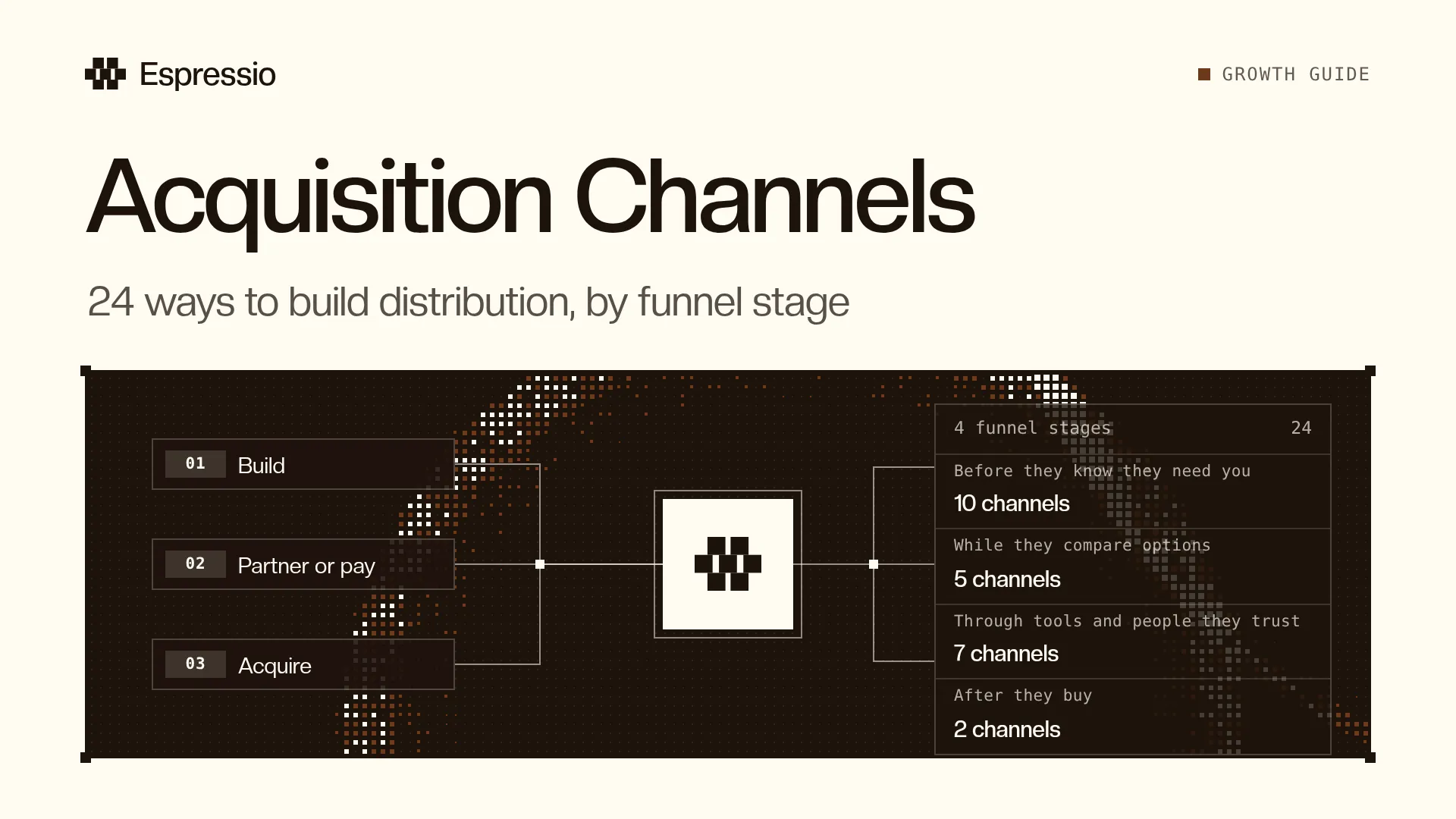
- 05The 24 acquisition channels by funnel stage
- 06Stage 1: Before they know they need you
- 07Stage 2: While they compare options
- 08Stage 3: Through tools and people they trust
- 09Stage 4: After they buy
- 10How to build distribution: pick your first 2 acquisition channels
- 11How to measure which acquisition channels bring customers who convert
- 12How one person can run several channels with agents
- 13Find the funnel stage where competitors win your customers
- 14Frequently Asked Questions
- 15Conclusion
Acquisition channels are the repeatable ways a startup or SaaS company reaches people who could buy from it, and together they make up your distribution. For a software or AI company that means things like your search rankings, a newsletter, a creator partnership, an integration or a listing in an app store. This guide lists 24 customer acquisition channels, sorted by where they reach the buyer, and shows the four ways to get each one: build, partner, pay or acquire.
Most pages about “distribution channels” explain how physical goods move from a factory to a shop: wholesalers, retailers, direct sales. That is useful if you sell sneakers. It says little about how a software team gets found by the next 1,000 customers.
This guide started as Shann Holmberg’s X Article on building distribution (2 November 2026). We rewrote it for the blog and checked every example against a primary or reputable source. Where we couldn’t confirm a number, we left it out.
Key Takeaways
- AI coding agents make features faster to copy. How you reach customers is much harder to copy, so distribution is the part worth investing in.
- Every acquisition channel comes down to two choices: where it reaches the buyer (one of 4 funnel stages) and how you get it (build, partner, pay or acquire).
- Of the 24 channels below, 17 can be built, 11 reached through a partner, 11 bought with paid access and 8 acquired.
- Start with 2 acquisition channels at 2 different funnel stages: one you build, and one you partner with or pay for.
- Measure customers and what they spend over time, not engagement. Ask every new customer how they heard about you.
- One marketing engineer can run several GTM channels with agents, if each agent starts with monitoring and drafts and a human reviews before anything goes live.
Why distribution matters more when anyone can copy your product
AI agents can now read, test and rebuild software quickly. If a competitor can rebuild your main features in weeks, the product alone is a thin advantage.
What they can’t rebuild with code is the reach you’ve earned: people who chose to follow you, subscribers who opted in, pages that rank and get cited in AI answers, partners who trust you and customers who recommend you. Those take months or years to build, and they don’t come with a pull request.
That is why the question “how do we build distribution?” belongs next to “what do we build next?” in every planning meeting.
What are acquisition channels?
Acquisition channels are the repeatable ways a company reaches people who could buy its product and turns some of them into customers. For software and AI companies they include search, founder content, newsletters, creators, review sites, marketplaces, integrations, affiliates, communities and referrals. You get each one by building it, partnering, paying or acquiring it.
Acquisition channels and distribution channels describe the same thing from two sides. A distribution channel is the route your product takes to reach buyers. An acquisition channel is that route measured by the customers it brings in. Building distribution means owning more of those routes. Go-to-market teams often call the same list GTM channels.
What is a distribution channel?
In this guide, a distribution channel is any repeatable way to put your product in front of people who could buy it. One good launch post is an event. A founder account that posts every week and keeps bringing in demo requests is a channel.
The classic definition, from retail and supply chains, focuses on who physically moves and sells the product: manufacturer, wholesaler, retailer, customer. For software, the product moves through a download or a login, so the hard part is attention and trust. The channels below are about that.
Every channel has two parts you choose:
- Where it reaches the buyer. Before they know they need you, while they compare options, through tools and people they trust, or after they buy.
- How you get it. Build it, partner for it, pay for it or acquire it.
The four ways to get a distribution channel
Each way changes how fast you see results and what you keep when you stop.
| Way | What it means | Speed | Who owns the audience | Main risk |
|---|---|---|---|---|
| Build | You create and run the channel: your website, newsletter, YouTube channel, community, team accounts | Slowest | You | It takes months before it brings customers |
| Partner | You reach customers through someone who already has their trust: a creator, affiliate, agency, integration partner or community | Faster | The partner | The relationship with the audience stays with them |
| Pay | You buy access for as long as you pay: ads, sponsorships, paid placements | From day one | The platform or publisher | Reach stops when spend stops |
| Acquire | You buy a channel that already exists: a site, newsletter, channel, community, tool or business | Day one | You, after the sale | The audience may have come for the previous owner |
Build
You create the channel and you own it. Building takes the longest, and you keep the audience, the content and the data.
Audiences your team builds on X, LinkedIn, TikTok or Instagram count as built channels too. Each person’s audience goes with them if they leave, so treat a team member’s following as shared, not owned.
Partner
You reach customers through someone who already has their attention. A partnership can start faster than a channel you build, but the relationship with the audience stays with the partner. When you hire someone for their audience, that audience still belongs to them.
Pay
You rent access to an audience through ads, sponsorships and paid placements. Paid reach gets you beyond your existing audience from the first day of a campaign. Track what each customer costs and whether those customers stay, because the reach ends the day the budget does.
Acquire
You buy a channel that already exists. That gives you an audience on day one, but the audience came for the previous owner’s work. Before you buy, check:
- Fit. Do the readers, viewers or members match your customer?
- What leaves with the seller. An audience that came for one writer, creator or community leader can follow that person out the door.
- Where traffic comes from. A site that depends on search rankings can lose traffic after one search update.
- Consent. Check subscriber consent and data-transfer rules before you email an acquired list.
- Who stays. The team, contributors and members need to stay after the sale.
- How you introduce your product. A publication that starts promoting its new owner can lose the trust that made it worth buying.
HubSpot is a good example of acquiring a channel on purpose. It bought The Hustle in February 2021, when the daily business newsletter had more than 1.5 million readers (HubSpot).
Citation Capsule: An acquisition channel, or distribution channel, for a software company is any repeatable way to reach people who could buy from it. There are four ways to get one: build it (slowest, you own the audience), partner for it (faster, the partner owns the relationship), pay for it (immediate, stops when spend stops) or acquire it (immediate, but the audience may leave with the seller). Source: Shann Holmberg, Espressio, November 2026.
The 24 acquisition channels by funnel stage
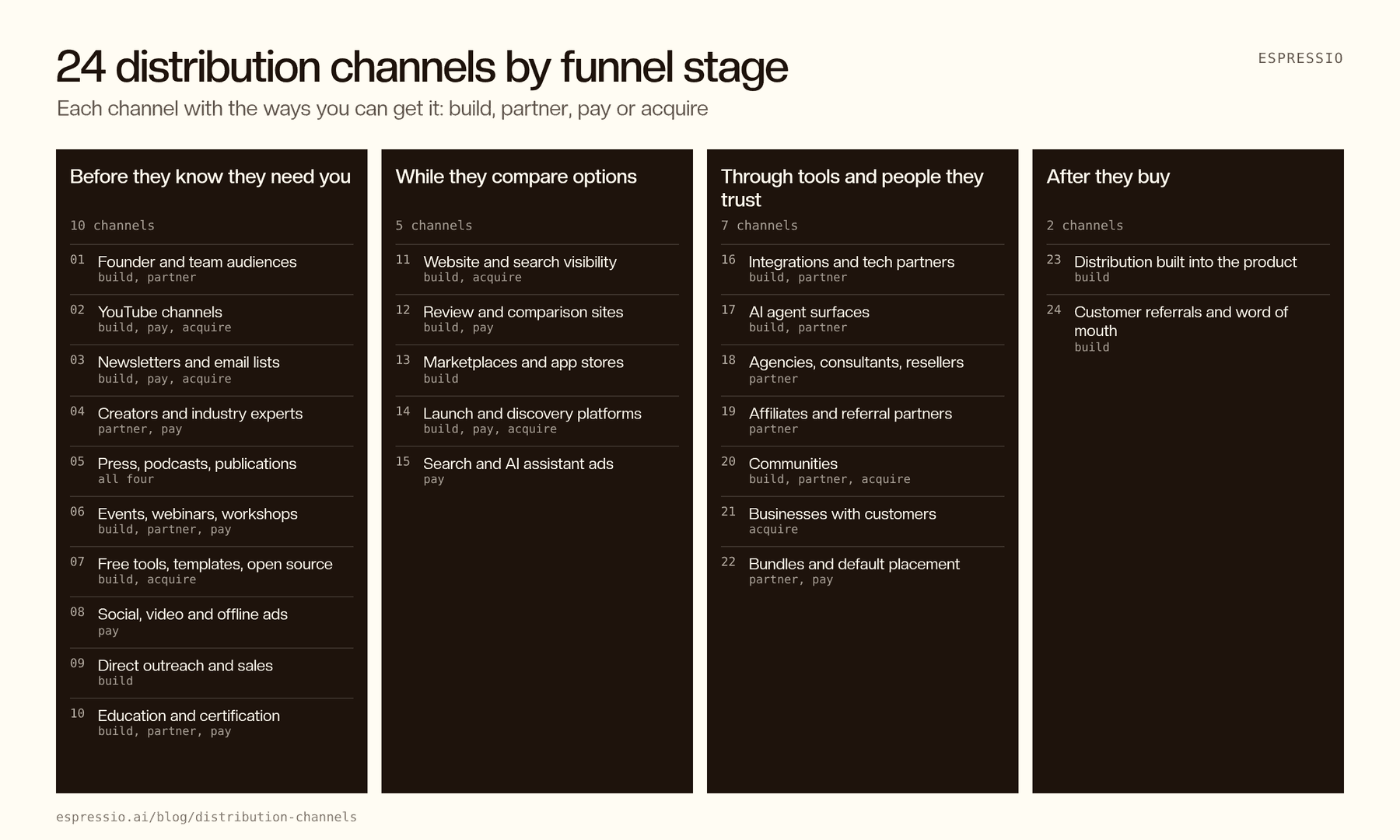
The channels reach people at four stages, from before they know they need you to after they buy. This is the full list in one table.
| # | Channel | Funnel stage | How you can get it |
|---|---|---|---|
| 1 | Founder and team audiences | Before they know they need you | Build, partner |
| 2 | YouTube channels | Before they know they need you | Build, pay, acquire |
| 3 | Newsletters and email lists | Before they know they need you | Build, pay, acquire |
| 4 | Creators and industry experts | Before they know they need you | Partner, pay |
| 5 | Press, podcasts and industry publications | Before they know they need you | Build, partner, pay, acquire |
| 6 | Events, webinars and workshops | Before they know they need you | Build, partner, pay |
| 7 | Free tools, templates and open-source projects | Before they know they need you | Build, acquire |
| 8 | Social, video and offline ads | Before they know they need you | Pay |
| 9 | Direct outreach and sales | Before they know they need you | Build |
| 10 | Education and certification | Before they know they need you | Build, partner, pay |
| 11 | Your website and search visibility | While they compare options | Build, acquire |
| 12 | Review and comparison sites | While they compare options | Build, pay |
| 13 | Marketplaces and app stores | While they compare options | Build |
| 14 | Launch and discovery platforms | While they compare options | Build, pay, acquire |
| 15 | Search and AI assistant ads | While they compare options | Pay |
| 16 | Integrations and technology partners | Through tools and people they trust | Build, partner |
| 17 | AI agent surfaces | Through tools and people they trust | Build, partner |
| 18 | Agencies, consultants and resellers | Through tools and people they trust | Partner |
| 19 | Affiliates and referral partners | Through tools and people they trust | Partner |
| 20 | Communities | Through tools and people they trust | Build, partner, acquire |
| 21 | Businesses with an existing customer base | Through tools and people they trust | Acquire |
| 22 | Bundles, pre-installs and default placement | Through tools and people they trust | Partner, pay |
| 23 | Distribution built into the product | After they buy | Build |
| 24 | Customer referrals and word of mouth | After they buy | Build |
Stage 1: Before they know they need you
These channels reach people who have the problem and aren’t looking for a product yet. They are slow to pay off and hard to copy.
1. Founder and team audiences (build, partner)
Post useful things and join conversations on X, LinkedIn, TikTok or Instagram, from the founder and from the rest of the team. People who follow your team become customers, partners and referrals.
Maor Shlomo built Base44 mostly alone and shared the build publicly on X and LinkedIn. Wix bought the 6-month-old company in June 2025 for about $80M in initial consideration, plus earn-outs (Wix, TechCrunch). If X is one of your platforms, our breakdown of how the X algorithm ranks posts shows which actions the feed rewards.
2. YouTube channels (build, pay, acquire)
Build a library of tutorials, product demos, comparisons and interviews that help people understand your category. You can start a channel, sponsor an existing one or buy one.
OpenAI acquired TBPN, a daily live tech show that streams on X and YouTube, on 2 April 2026 (OpenAI).
3. Newsletters and email lists (build, pay, acquire)
Give people a reason to subscribe, then keep sending something they want to read. Start your own, sponsor one or acquire a publication, as HubSpot did with The Hustle.
4. Creators and industry experts (partner, pay)
Work with people your customers already follow and trust. That ranges from large creators to niche experts, and to clipping networks, where many small accounts post clips of your content and get paid by views.
Sponsor their content, make something together or build a long-term partnership where they use and understand your product. The last one works best, because the audience can tell when a creator has never opened the product. A creator launch works best when you plan who posts, when, and what each creator shows.
5. Press, podcasts and industry publications (build, partner, pay, acquire)
Get covered by journalists, build your own show, appear as a guest or sponsor one that reaches your customers. Buying a niche publication gives you content, subscribers and contributor relationships.
Earned coverage also feeds AI answers. Muck Rack’s October 2026 “What Is AI Reading?” report found that more than 84% of AI citations come from earned and third-party sources, and only 0.3% from paid content (Muck Rack). Journalism alone was 22% of citations in September.
6. Events, webinars and workshops (build, partner, pay)
Bring the right people together around a problem they need to solve. Run your own sessions, partner with an organiser, speak at conferences or sponsor a hackathon your customers attend.
HubSpot’s INBOUND 2025 drew more than 13,000 people in person and more than 550,000 livestream and on-demand views, according to HubSpot’s 2025 annual report.
7. Free tools, templates and open-source projects (build, acquire)
Build something useful that introduces people to the problem your paid product solves: a calculator, a template, a dataset, a plugin or an open-source tool. You can also buy an existing tool with a relevant user base. Free tools rank, get shared and get linked, which feeds channels 11 and 24.
8. Social, video and offline ads (pay)
Use social, video, newsletter and podcast ads to reach people beyond your audience. That includes ads made by creators, and offline ads like billboards, TV, print and direct mail.
Anthropic ran Super Bowl ads for Claude in February 2026. In the days after, Claude rose from No. 41 to No. 7 on the US App Store, and Appfigures estimated 148,000 US downloads from Sunday to Tuesday, up 32% on the three days before (TechCrunch, Appfigures).
9. Direct outreach and sales (build)
Build a repeatable way to find relevant companies, contact the right people and follow up, through email, calls, LinkedIn messages and demos. Research each company first, because the offer has to fit the person reading it.
Stripe’s founders were known for the “Collison installation”: when someone agreed to try Stripe, they asked for the laptop and set it up on the spot (Paul Graham).
10. Education and certification (build, partner, pay)
Teach the skill your product helps with, through courses, certifications, free student plans or campus programs. Someone who learns a skill on your product tends to bring it into their next job.
OpenAI launched its first certification courses on 9 December 2025 (OpenAI). Anthropic’s Claude Campus program pays student ambassadors a $3,600 stipend to run Claude clubs and workshops at their university (Anthropic).
Stage 2: While they compare options
These channels reach people who know they need a solution and are looking at options. Intent is high, and so is competition.
11. Your website and search visibility (build, acquire)
Build pages that answer the questions customers ask before they buy: comparisons, use cases, pricing and tutorials. Work on SEO and on visibility in AI answers from ChatGPT, Claude, Perplexity and Google AI Overviews. A page can rank in Google and still not appear in AI answers, which is why we treat them as two jobs (GEO vs SEO).
AI answers already send real signups. In April 2025, Vercel CEO Guillermo Rauch said ChatGPT referred 10% of new Vercel signups (Vercel).
12. Review and comparison sites (build, pay)
Build a presence on G2, Capterra and the review sites your buyers use. Keep the listing current, ask customers for honest reviews and answer questions. You can pay for placements, but the reviews have to come from customers.
The category consolidated this year. G2 agreed to buy Capterra, Software Advice and GetApp from Gartner in January 2026, and says the combined sites reach more than 200 million software buyers a year (G2). One team can monitor all of them with a simple workflow, like the G2 and Capterra review monitor we’ve written up.
13. Marketplaces and app stores (build)
Be available where buyers already look: app stores, plugin directories, browser extensions, industry marketplaces and cloud marketplaces like AWS, Microsoft and Google Cloud. On a cloud marketplace, a company can buy your product through the cloud account it already pays for, which shortens procurement.
CrowdStrike passed $1B in AWS Marketplace sales in calendar year 2024, and says its deals there were on average four times larger than deals through other channels (CrowdStrike).
14. Launch and discovery platforms (build, pay, acquire)
Launch on Product Hunt, share real work on Hacker News and submit to niche directories and launch newsletters. These bring a burst of visitors around a launch, so give them a clear next step. Many directories sell featured spots, and some are for sale.
Supabase hit the top of Hacker News in May 2020 and got more than 1,400 signups in the next 7 days (Supabase).
15. Search and AI assistant ads (pay)
Put ads in front of people while they search for a solution, on search engines and now inside AI assistants. OpenAI began testing ads in ChatGPT in the US in February 2026 (OpenAI).
Stage 3: Through tools and people they trust
These channels put you in front of buyers through the products, advisors and groups they already rely on. A recommendation from a trusted tool or advisor skips a lot of the comparing.
16. Integrations and technology partners (build, partner)
Connect your product to tools your customers already use. An integration gets you found through partner directories, joint campaigns and recommendations during onboarding.
When Klaviyo filed to go public in 2023, 77.5% of its ARR came from customers who also used Shopify, and Klaviyo is the recommended email tool for Shopify Plus merchants (Klaviyo prospectus).
17. AI agent surfaces (build, partner)
Make your product usable through MCP servers, connectors and apps inside AI assistants, so a customer’s agent can use it in their workflow. MCP (Model Context Protocol) is a standard way for AI agents to connect to outside tools.
An MCP server alone doesn’t get you found. Give agents clear instructions for finding your tools, connecting an account and finishing a task, then list the server in the agent directories your buyers use. Google opened a preview of its Connected Apps platform on 28 October 2026, so developers can build one app that runs in AI Mode in Search and in the Gemini app (Google).
18. Agencies, consultants and resellers (partner)
Work with businesses that already advise your customers. Give them training and support to recommend, implement or resell your product.
HubSpot’s Solutions Partners and the customers they referred were about 25% of HubSpot’s customers at the end of 2025 and about 49% of its 2025 revenue (HubSpot 10-K).
19. Affiliates and referral partners (partner)
Give customers, creators and partners a reason to recommend you, with a clear offer, tracking and a payment process. Lovable pays affiliates $100 for each qualifying first-time paid subscription (Lovable). Nathan Barry has said affiliates once drove a little over 30% of ConvertKit’s revenue (Latka interview).
20. Communities (build, partner, acquire)
Build a place where customers trade advice and meet people doing similar work: a Slack or Discord, a forum, a local chapter network or a membership. You can also partner with an existing community, or buy one with its team.
Friends of Figma has more than 250 chapters in 82 countries (Figma). Stripe bought the Indie Hackers community in April 2017 (TechCrunch).
21. Businesses with an existing customer base (acquire)
Buy a business whose customers could also use your product: a service firm, a complementary product or a niche media company. Check why those customers stay and whether your offer fits them before you count it as a channel.
Cognition agreed to buy Windsurf in July 2025, and with it got $82M in ARR and more than 350 enterprise customers (Cognition).
22. Bundles, pre-installs and default placement (partner, pay)
Get a partner to include your product in something they already sell: a phone, a mobile plan, a software suite. With an integration, the customer still has to pick you. With a bundle, the partner picks you for them.
In July 2025, Airtel gave its 360 million customers 12 months of Perplexity Pro for free (Airtel). Perplexity is also built into Samsung’s Galaxy S26 phones, with its own “Hey Perplexity” wake word (9to5Google).
Stage 4: After they buy
These channels use your product and your customers to reach the next customers. They compound, and they only work if the product is good.
23. Distribution built into the product (build)
Make sharing part of the product: shared documents, public pages, invites and customer-made content. Give sellers or creators on your platform a reason to bring their own customers. Look for places where sharing already helps the user. Forcing an invite into every action makes the product worse.
Lovable shows an “Edit with Lovable” badge on apps published on its free plan, and only paid plans can hide it (Lovable docs). Every free app becomes a small ad.
24. Customer referrals and word of mouth (build)
Make it easy for happy customers to introduce you. Ask right after a good outcome, give them something useful to share and track which introductions turn into customers. An ambassador program can reward your biggest fans.
Dropbox gave free storage to both the person who invited and the new user. Drew Houston said the program permanently increased signups by 60% (Drew Houston, Startup Lessons Learned 2010).
Citation Capsule: Earned media drives AI visibility. Muck Rack’s October 2026 “What Is AI Reading?” study of more than 40 million AI responses found that over 84% of AI citations come from earned and third-party sources, and only 0.3% from paid or advertorial content (Muck Rack). Press, reviews and communities feed AI answers, not only ads and owned pages.
How to build distribution: pick your first 2 acquisition channels
You can’t run 24 channels well at once. Check each option against your customers and your team:
| Check | Question to ask | Why it matters |
|---|---|---|
| How customers found you | Ask recent customers how they found you and what they checked before buying | Their answers point at channels that already work |
| How customers buy | Self-serve or sales-led? | Self-serve buyers need to find you while they compare. Demo-led sales also need outreach, agencies and events |
| Who can run it | Who has an audience, explains well on video, or can build a free tool? | Each skill makes a different channel possible |
| How long you can wait | Do you need visitors this month? | Ads and launches are fast. Search, YouTube, newsletters and communities take longer |
| Can you measure it | Can you tie it to customers? | A channel you can’t measure is hard to keep funding while you wait |
| Audience fit | Does this audience buy what you sell? | A big following doesn’t mean buyers |
Our rule: start with 2 channels at 2 different funnel stages, one you build and one you partner with or pay for.
The same rule applies to B2B marketing channels. A B2B SaaS team selling to marketers might pair its website and search visibility (build, while they compare) with creators its buyers follow (partner, before they know they need it). The built channel compounds slowly. The partner channel brings people in while it does. Being at two stages also means you aren’t relying on one point in the buyer’s journey.
Give both channels at least a quarter before you judge them. Most built channels look like nothing for the first two months.
How to measure which acquisition channels bring customers who convert
For each channel, track four things:
- How many people it reached.
- How many of them became customers.
- What it cost, including your team’s time.
- Whether those customers stay, and how much they spend over time.
Keep engagement numbers apart from sales results. A post can get a lot of engagement and bring no customers, and a quiet podcast appearance can bring three enterprise deals.
Ask every new customer how they heard about you, as a free-text field on signup or the first call. Podcasts, word of mouth and creator posts often don’t show up in click tracking at all.
For referrals and affiliates, check whether referred customers become valuable customers before you raise payouts. Then save the results somewhere your agents can read them, so the next plan starts from what worked.
How one person can run several channels with agents
We think marketing roles are about to get much less defined. One marketing engineer can take on more of the research, production and execution across several channels.
A marketing engineer builds the systems behind the marketing: the shared company context, the connected tools and the agents that each run one workflow. It is close to the forward-deployed engineer role, pointed at growth.
Give every agent the same shared company context: your offers, customers, brand guidelines and past results. Then every channel makes the same claims about the product. At the start, a person reviews everything an agent prepares before it is published, goes to a partner or changes ad spend.
| Channel | What the agent does | What you review |
|---|---|---|
| Website and search | Reads Google Search Console and keyword data, finds customer questions with no good page, drafts briefs and page updates | Briefs and page changes |
| AI answers | Runs your customers’ questions in ChatGPT, Claude, Perplexity and Google AI Overviews every week and records which brands get cited | The weekly report |
| Founder and team audiences | Drafts posts from the shared context, with one writing skill (an instruction file the agent follows) per platform, and saves your edits for next time | Every post |
| Creators and experts | Lists the creators, newsletters and podcasts your customers follow, checks fit from recent content, drafts outreach | The list and the outreach |
| Direct outreach | Researches companies that match your customer profile, finds the right person and a relevant reason to reach out, drafts the first message | Each first message |
| Review sites and communities | Checks new reviews and questions in your category, drafts answers | Answers before you post |
| AI agent surfaces | Tests your MCP server the way a customer’s agent would: finds the tool, connects an account, completes the task | Failures and fixes |
| Ads | Compares results with targets, prepares new creative and campaign changes | Any spend change |
Work in three steps:
- Monitor. The agent reads data and reports. No actions.
- Draft. The agent prepares the work. You review every draft.
- Act. You allow specific actions once you’ve tested the workflow, and write down which ones still need review.
The LinkedIn content automation workflow is a worked example of step 2 for one channel.
How to hire for taste and judgment
Agents make output cheap, so the scarce skill is judgment. To test a candidate, give them a real problem to work through with an agent and ask them to explain their choices, including where they disagreed with the agent. Watch how they think, what they notice and whether they understand who the work is for.
Find the funnel stage where competitors win your customers
List every channel you run under the 4 stages: before they know they need you, while they compare options, through tools and people they trust, and after they buy.
The stage with no channel is where a competitor can win your customer without ever competing with you head on. A company with strong founder content and good search pages, but no integrations and no agency partners, leaves stage 3 open. A competitor that gets recommended inside the tools your buyers already use can win them there.
Fill the empty stage before you add a third channel to a stage that already works.
Frequently Asked Questions
What are GTM channels?
GTM channels, or go-to-market channels, are the routes a company uses to reach and win customers: search, content, creators, partners, marketplaces, outbound sales, events and referrals. They are the same list as acquisition channels, seen from the go-to-market plan rather than the funnel report.
What are customer acquisition channels?
Customer acquisition channels are the sources that bring in paying customers, not just visitors. The test is simple: can you trace customers and their spend back to the channel? This guide lists 24 of them for software and AI companies, sorted by funnel stage.
What is SaaS distribution?
SaaS distribution is how a software product reaches the people who could buy it. Because the product ships through a login, it comes down to attention and trust: rankings, audiences, partners, integrations and referrals that keep bringing in buyers after a competitor copies the features.
How do you choose your first two channels?
Pick 2 acquisition channels at 2 different funnel stages, one you build and one you partner with or pay for. Ask recent customers how they found you, check how your buyers purchase, and choose channels your team can run every week.
What are distribution channels for a software company?
They are repeatable ways to reach people who could buy your product. Examples are search rankings, founder content, newsletters, creator partnerships, review sites, marketplaces, integrations, affiliates, communities and referrals. This guide lists 24, sorted by the funnel stage where they reach the buyer.
What are the four ways to get a distribution channel?
Build it, partner for it, pay for it or acquire it. Building is slowest, but you own the audience. Partnering is faster, but the partner owns the relationship. Paid reach is immediate and stops when spend stops. Acquiring is immediate, but the audience may follow the seller.
What is the best distribution channel for SaaS?
There is no single best one. It depends on how your customers buy. Self-serve SaaS distribution relies on being found while buyers compare options, through search, AI answers, review sites and marketplaces. Sales-led products lean on B2B marketing channels too: direct outreach, agencies and events.
Why is distribution a moat?
AI agents make product features faster to copy. A competitor can’t copy your followers, opted-in subscribers, pages that rank and get cited, partners who trust you or customers who refer you. Those take time to earn.
How do AI agents help with distribution?
Agents can monitor search data, AI answers, reviews and ad results, and draft posts, briefs, outreach and answers. Start with monitoring and drafts, keep a person reviewing everything that goes live, and allow specific actions only after you’ve tested the workflow.
How do you measure a distribution channel?
Track reach, customers, total cost including team time, and whether those customers stay and how much they spend. Add a “how did you hear about us?” question, because podcasts, word of mouth and creator posts rarely show up in click tracking.
Conclusion
When features get easy to copy, reach is the advantage that lasts, and your acquisition channels are where that reach comes from. The plan fits on one page:
- Map the channels you run onto the 4 funnel stages.
- Pick 2 at different stages: one you build, one you partner with or pay for.
- Measure customers and spend over time, and ask how people heard about you.
- Add agents one workflow at a time: monitor, then draft, then act.
At Espressio, a Lisbon-based AI agency, we build these agent workflows for tech companies and run channels with them, either inside your team or for you. If you want to talk through which two channels to start with, book a strategy call.
Sources: Shann Holmberg, “How to Build Distribution When Anyone Can Clone Your Product” (X, 2 November 2026), and the primary sources linked in each section, checked on 5 November 2026.