GEO vs SEO vs AEO: What Actually Changes in AI Search
GEO vs SEO vs AEO without the hype: what Google says, what really changes in ChatGPT and AI Overviews, and a 6-step plan for AI and B2B tech teams.

On this page
- 01What do SEO, AEO and GEO mean?
- 02GEO vs SEO vs AEO: the side-by-side comparison
- 03What does Google say about AEO and GEO?
- 04So what actually changes with GEO?
- 05What does the research say works for GEO?
- 06Does llms.txt help with GEO?
- 07What should an AI or B2B tech company do first?
- 08How do you measure SEO, AEO and GEO together?
- 09Do you need a separate GEO agency?
- 10Frequently Asked Questions
- 11Conclusion
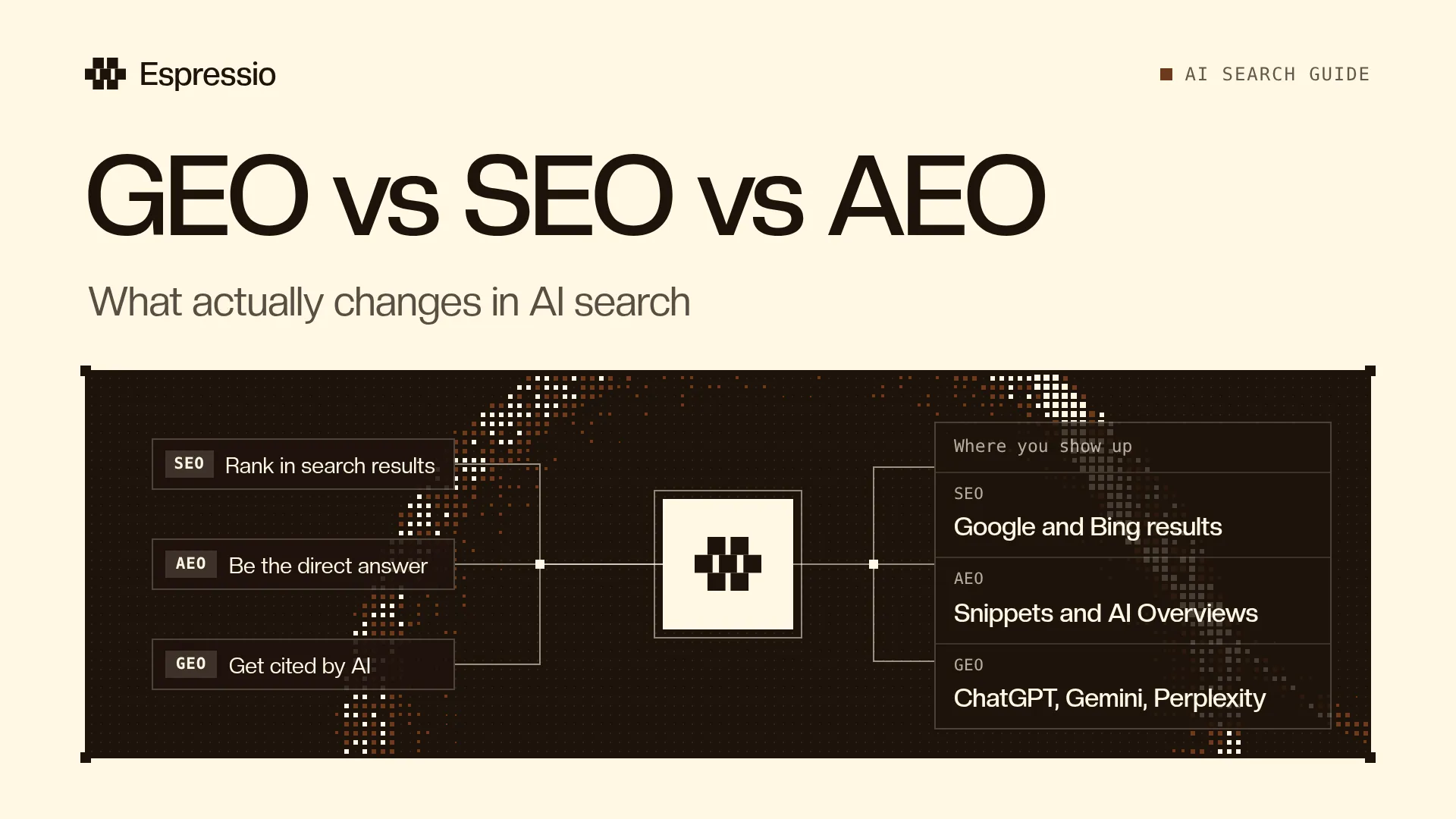
SEO gets your pages ranked in search results. AEO gets your content used as the direct answer to a question. GEO gets your brand named and cited in AI answers from ChatGPT, Claude, Gemini, Perplexity and Google’s AI Overviews. All three share one foundation. What changes is where you appear and how you measure it.
Most articles on GEO vs SEO pick a side. One camp says GEO is a new discipline that needs a new budget. The other says it’s SEO with a new name. Both are half right, and the useful part is knowing which half applies to your company.
Below: what each term means, what Google itself says, the four things that really change, what the main GEO study found, and a six-step plan for AI and B2B tech companies. It is for founders and marketing leads deciding where the next hour of work goes.
Key Takeaways
- Google’s own guide says optimizing for its AI features “is optimizing for the search experience, and thus still SEO” (Google Search Central, 2026). For Google, AEO and GEO are SEO.
- Four things do change: the answer often replaces the click, every AI engine has its own crawler, AI answers name brands based on what other sites say, and you need new ways to measure.
- In Pew Research Center data from 2025, Google users clicked a result in 8% of visits when an AI summary appeared, against 15% without one.
- In the original GEO study, adding citations, quotes and statistics raised visibility in AI answers by up to 40%. Keyword stuffing did not help (Aggarwal et al., KDD 2024).
- Run one program with three scoreboards: Google rankings, AI impressions in Search Console, and a monthly prompt check across the AI assistants your buyers use.
What do SEO, AEO and GEO mean?
The three terms describe the same job (getting found) on three kinds of results. One sentence each:
- SEO (search engine optimization) is the work of getting your pages crawled, indexed and ranked in search engines like Google and Bing, so people click through to your site.
- AEO (answer engine optimization) is the work of making your content the direct answer to a question. The term is older than ChatGPT. It started with featured snippets, People Also Ask boxes and voice assistants, and now also covers AI answers.
- GEO (generative engine optimization) is the work of getting your brand mentioned, cited and described correctly in answers written by AI models. The name comes from a 2023 research paper by a team from Princeton and IIT Delhi, later published at KDD 2024 (arXiv).
You will also see AIO (AI optimization), LLM SEO and AI search optimization. They mean the same thing as GEO. Vendors pick the label that sells their tool, so don’t let the label decide your plan.
In practice, AEO and GEO overlap almost completely today. A Google AI Overview is both an answer engine and a generative engine. Pick one name for your reporting and move on.
GEO vs SEO vs AEO: the side-by-side comparison
| SEO | AEO | GEO | |
|---|---|---|---|
| Where you show up | Ranked links on a search results page | Featured snippets, People Also Ask, voice answers, AI answer boxes | Answers in ChatGPT, Claude, Gemini, Perplexity, Copilot, AI Overviews and AI Mode |
| What winning looks like | A top position and a click | Your words are the answer | Your brand is named, cited and described correctly |
| Unit you optimize | A page for a query | A passage for a question | Your brand and facts across many sources |
| Main levers | Crawlability, content that matches intent, links, page experience | Clear question headings, direct answers near the top, lists and tables | The SEO levers, plus mentions on other sites, consistent facts, open access for AI crawlers |
| Who decides | Google and Bing ranking systems | The search engine’s answer features | Each AI model, with its own retrieval and its own crawler |
| How you measure | Rankings, clicks, impressions, conversions | Snippet and PAA ownership | AI impressions in Search Console, AI referral traffic, prompt checks |
| Clicks you can expect | The most of the three | Fewer, because the answer is on the page | The fewest. Being named is the result |
Most guides skip the last row. Don’t expect GEO to bring the old traffic back. Its job is to put you in the answer when the buyer never clicks.
Citation Capsule: SEO ranks pages, AEO makes your content the direct answer, and GEO gets your brand cited inside AI-written answers. Google says that for its own AI features, “optimizing for generative AI search is optimizing for the search experience, and thus still SEO” (Google Search Central, 2026).
What does Google say about AEO and GEO?
Google published a guide to optimizing for its generative AI features in May 2026. It answers the GEO vs SEO question directly: “From Google Search’s perspective, optimizing for generative AI search is optimizing for the search experience, and thus still SEO” (Google Search Central).
The guide explains why. AI Overviews and AI Mode pull pages from the normal Search index and rank them with the normal ranking systems. Two AI techniques sit on top:
- Retrieval-augmented generation (grounding). The model reads pages that Search already ranks and writes an answer with links to them.
- Query fan-out. The model runs several related searches at once to cover sub-topics. Google’s example: a search for “how to fix a lawn that’s full of weeds” can fan out to “best herbicides for lawns” and “remove weeds without chemicals”.
To appear at all, a page must be indexed and eligible to show with a snippet. Your site must also be included in the new “Search generative AI” setting in Search Console. Include is the default, and the control went live for all sites on August 31, 2026 (Search Console Help).
The guide also lists things you can ignore for Google:
- llms.txt and other “AI files”. Google Search doesn’t use them.
- Chunking content into small pieces. Google can find the relevant part of a long page.
- Rewriting for AI with special phrasing or every long-tail variant.
- Chasing inauthentic mentions across blogs, forums and videos.
- Special schema for AI. Structured data isn’t required for AI features.
What Google says does matter is “non-commodity” content. Its example contrasts “7 Tips for First-Time Homebuyers” (anyone could write it) with “Why We Waived the Inspection & Saved Money: A Look Inside the Sewer Line” (only someone who did it could). For a B2B tech company, the second kind is your benchmark data, your migration story, your pricing logic and the mistakes your team made in production.
So for Google, there is no separate GEO playbook. If your SEO is good, your AI Overview odds are good.
So what actually changes with GEO?
Google is one engine. Your buyers also ask ChatGPT, Claude, Perplexity and Copilot, and those are separate systems with separate rules. Four things are different enough to plan for.
1. The answer often replaces the click
Pew Research Center tracked the browsing of 900 US adults in March 2025. When a Google search showed an AI summary, users clicked a normal result in 8% of visits. Without a summary, they clicked in 15%. Users clicked a link inside the AI summary itself in just 1% of visits.
Question searches are hit hardest. In the same Pew study, 60% of searches that started with who, what, when or why showed an AI summary.
That changes what a top-of-funnel article is for. “What is a vector database” may now win you a mention and no visit. The page still has value if the answer names you. It has much less value if the answer only borrows your definition.
2. Every AI engine has its own crawler
Google uses Googlebot for both search and AI Overviews. The others send their own bots, and each one can be blocked on its own:
| Bot | Company | What it does |
|---|---|---|
| OAI-SearchBot | OpenAI | Decides if your site can appear in ChatGPT search answers |
| GPTBot | OpenAI | Collects training data. Blocking it does not remove you from ChatGPT search |
| Claude-SearchBot | Anthropic | Indexes pages for Claude’s search results |
| ClaudeBot | Anthropic | Collects training data |
| PerplexityBot | Perplexity | Indexes pages for Perplexity search. Perplexity says it is not used for model training |
Sources: OpenAI, Anthropic, Perplexity.
A common mistake is a team that blocks “AI bots” to stop training, and blocks the search bots along with them. The other one is the CDN. Since July 1, 2025, Cloudflare has asked every new domain to allow or block AI crawlers at sign-up, with blocking as the starting setting (Cloudflare). If your site sits behind Cloudflare, check that setting before you write a single GEO article.
3. AI answers name brands based on what other sites say
Ask an assistant “what’s the best observability tool for a 20-person startup” and it writes a shortlist. That list is built from what it finds about you on other sites, not only from your own pages: review sites, comparison posts, Reddit threads, podcasts, docs and news.
Pew found that Wikipedia, YouTube and Reddit were the three most-linked sources in Google’s AI summaries, at 15% of all links combined. This is where GEO gets close to PR. You can’t write your way onto a shortlist with on-page tweaks if no one else talks about you.
Google warns against fake mentions, and it’s right to. What works is the slow version: real reviews, real founder interviews, honest answers in communities where you are a known member, and comparison pages that treat competitors fairly.
4. You need new ways to measure
Rankings don’t tell you if ChatGPT recommends you. Until this year there was no first-party data for AI answers at all. That changed for Google. Search Console’s Generative AI performance report shows how often your pages were linked in AI Overviews and AI Mode, by page, country, device and date. It launched on June 3, 2026, reached all sites on August 31, 2026, and shows impressions but no clicks yet (Google Search Central Blog).
For ChatGPT, OpenAI adds utm_source=chatgpt.com to links it sends (OpenAI Help Center). For the other assistants, you work from referrers in your analytics and from manual checks. More on that below.
Citation Capsule: In Pew Research Center data from March 2025, users clicked a normal Google result in 8% of visits when an AI summary appeared, against 15% without one. They clicked a link inside the summary in 1% of visits. GEO is about being named in the answer, because the click often never comes.
What does the research say works for GEO?
Most GEO advice online is opinion. The one peer-reviewed study is the paper that named GEO: Aggarwal and colleagues tested nine ways of rewriting web pages on a benchmark of 10,000 queries, then checked how visible each page was in AI answers (Aggarwal et al., KDD 2024).
What they found:
- Citing sources, adding quotes and adding statistics worked best. They raised visibility by 30 to 40% on the paper’s main measure.
- Keyword stuffing did not help. On Perplexity it did about 10% worse than doing nothing.
- A more persuasive, “authoritative” tone did little. The models were hard to impress with style.
- Lower-ranked pages gained the most. Adding citations raised visibility by 115% for pages ranked fifth in search, while pages ranked first lost 30%.
That last point is the hopeful one for smaller companies. In AI answers, a well-sourced page from a small site can beat a big brand that ranks above it.
Two caveats. The tests used GPT-3.5 and a simulated engine, with one Perplexity check, so treat the numbers as direction, not a forecast. And the winning moves are what good SEO writers already do: cite the source, show the number, quote the expert. They help in Google too.
Does llms.txt help with GEO?
Not for Google. Google’s guide says Google Search ignores llms.txt and it “will neither harm nor help” your visibility there (Google Search Central). We have not seen any major AI search engine confirm that it uses llms.txt to pick sources.
It takes an hour to create and some coding tools read it, so it is fine to have one. Just don’t let anyone sell it to you as a ranking lever, and do it after the steps below, not before.
What should an AI or B2B tech company do first?
Here is the order we would work in. The first three steps take a day. The last three are the ongoing work.
1. Check that Google can use you. In Search Console, open Settings and then Search generative AI, and confirm your site is set to include. Then open the Generative AI performance report and note which pages already get AI impressions. Those pages show what Google trusts you on.
2. Open the door to AI search crawlers. Check robots.txt and your CDN or firewall rules. A clear setup looks like this:
# AI search: allow, so we can be cited
User-agent: OAI-SearchBot
Allow: /

User-agent: Claude-SearchBot
Allow: /

User-agent: PerplexityBot
Allow: /

# AI training: allow or block as a separate decision
User-agent: GPTBot
Allow: /

User-agent: ClaudeBot
Allow: /
Training is a licensing choice. Search is a visibility choice. Decide them apart.
3. Track AI referrals. In GA4, build a segment or custom channel group for sessions whose source matches a pattern like chatgpt\.com|perplexity\.ai|claude\.ai|gemini\.google\.com|copilot\.microsoft\.com. Some AI traffic still lands as Direct, so read this number as a floor.
4. Write down the prompts your buyers ask. Not keywords. Full questions, such as “what’s the best open-source alternative to [your competitor]” or “how do I add evals to a RAG pipeline”. Twenty is enough. Once a month, run them in ChatGPT, Claude, Gemini and Perplexity, and log three things for each: are you mentioned, are you linked, and is the description correct. A spreadsheet works. Tools can scale this later, but Google notes that no third-party tool can see inside its ranking or AI systems (Google Search Central).
5. Fix the pages that answer those prompts. For each prompt where you are missing or described wrong, find or write the page that should answer it. Put the answer in the first two sentences. Add the facts a model needs to describe you: who it’s for, what it does, what it costs, how it compares. Keep pricing, specs and docs in plain HTML text, not only in images, PDFs or client-side scripts. Cite your sources. This is also the “non-commodity” content Google asks for, so it pays off in both places.
6. Earn the mentions. Find the sources the assistants cite for your prompts. If it is always the same two review sites, a Reddit thread and a newsletter, that is your PR list. Get real customer reviews, pitch founder interviews, write the honest comparison post, and show up where your buyers ask questions. This step is slow, and it is the one that moves shortlists.
If your team has limited time, do steps 1 to 3 this week and steps 4 and 5 for your five most valuable prompts this month. That covers most of the gap.
How do you measure SEO, AEO and GEO together?
One dashboard, three sections:
| Scoreboard | Metric | Where it comes from |
|---|---|---|
| SEO | Rankings, clicks, impressions, CTR, sign-ups from organic | Search Console performance report, GA4 |
| AEO and Google AI | Impressions in AI Overviews and AI Mode by page | Search Console Generative AI performance report |
| GEO beyond Google | Mention rate, link rate, accuracy across your prompt list | Monthly prompt check (manual or a tracking tool) |
| Business result | AI referral sessions, demo requests, “how did you hear about us” answers | GA4 segment, CRM, sign-up form |
Add “how did you hear about us” as a free-text field on your demo form if you don’t have one. When people say “ChatGPT recommended you”, that line is often the clearest GEO signal you will get.
Review it monthly. AI answers change between runs, so look for trends over three months, not single wins.
Do you need a separate GEO agency?
Usually not. If your SEO partner already writes original content, fixes technical issues, reads Search Console and builds real mentions, they are doing most of GEO. Ask them three questions:
- Which AI crawlers can reach our site today, and how do you know?
- What did our Generative AI performance report show last month?
- Which prompts do you check for us, and how often?
If they can’t answer, you have found a real gap. It is a gap in measurement and off-site work, and it rarely needs a second retainer. Be wary of anyone who leads with llms.txt, “AI schema” or guaranteed placements in ChatGPT. Google’s guidance on third-party SEO services is a good filter (Google Search Central).
At Espressio, SEO and AI search is one service for exactly this reason. It covers Google rankings and AI answers in one plan with one report, because the work underneath is the same. See how it works.
Frequently Asked Questions
Will GEO replace SEO?
No. Google’s AI Overviews and AI Mode retrieve pages from the regular Search index using the regular ranking systems, so you can’t be in them without SEO. ChatGPT and Perplexity run their own search crawlers too. GEO adds measurement and off-site work on top of SEO. It doesn’t replace it.
Is GEO just SEO with a new name?
For Google, yes. Google’s own guide says optimizing for its AI features “is optimizing for the search experience, and thus still SEO.” Outside Google, there are real differences: separate crawlers for each AI company, answers shaped by what other sites say about you, and no ranking position to track. Those differences are why the term stuck.
Is AEO part of GEO?
They overlap so much that the difference rarely matters. AEO started with featured snippets and voice answers, and it focuses on being the direct answer to a question. GEO focuses on being cited and named in AI-written answers. A Google AI Overview is both. Use whichever term your team understands and measure the same things.
Does schema markup help with GEO?
It helps a little and indirectly. Google says structured data isn’t required for its AI features and there’s no special AI schema. It still helps Google understand your pages and makes you eligible for rich results. Add Organization, Article and Product markup that matches what’s visible on the page, then spend the rest of your time on content and mentions.
How long does GEO take to show results?
Technical fixes like unblocking OAI-SearchBot can take effect within about a day for ChatGPT, according to OpenAI’s crawler docs. Content and mentions are slower, much like SEO, and usually take months. AI answers also change from run to run, so judge progress on a three-month trend across your prompt list.
What is the difference between GEO and LLM SEO?
There is none in practice. LLM SEO, AI search optimization, AIO and GEO all describe getting your brand into answers written by large language models. GEO is the name from the original research paper. The others are mostly marketing labels.
Conclusion
The GEO vs SEO debate is mostly about names. For Google, the work is SEO, and Google says so. Outside Google, four things really change: fewer clicks, separate crawlers, answers built from what others say about you, and new ways to measure.
The plan that follows from this is simple:
- Keep doing SEO well. It feeds Google’s AI features directly.
- Unblock the AI search crawlers and track AI referrals this week.
- Check 20 buyer prompts every month across the assistants your buyers use.
- Fix the pages and earn the mentions that those prompts reveal.
If you want us to run this for your company, let’s chat.
For the Perplexity side of this in more depth, read how to optimize content for Perplexity AI.