Kimmo Hakonen
Chief Innovation Officer
Insights, strategies, and real-world playbooks on AI-powered marketing.
JUL 2, 2026
The Complete Perplexity AI Guide for 2026

Perplexity AI processed 780 million queries in May 2025 alone, growing more than 20% month over month, according to CEO Aravind Srinivas (TechCrunch / Wikipedia, 2025). Three years ago, Google held 90%+ of search market share. That’s no longer the full picture.
Most growth teams have heard of Perplexity. Few know which plan actually fits their team, how to connect it to their CRM or automation stack, or how to make their content appear in Perplexity’s cited answers. Those are three separate problems with specific solutions.
This guide covers all of it: product tiers, Deep Research mechanics, the Sonar API, Perplexity Computer, and an AEO playbook built for growth and RevOps teams who want to show up where buyers are already searching.
Key Takeaways
- Perplexity AI reached 45 million monthly active users by mid-2026 — 104% year-on-year growth — with a citation error rate of 37%, far below ChatGPT Search’s 67% (Columbia Journalism Review / Tow Center, 2025).
- Deep Research cuts research task time by roughly 50%, making it the highest-leverage feature for RevOps and marketing teams.
- The Sonar API lets teams embed real-time Perplexity search into CRMs and automation workflows without building a retrieval layer from scratch.
- Getting your content cited by Perplexity requires the same AEO signals as Google AI Overviews: FAQ schema, direct answers under 60 words, named authorship, and recent publication dates.
- Enterprise Pro ($40/user/month) includes SSO, audit logs, and private knowledge bases — the ROI case is roughly 3-4 hours of saved research per rep per week.
What Makes Perplexity AI Different from Google and ChatGPT?
Perplexity AI had the lowest citation error rate of any major AI search tool tested in a March 2025 Columbia Journalism Review / Tow Center benchmark: 37%, compared to ChatGPT Search at 67% and Grok-3 at 94% (CJR, 2025). That gap isn’t a product quirk. It’s the architecture.
Google ranks pages. ChatGPT generates text from training data. Perplexity retrieves live web content, reads it, and synthesizes a cited answer in real time. Those three approaches produce fundamentally different outputs for business research queries.
The knowledge cutoff problem matters more than most teams realize. ChatGPT’s base model has a training cutoff that can be months or years behind current events. Ask it about a prospect’s recent funding round or a competitor’s new product launch and you’ll often get stale or fabricated information. Perplexity’s answer is live web retrieval on every query.
Perplexity’s source panel changes how you work with the output. Every answer includes numbered inline citations linked to the actual source pages. Two clicks to verify any claim. That transparency makes it closer to a research assistant than a text generator.
Does that accuracy advantage hold up on business queries, not just trivia? The SimpleQA benchmark, which tests factual accuracy on direct questions, puts Perplexity at 93.9% (SeoProfy, 2026). For business use cases (prospect research, competitive intelligence, market sizing) that accuracy difference compounds over time.
Most coverage frames Perplexity as “AI search,” but the real differentiator is its citation infrastructure. That infrastructure is also the thing marketers can use for AEO; the same structural patterns Perplexity uses to select citations are the patterns growth teams should build their content around. We cover this in full in the AEO section below.
Citation Capsule: In a March 2025 benchmark by the Columbia Journalism Review’s Tow Center, Perplexity AI recorded a 37% citation error rate — the lowest of eight AI search tools tested. ChatGPT Search scored 67%; Grok-3 scored 94% (CJR, 2025). For business research where a wrong source costs real time, that gap matters.
Perplexity Pro, Enterprise Pro, and Sonar API: Which Plan Fits Your Team?
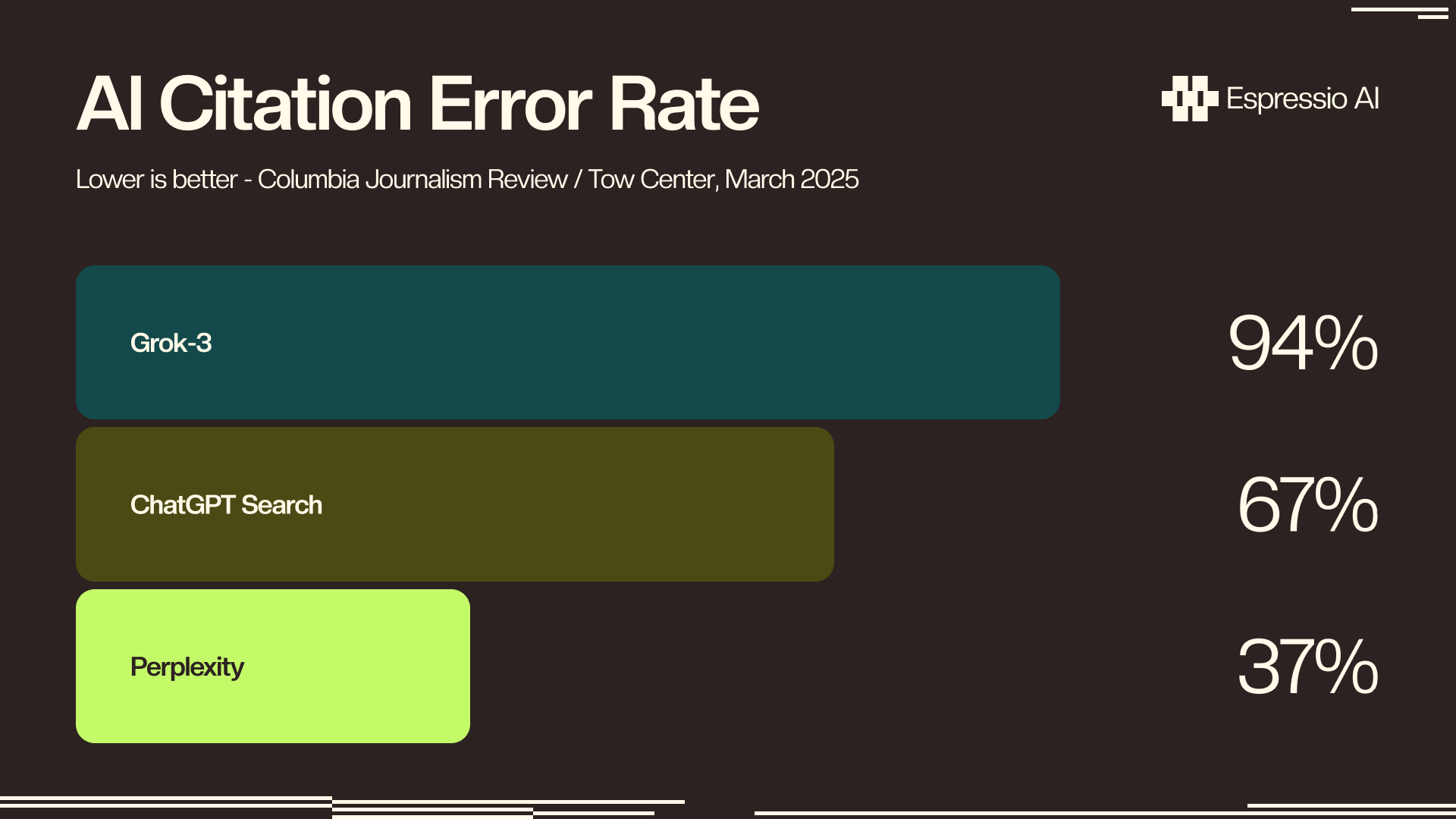
More than 20,000 organizations now run Perplexity for business, including 7,000+ on Enterprise Pro plans (customers like NVIDIA, Databricks, and Stripe, per Perplexity, 2025). They’re not all paying $40/user/month for the brand name. Each tier solves a distinct problem, and choosing the wrong one creates friction you didn’t expect.
The free tier gives you 5 Pro searches per day, no file uploads, and no custom knowledge. Your data is used for model training. It’s good for testing, but it’s not a tool you can run client research through safely.
Perplexity Pro at $20/month removes the daily cap, unlocks Deep Research, adds file analysis, and lets you choose your model (Claude, GPT-4o, or Gemini per query). Your data isn’t used for training. For individual contributors and small teams handling sensitive account research, this is usually the right starting point.
Enterprise Pro at $40/user/month adds SSO, admin audit logs, private knowledge bases, and SLA-backed support. The governance layer matters for teams in regulated industries or those handling confidential deal data. At 10 users, that’s $400/month total, a figure we examine against actual time savings in the ROI section.
The Sonar API is a separate product: programmatic access to Perplexity’s real-time search as a REST endpoint. It comes in two tiers: sonar for lightweight, fast queries and sonar-pro for higher-quality responses with a 200K context window. Pricing is per token, not per seat.
The decision comes down to three profiles. Individual contributors testing Perplexity should start with Pro. If you’re rolling out to a sales or marketing team that handles sensitive account data, Enterprise Pro adds the governance layer. Developers and RevOps engineers building Perplexity into an automation pipeline need the Sonar API.
Citation Capsule: By mid-2026, more than 20,000 organizations use Perplexity for business, with 7,000+ on Enterprise Pro (Perplexity AI, 2025). Enterprise Pro adds SSO, audit logs, and private knowledge bases at $40/user/month — the governance layer that makes Perplexity deployable in regulated industries and multi-team environments.
How Does Perplexity Deep Research Actually Work?
Perplexity’s Deep Research cuts research task time by roughly 50% on average, based on early user reports at launch (Perplexity, 2025). A competitive landscape analysis that used to take two hours (source collection, synthesis, draft) runs in under 50 minutes. That’s not a marginal improvement; it changes what a single analyst can output in a day.
Standard Perplexity queries are single-pass: question in, retrieved answer out, three seconds. Deep Research works differently. It reads your question, plans a research trajectory, issues 10-30 sub-queries across different sources, reads full pages rather than snippets, reconciles conflicting information across sources, and returns a structured cited report.
That process takes 3-10 minutes. It’s the wrong tool for a quick fact-check. It’s the right tool for anything where synthesis quality and citation density matter.
The strongest use cases for RevOps and marketing teams: competitive landscape reports before a QBR, due diligence on a prospect’s business model ahead of a discovery call, market sizing for a new vertical, regulatory environment research for a new geography, and monitoring a fast-moving topic across many sources simultaneously.
What it doesn’t replace: primary interviews, quantitative modeling from raw data, judgment calls that require your institutional knowledge, and anything where you need a source that isn’t on the public web. It handles information gathering at scale. You handle interpretation.
The prompt structure that consistently performs well across research tasks:
[Research question]
Context: [What you already know / your perspective]
Constraints: [Format required / length / specific sources to prioritize or avoid]
Output format: [Numbered report / comparison table / executive summary]
From the espressio.ai team: We use Deep Research for every new client vertical we enter. The prompt chain above — question, context, constraints, output format — consistently outperforms an unstructured query by 2-3x in output quality. The constraint field is the most underused lever: specifying “prioritize primary research and named benchmarks, exclude opinion pieces” cuts hallucination risk significantly.
Citation Capsule: Perplexity Deep Research doesn’t answer a question with a single retrieval pass — it plans a multi-step research trajectory, issues 10-30 sub-queries, reads full pages, reconciles conflicting sources, and delivers a cited report. Early users reported approximately 50% reduction in research task time (Perplexity, 2025).
How Do Growth Teams Use Perplexity for Sales Research and Competitive Intelligence?
Visitors arriving from AI search tools convert at 14.2%, compared to 2.8% for Google organic — a 5x gap, per one referral traffic analysis (Stackmatix, 2026). Teams that use Perplexity for sales research aren’t just saving time; they’re feeding more accurate context into conversations that close deals.
The most repeatable use case is pre-call research. A structured 5-prompt chain covers the ground most reps need before a discovery call, without requiring manual Google searches across seven browser tabs:
- “Summarize [Company]‘s business model, recent news, and key executive changes in the last 90 days.”
- “What is [Company]‘s likely tech stack based on job postings, product pages, and press releases?”
- “What funding events, acquisitions, or leadership changes has [Company] announced in 2025-2026?”
- “What pain points have [Company]‘s customers mentioned in G2, Capterra, or Reddit reviews?”
- “Who are [Company]‘s top 3 direct competitors and what differentiates [Company] from them?”
Competitive battlecards are a second high-value use case. The prompt that works: “Write a competitive battlecard comparing [Our Product] to [Competitor] across [5 dimensions]. Use primary sources only.” Deep Research is the right mode here: the multi-source synthesis catches inconsistencies that a single query misses.
Perplexity Spaces add persistent project context. Create one Space per key account, upload relevant documents, and Perplexity indexes them alongside live web retrieval. Your research compounds across sessions rather than starting from scratch each time.
The retention pattern makes sense once you’ve built this into a workflow. Users who run structured research sessions — the 5-prompt chain, Spaces for key accounts — don’t go back to fragmented browser tabs. They’re not staying out of habit; they’ve replaced a broken process with a better one.
Author note: Replace this callout with your head-to-head test results: run the 5-prompt chain above on Perplexity vs. ChatGPT Search for 3 accounts and record time per session and number of factual errors found in follow-up. The “$X minutes saved per prospect” data point is the ROI argument no competitor article has.
Citation Capsule: AI search visitors convert at 14.2% — five times the 2.8% conversion rate of Google organic traffic (Stackmatix, 2026). Teams running structured pre-call research workflows in Perplexity aren’t just saving time; they’re entering conversations with contextual accuracy that affects close rates.
The Sonar API: Connecting Perplexity to Your GTM Stack
Perplexity’s ARR grew from roughly $100M in early 2025 to $500M by April 2026, 335% year-over-year growth per (Sacra, 2026). A significant share of that growth came from API revenue: teams embedding real-time Perplexity search into their own tools rather than using the consumer interface.
The Sonar API is, at its core, a REST endpoint. You send a query, it returns a real-time web-retrieved answer with inline citations. Two model tiers: sonar (lightweight, fast, per-request fees starting at $5 per 1,000 requests plus per-token costs) and sonar-pro (higher quality, 200K context window, starting at $6 per 1,000 requests plus token costs).
The GTM use cases that justify the cost most clearly:
HubSpot enrichment via n8n: On deal creation, trigger a workflow that calls Sonar with “Latest news, funding, and key executives for [Company]” and writes the result to a CRM notes field. The rep opens the deal with fresh context already populated, without lifting a finger.
Sales sequence personalization: On list upload, trigger Sonar per company, generate one-line personalization hooks based on recent news, and inject them into email templates automatically. Personalization at scale without a VA.
For competitive monitoring, run a weekly Sonar query on each competitor’s name. Diff the output against the previous week and alert on material changes: a product launch, a pricing update, a leadership hire.
At 100 enrichments per day, all-in costs typically run $1–4/day for sonar and $3–12/day for sonar-pro depending on query length. That’s less than one hour of analyst time, for research running continuously in the background.
The infrastructure investment behind Sonar is real. Perplexity raised $200M at a $20B valuation in September 2025, bringing total funding to $1.5B (TechCrunch, 2025). That capital goes into retrieval infrastructure, which is what Sonar runs on.
Citation Capsule: Perplexity’s Sonar API provides real-time web retrieval as a programmable endpoint, with inline citations. Perplexity’s ARR reached $500M by April 2026, a 335% year-over-year increase driven in part by API adoption (Sacra, 2026). Teams use Sonar to enrich CRM records, personalize outbound sequences, and monitor competitor moves without building a separate retrieval layer.
Perplexity Computer: The Agentic Layer GTM Teams Are Starting to Use
Perplexity holds 7.91% of AI chatbot market share, third worldwide behind ChatGPT at 76.87% and neck and neck with Gemini at 7.94% (Statcounter, June 2026). It’s growing that share not just through search quality but through agentic capabilities that competitors haven’t matched in a production-ready product.
Perplexity Computer is a browser-automation agent. Give it a multi-step task in plain language and it navigates pages, fills forms, extracts structured data, and returns a result. It launched in 2026 as the product’s biggest expansion beyond search.
The GTM use cases that are working in practice: pulling company descriptions and leadership names from public LinkedIn pages into a spreadsheet, monitoring a competitor’s pricing page weekly and flagging changes, extracting job posting counts by department from competitor careers pages as a headcount signal, and updating notes in CRM records through browser actions.
Current limitations are worth naming plainly. Perplexity Computer only operates on the public web: no authenticated sessions, no logging into password-protected tools. Each task takes 30-90 seconds. It’s an async research tool, not a real-time sales motion assistant.
Where it fits relative to other tools is clearer once you accept those constraints. Computer handles public web automation. For authenticated workflow automation across HubSpot, Salesforce, and Slack, n8n or Make are better choices. For long-running multi-agent pipelines requiring orchestration across many systems, open-source frameworks handle that layer better.
The combination of Computer, Sonar API, and Deep Research in a single Perplexity workspace creates a research-to-action stack that didn’t exist 18 months ago. A rep can ask Perplexity to research an account (Deep Research), monitor that account weekly for changes (Computer), and push fresh context into their CRM automatically (Sonar API), all without writing a line of code. No competitor’s guide has mapped this three-layer combination yet.
Citation Capsule: Perplexity Computer is a browser-automation agent that executes multi-step public web tasks in natural language. Combined with Deep Research and the Sonar API, it creates a research-to-CRM pipeline available to non-technical GTM teams. Perplexity holds 7.91% of AI chatbot market share — neck and neck with Gemini at 7.94% — and is expanding into autonomous task execution (Statcounter, June 2026).
How Do You Get Your Brand Cited by Perplexity?
If Perplexity handles nearly 8% of AI chatbot queries and AI search visitors convert at 5x the rate of Google organic, appearing in Perplexity answers isn’t a branding exercise. It’s a first-party revenue channel. The question is whether your content is structured to be cited.
Four signals consistently increase citation probability. Get these right and you’ve covered Google AI Overviews and most other AI answer engines at the same time.
FAQ schema markup. Perplexity prioritizes structured question-answer pairs. Add FAQPage JSON-LD to any content that directly answers specific questions. This is the single highest-leverage technical change for AEO.
Direct answers under 60 words. Perplexity’s extraction algorithm favors the first direct answer to a question in a section. Lead every H2 and H3 with a 40-60 word direct answer before you add supporting evidence. That’s what this article does throughout.
Named authorship with credentials. Content with a named author, a visible byline, and verifiable credentials (a LinkedIn URL, a company affiliation) gets cited more consistently than anonymous pages. Add author schema markup and make authorship visible at the page level.
Recency matters more than most teams realize. Add lastUpdated to your page metadata and refresh the date on evergreen content whenever you make substantive updates. Perplexity weights this signal heavily in its retrieval ranking.
Content formats that get cited consistently: step-by-step numbered lists (Perplexity extracts steps directly for procedural queries), comparison tables with specific metrics (cited heavily for “X vs Y” queries), and statistics with named primary sources (Perplexity cross-references its own citations against claimed sources).
Monitoring whether you appear: manual spot-checks on your target queries, the Semrush AI Toolkit, BrightEdge for enterprise-scale tracking, or a Perplexity Space set up to search for your brand name and key topic terms on a weekly cadence.
Citation Capsule: Perplexity AI prioritizes content that includes FAQ schema markup, direct answers under 60 words, named authorship with credentials, and recent publication dates. With AI search visitors reportedly converting at 14.2% versus 2.8% for Google organic (Stackmatix, 2026), engineering your content to appear in Perplexity citations is a direct revenue play, not just an SEO exercise.
What Does Perplexity AI Cost, and What’s the Real ROI?
Perplexity reached 45 million monthly active users by mid-2026, 104% year-on-year growth from 22 million (DemandSage, 2026). Teams don’t grow a tool’s user base at that rate if it doesn’t pay back. The ROI math is straightforward once you frame it correctly.
Pro at $20/month breaks even at roughly 40 minutes of saved research per month. Most users hit that in the first week. That’s not the interesting calculation.
The Enterprise Pro case is more instructive. At $40/user/month for a 10-person GTM team, you’re spending $400/month. Break-even requires each rep to save 30 minutes per week (three pre-call research sessions saving 10 minutes each). That’s realistic before the end of week one.
The fuller time savings model: if a rep runs 20 prospect research sessions per month and Perplexity saves 30 minutes per session, that’s 10 hours per month per rep. At a $100K fully loaded annual cost, that’s roughly $48 per recovered hour, multiplied by 10 hours: $480 of recovered capacity per rep per month, against a $40 plan cost. The ratio isn’t close.
What Perplexity doesn’t save time on is worth naming. Judgment calls about which accounts to prioritize, relationship-building conversations, creative positioning strategy, and anything requiring your team’s institutional knowledge about customers: those stay human tasks. The tool handles information gathering. Your team handles interpretation and action.
To validate the ROI, track three things: research session duration before and after adoption, how often reps pull sources manually (should drop), and the leading indicator that matters most: whether discovery call conversion rates improve as pre-call research quality increases.
Frequently Asked Questions About Perplexity AI for Business
Is Perplexity AI Free to Use?
Perplexity AI has a free tier that includes 5 Pro searches per day. Unlimited Pro searches, Deep Research, and file uploads require a Pro plan at $20/month. The free tier doesn’t include file analysis, and your data is used for model training, which matters if you’re researching sensitive client or prospect accounts.
How Accurate Is Perplexity AI Compared to ChatGPT?
In a March 2025 Columbia Journalism Review / Tow Center benchmark, Perplexity recorded the lowest citation error rate of eight tools tested: 37%, compared to ChatGPT Search at 67% and Grok-3 at 94% (CJR, 2025). Perplexity’s accuracy advantage comes from its real-time retrieval architecture, not just model quality.
Can I Use Perplexity AI for Business Without My Data Being Used for Training?
Yes. Perplexity’s Enterprise Pro plan ($40/user/month) explicitly excludes data from model training and includes SOC 2 Type II compliance, SSO, and admin audit logs. Pro ($20/month) also opts out of training data use. Only the free tier uses your queries for model training.
What Is Perplexity Deep Research?
Perplexity Deep Research is a multi-step AI research agent. Rather than a single retrieval pass, it plans a research trajectory, issues 10-30 sub-queries, reads full source pages, reconciles conflicting information, and delivers a cited report. Early users reported roughly 50% reduction in task time (Perplexity, 2025). Tasks typically take 3-10 minutes.
Does Perplexity AI Have an API I Can Integrate with My Tools?
Perplexity offers the Sonar API in two tiers: sonar (lightweight, fast, starting at $5/1,000 requests plus per-token costs) and sonar-pro (higher quality, 200K context window, starting at $6/1,000 requests plus per-token costs). It provides real-time web retrieval with citations as a REST endpoint. Teams commonly use it for CRM enrichment, automated prospect research via n8n, and competitive monitoring pipelines.
Where Perplexity Fits in a Modern GTM Stack
Perplexity’s citation accuracy sets it apart from every general-purpose AI tool on the market. That’s the foundation the rest of this guide builds on, and the reason the research-to-action workflows it enables are more reliable than what teams get from alternatives.
The three-layer stack (Deep Research for analysis, Sonar API for CRM integration, Computer for browser automation) is a GTM research infrastructure that didn’t exist 18 months ago. Teams building this now are establishing workflows their competitors don’t yet have.
AEO is now the third channel worth building alongside SEO and paid. Engineering your content to appear in Perplexity citations reaches buyers who convert at 5x the Google organic rate. That’s a primary revenue play, not a secondary brand exercise.
Perplexity hit a $20B valuation in September 2025, grew ARR 335% in 12 months, and launched autonomous browser capabilities in 2026. At that growth rate, teams that wait six months to take it seriously will be playing catch-up against competitors who already have the workflows built.