What Is a Knowledge Factory? How to Build One That Stays Current
A knowledge factory (company brain) is the know-how your AI agents need to do real work. What goes in it, the loop that keeps it current, and how to start small.

On this page
- 01What is a company brain?
- 02Why AI agents fail without one
- 03The three kinds of knowledge to collect
- 04The loop that keeps a company brain current
- 05The harness: what your agents need around the brain
- 06Results: what this looks like in practice
- 07How to build a company brain: a 30-day start for small teams
- 08Common objections
- 09Where a company brain fits in marketing and growth
- 10Related reading
- 11Want help building yours?
- 12Frequently Asked Questions
A knowledge factory, also called a company brain, is a shared, written record of how your company works, kept in a form that AI agents can read and act on. It holds your processes, the facts about your business, and directions to your live data. The part most teams miss is the upkeep: a good knowledge factory has a loop that finds what is missing or wrong and fixes it, so it gets better as the agents work.
The idea went mainstream in 2026. Y Combinator put “Company Brain” on its Summer 2026 Request for Startups, and LangChain CEO Harrison Chase has since shared on X how his team keeps one current for its own agents. That post passed 430,000 views and 6,900 bookmarks within a day. This guide explains the idea in plain terms, shows the three kinds of knowledge to collect, walks through the loop that keeps it fresh, and gives a small business a way to start this month.
Key Takeaways
- A company brain is not a search box over your files. It is curated knowledge: how to do the work, how the business works, and where current data lives (LangChain, November 2026).
- YC’s Tom Blomfield called it “a living map of how a company works”, not company-wide search or a chatbot over documents (Y Combinator on LinkedIn, Summer 2026 RFS).
- The hard part is upkeep. Agents flag gaps while they work, and a separate curator agent fixes the source on a schedule (LangChain).
- LangChain’s GTM agent, built on this kind of setup, saved each sales rep 40 hours a month, and lead-to-qualified-opportunity conversion rose 250% from December 2025 to March 2026 (LangChain, March 2026).
- Start with one recurring workflow, write down how it is done, and let real runs show you what is missing.
What is a company brain?
Every company already has a brain. It just lives in the wrong places. Some of it sits in the heads of your best people. Some is spread across Slack threads, old emails, a wiki nobody updates and a few spreadsheets. People get by because they remember who to ask.
AI agents can’t work that way. An agent that writes your reports, answers leads or drafts content needs to know the same things a good employee knows: how you do it, what your terms mean, which numbers to trust and where to find them.
A company brain is the system that collects that knowledge, keeps it in order and hands it to agents when they need it. In its Summer 2026 Request for Startups, Y Combinator described it as a system that pulls knowledge out of scattered sources, structures it, keeps it current and turns it into skills AI agents can use, covering things like how refunds get handled or how pricing exceptions are approved (Y Combinator RFS; Tom Blomfield on LinkedIn).
Search interest is following. US searches for “company brain” went from about 10 a month in early 2026 to 210 a month by November (SE Ranking keyword data, November 2026).
Context vs knowledge
Harrison Chase draws a useful line between two words people often mix up (How to build a knowledge factory, LangChain):
- Context is everything an agent has in front of it while it does a task.
- Knowledge is the reusable understanding that lets it do the task correctly. What a metric means, which source to trust, how you handle a tricky case.
Knowledge becomes part of the context. But not all context needs to be curated knowledge. Your raw sales numbers already live in your CRM or database. You don’t need a second copy of them. You need a short note that tells the agent where they are and how to read them.
What a company brain is not
| Tool | What it does | Why it falls short on its own |
|---|---|---|
| Company wiki | Stores pages people write | Goes stale. Nobody owns the updates. |
| Enterprise search | Finds documents that match a query | Returns files, not the rule you follow. |
| Chatbot over your docs (RAG) | Pulls similar text into an answer | Can’t tell an old decision from the current one. |
| Personal second brain | Notes for one person | Built for one view, not a shared team truth. |
| Company brain | Curated, maintained knowledge for people and agents | Needs a loop to stay correct. |
Conor Brennan-Burke, CEO of Hyperspell, put the trap well: connecting an AI tool to Slack, Drive and your CRM “feels like you’ve built a company brain”, but most teams have only built a retrieval layer. The hard part is “maintaining a shared understanding of what’s actually true” (X, 3 July 2026).
Why AI agents fail without one
If AI still isn’t changing how your team works, the model is usually not the problem. As Grant Miller summed up Harrison Chase’s post, “your agents just don’t know how your company works” (X, 21 November 2026).
You see it in small ways:
- The agent writes a report in the wrong format because nobody wrote down the house style.
- It uses an old price list because three versions sit in the shared drive.
- It drafts an email to a lead your colleague called yesterday, because it never saw the call notes.
- It calculates revenue a different way than your finance lead does.
None of these are model failures. They are missing knowledge. Better prompts help once. Writing the knowledge down, and keeping it right, helps every time.
The three kinds of knowledge to collect
LangChain splits company knowledge into three parts (LangChain). It is a simple way to decide what to write down first.
1. Skills: how to do the work
Skills are step-by-step instructions for doing a task the way your company does it. How you write a client report. How you qualify a lead. How you brief a designer. Most of this was never written down. It got passed from one colleague to the next.
In practice a skill is often a short markdown file with steps, examples and the checks to run at the end. Claude and LangChain’s Deep Agents both use this format, which is one reason “agent skills” searches grew from about 70 a month in December 2025 to 4,400 a month in November 2026 (SE Ranking, US).
2. Domain knowledge: how the business works
This is the slower-moving truth about your company. Your products and prices, your ideal customers, your competitors, your policies, and the definitions behind your numbers. LangChain’s example is “how we calculate ARR”, kept on a company wiki page.
Much of this is already written somewhere. The problem is that it is incomplete or out of date, and agents can’t tell which version is right.
3. Data access guidance: where to find current information
Some knowledge changes every day: revenue, pipeline, campaign results, inventory. Don’t copy it into the brain. Keep it in the system that already owns it, and write a short guide that tells the agent which tool holds what and how to query it. If your data setup is solid, this guide is all the agent needs.
Here is how the three parts look for a typical small business:
| Type | Example | Where it can live |
|---|---|---|
| Skill | “How we write a monthly client report” | A markdown file in a shared folder or GitHub |
| Domain knowledge | Price list, service tiers, ideal customer profile, how we count a qualified lead | A wiki page or one doc with a named owner |
| Data access | “Leads are in HubSpot, ad spend is in Google Ads, traffic is in GA4. Use these fields.” | A query guide next to the skills |
The loop that keeps a company brain current
This is where most company brains die. Teams spend a month writing docs, then nobody updates them, and six months later the agents follow rules that no longer apply. Writing everything down first is also too big a job. Chase calls manual upkeep “a herculean effort”.
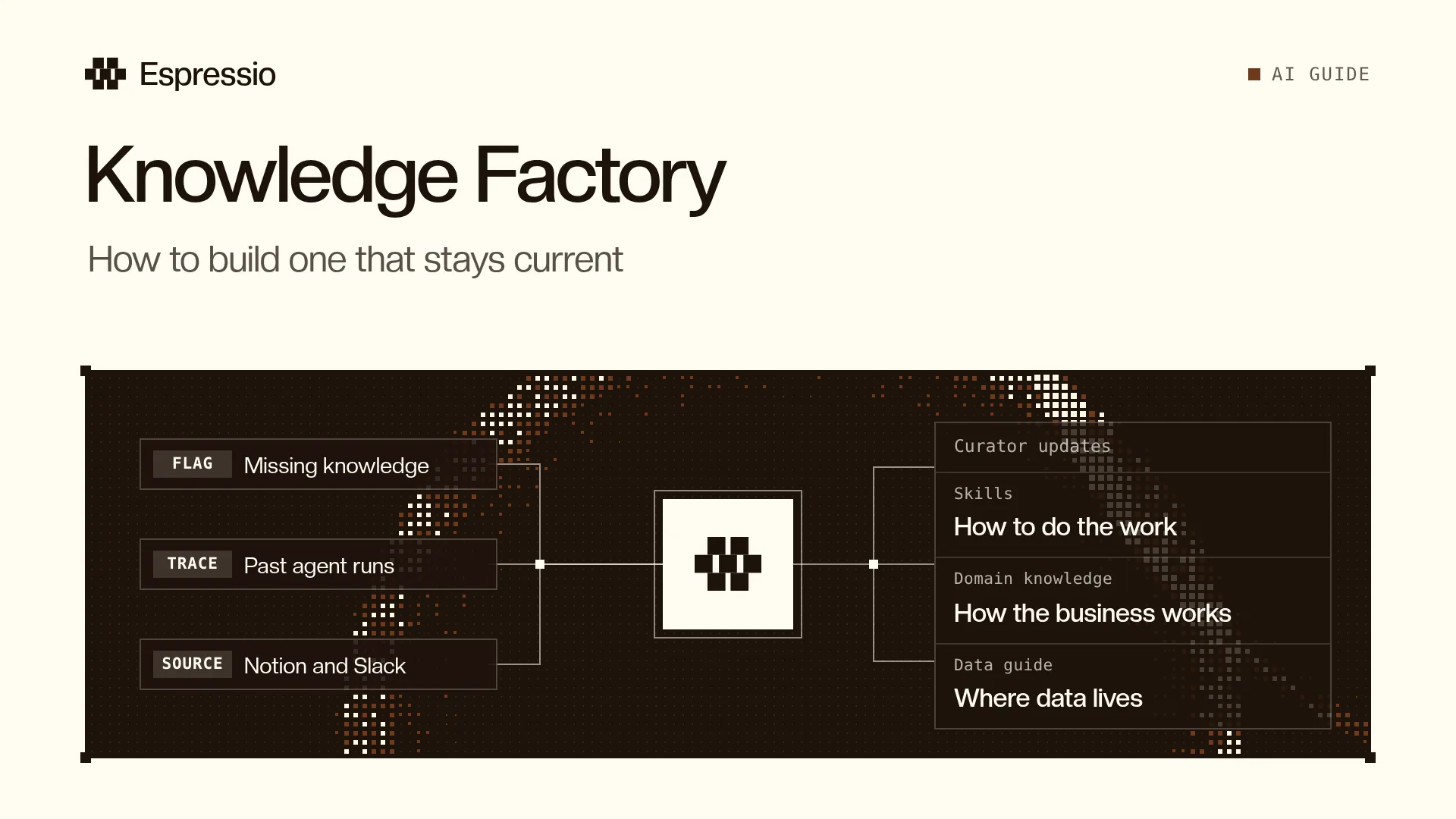
LangChain’s answer is to build a system that maintains the knowledge for you. They call it a knowledge factory. It has three parts.
Agents do the work
- Run reports, outreach, content
- Flag missing or wrong knowledge
- Leave traces of each run
Curator agent
Runs in the background on a schedule
- Reads the flags
- Reads past run traces
- Reads raw sources like Notion and Slack
Company brain
- Skills
- Wiki of how the business works
- Guide to where data lives
The next runs use the updated knowledge.
1. Agents flag what is missing or wrong
The agents that do the work are the best sensors you have. When an agent can’t find something, or finds a fact that turns out to be wrong, it should say so. Give it a simple tool to report the problem and, if it can, suggest the fix.
2. A curator agent fixes the source on a schedule
The working agents should not rewrite the knowledge themselves. They are busy with their own task, and if every agent edits the shared files you end up with a mess of contradictions. Instead, a separate curator agent runs in the background, for example every night. It reads:
- the flags the working agents raised,
- the traces of past runs, so it can see where people corrected the agent,
- the raw sources where knowledge is scattered, like Notion and Slack.
Then it updates the skills, the wiki pages and the query guides.
3. Storage, which matters less than you think
You can keep the knowledge as skill files in GitHub, a single Notion page, a knowledge graph, or a hub product like LangSmith Context Hub. Chase calls storage “the least important thing” because a curator agent can work with any of these formats. He also notes there is no standard yet for this kind of memory, so don’t overbuild it.
A worked example: the revenue report
LangChain’s own example shows the loop in one day:
- An agent builds a revenue report. It pulls numbers from BigQuery and Salesforce, follows a “LangChain style” report skill, and uses the ARR definition on the wiki.
- A column in BigQuery was renamed. The agent works out the right column, finishes the job, and flags the change with a suggested fix.
- The finance lead reviews the report with the agent and asks for a new header that all company documents now need.
- That night the curator agent reads the flag and the trace of the chat with the finance lead. It updates two skills: the data skill now uses the new column, and the report skill now uses the new header.
The next report is right the first time, and nobody had to update a document by hand.
As Chase puts it, the goal isn’t to document everything before agents can start. It is to build a system where doing the work shows what knowledge is missing, and fixing those gaps makes the next run better.
The harness: what your agents need around the brain
Knowledge is half the job. The other half is how agents run inside the company. In an October 2026 post, Harrison Chase and Caspar Broekhuizen described the five things every LangChain internal agent ended up needing (The five components of building a “company harness”). LangChain runs three of these agents: a GTM agent for sales, OpenSWE for engineering, and Content Studio for marketing assets.
- It lives where people already work. For LangChain that is Slack. Agents can be messaged or tagged in a channel, and others learn by watching how colleagues use them. For big queues, like reviewing a backlog of email drafts, they built a separate screen.
- It knows who is asking. Some tools act on behalf of the person who asked, like sending email from their account. Others use a shared company identity, like a CRM login. Sensitive actions, such as posting to the company X account, are limited to a short list of people.
- It has memory at two levels. Global memory for facts that apply to everyone, and user memory for one person’s preferences.
- Code runs in a sandbox. The agent can run scripts and call services that need logins, without exposing those secrets.
- Many runs are scheduled. A large share of runs start on a timer or an event, not a human prompt. A daily brief. A review every time a new lead or pull request comes in.
The company brain and the harness work together. The brain tells the agent what is true and how to do the job. The harness decides where it runs, as whom, and when.
Results: what this looks like in practice
The clearest public numbers come from LangChain’s own GTM agent. It triggers on new Salesforce leads, checks whether to reach out, gathers context including meeting history, and sends the rep a Slack draft with its reasoning and sources. Nothing goes out without the rep’s approval. LangChain reports (How we built LangChain’s GTM Agent, March 2026):
- Lead-to-qualified-opportunity conversion up 250% from December 2025 to March 2026, with 3x more pipeline dollars in the same period.
- 40 hours a month saved per sales rep, 1,320 hours across the team.
- 50% daily and 86% weekly active use among sales team members.
The team also learned that the human review step was more than a safety net. Every send, edit and cancel became a signal the agent could learn from. That is the same loop as above: real work feeds the knowledge.
These are one company’s self-reported numbers, from a team that builds agent tools for a living. Treat them as a sign of what is possible, not a forecast for your business.
How to build a company brain: a 30-day start for small teams
You don’t need an enterprise platform to start. A small or medium business can build a useful first version with the tools it already pays for.
Week 1: Pick one recurring workflow
Choose a task that happens every week and follows clear rules. Good first picks: the weekly marketing report, lead follow-up, the monthly client update, or turning a call recording into a content brief. Write down what “good” looks like, with two or three real examples.
Week 2: Write the first skill and the key facts
Sit with the person who does the task best and record how they do it. Turn that into a skill file with steps and checks. Then write the few domain facts the task depends on: definitions, prices, tone rules. Give each page one named owner.
Week 3: Add the data guide and run it
List the tools that hold the live data for this task and what each field means. Connect the agent and run the workflow for real. Keep a human approval step on anything that leaves the building, like emails, posts or client reports.
Week 4: Close the loop
Give the agent a way to flag missing or wrong information, even if that is just a list in a shared doc. Once a week, or nightly if you have the setup, review the flags and the corrections people made, and update the files. At first a person can play the curator. Later an agent can do it, with the owner approving changes.
After 30 days, measure the time saved and the error rate on that one workflow. Then add the next one.
Common objections
“Isn’t this just writing things down?” Partly, and that is the point. One reply to Chase’s post joked that Silicon Valley rediscovers “that writing things down is useful” every few months (X). The new part is not the writing. It is that agents use the knowledge every day and help keep it current, which wikis never managed.
“Won’t the curator agent make bad changes?” It can, if you let it. Several replies to Chase raised this. One reply argued that a curator can’t tell a standard set by the person who owns an area from a one-off fix, so it should propose changes with evidence and let that owner approve them (X). Another suggested giving every piece of knowledge an owner and a review date, so stale docs don’t turn into “confident wrong answers” (X). Both are good rules to start with.
“What about changes nobody notices?” A renamed column breaks loudly, so the agent flags it. A metric whose meaning quietly shifts may not break anything, as one reply pointed out (X). This is why owners and regular reviews still matter. Check outcomes, not only whether the agent finished.
“Are we locking our knowledge into one AI vendor?” Not if you keep it in plain files and your own tools. A simple rule from Caelan Huntress: “Rent the model. Own the context” (X). Markdown skills and a wiki work with Claude, Grok, Codex and other agents alike.
“We’re too small for this.” Small teams have the most to gain. When one person leaves a five-person company, a large share of how things get done can walk out with them. A few skill files and an owned wiki page are cheap insurance.
Where a company brain fits in marketing and growth
Marketing is one of the best places to start, because so much of it repeats. Agents show up in marketing funnels and systems using Claude, Grok, Codex, and other AI solutions. Setting up result-driven workflows and funnels with AI support depends on the agents knowing your positioning, your audience and your numbers.
A marketing company brain usually starts with:
- Skills for briefs, posts, reports, outreach and launch checklists.
- Domain knowledge on your ideal customer, offers, proof points you are allowed to use, and brand voice.
- Data guides for your CRM, analytics, ad accounts and search data.
With that in place, a research agent, a content agent, an SEO agent, a reporting agent and an AI SDR can all work from the same truth. When one of them learns something, like a new objection from a sales call, the others get it too.
Related reading
- How to build an AI marketing team with Grok Bot shows how to set up the research, content and reporting agents that use a company brain.
- How to build an AI operating system for your agency covers the wider setup around your agents.
- How to build a LangGraph marketing agent with memory goes deeper on agent memory.
- How to integrate Claude with Slack to automate marketing briefs is a good first workflow for an agent that lives in Slack.
- How to build an AI SDR agent with Clay and GPT-5 shows an outreach agent that needs clean customer knowledge.
- AI agents for small business automation lists more workflows worth writing down first.
Want help building yours?
Espressio helps small and medium businesses with their AI solutions. We run our own agent systems for research, content, SEO and reporting, plus an AI SDR, and we set up the same kind of result-driven workflows for companies. If you want your first company brain workflow live in a month, book a call.
Frequently Asked Questions
What is a company brain?
A company brain is a shared, maintained record of how a company works that both people and AI agents can use. It covers how to do tasks (skills), how the business works (domain knowledge) and where to find current data (data access guidance). Unlike a wiki, it has a process that keeps it up to date.
How is a company brain different from a knowledge base?
A knowledge base stores documents for people to read. A company brain is written so agents can act on it, and it is kept current by a loop: agents flag gaps while they work, and a curator, human or agent, fixes the source. Many company brains start from an existing knowledge base.
What is a knowledge factory?
It is LangChain’s name for the system that builds and maintains a company brain. It has three parts: a way for agents to flag missing or wrong knowledge, a curator agent that updates the knowledge on a schedule, and storage for the knowledge itself.
What is a company harness?
It is the setup that lets agents work inside a company. LangChain lists five parts: the agent lives where people work, knows who is asking, has global and user memory, runs code in a sandbox, and runs on schedules as well as on request.
Do I need special software to build a company brain?
No. You can start with markdown skill files, a wiki page with a clear owner and a short guide to your data tools. Managed products exist, but storage matters less than the upkeep loop. Pick one workflow and start there.
How long does it take to build a company brain?
A useful first version for one workflow can take a few weeks. The brain is never finished, though. It grows each time an agent runs into a gap and someone fixes it.
Who should own the company brain?
Give each area a named owner, for example finance owns revenue definitions and marketing owns brand voice. An agent can suggest changes, but the owner should approve anything that changes how the company works.
Get the latest AI workflows, tools and news
Sign up for the Espressio newsletter. We want to make you AI-native.
You're on the list.
The next issue goes to your inbox.