Employee-Led Content: How to Turn Your Team Into Your Biggest Marketing Channel
Employee-led content is your team posting from their own accounts. 2026 data from X, a 30-day plan, and how to measure it as pipeline, not likes.

On this page
- 01What is employee-led content?
- 02Why employee-led content beats the brand account
- 03Founder-led vs employee-led content
- 04How to start an employee-led content program in 30 days
- 05How to measure employee-led content
- 06Common objections and how to handle them
- 07Where AI fits in employee-led content
- 08Related reading
- 09Want help setting this up?
- 10Frequently Asked Questions
Employee-led content is when the people on your team post about their work from their own accounts, in their own words, and the company gives them a system to do it well. It is also called employee-generated content (EGC) or team-led content. It works because each person reaches an audience your brand account never sees, and buyers trust people more than logos.
Founder-led content made the founder the face of the company. Employee-led content takes the same idea to the whole team. This guide uses fresh public data from X, collected in October and November 2026, to show how big the gap between team accounts and brand accounts can get. Then it gives you a plan to start in 30 days, the objections you will hear, and how to measure it as pipeline instead of likes.
Key Takeaways
- Employee-led content means team members post from their own accounts, with support from the company, not scripts from the brand.
- At Vercel, 30 badged team accounts reached 21.1M views on X in 30 days, about 705K per person (Julian Stafford, X, 18 November 2026).
- It is not only big brands. Espressio counted 4.1M views in 30 days from 10 non-founder team members at smaller AI startups (Espressio, X, 18 November 2026).
- A typical B2B purchase involves 13 internal stakeholders and nine outside influencers (Forrester, 2026). One founder can’t reach all of them. A team can.
- Start with three people, one topic lane each, for 30 days. Then measure conversations and meetings, not only views.
What is employee-led content?
Employee-led content is any post, thread, video or article that a team member publishes from a personal account about what they work on. An engineer explains how they fixed a hard bug. A salesperson shares the question every buyer asked this month. A designer posts the before and after of a launch page.
The company’s role is to make that easy and safe. It gives people topics, raw material, light review and credit. It does not write fake posts for them or force them to reshare the brand account.
The three terms you will see mean nearly the same thing:
| Term | What people usually mean |
|---|---|
| Employee-led content | The team is the main channel. Strategy, lanes and measurement sit behind it. |
| Employee-generated content (EGC) | Any content employees make about the company. Often used for culture and hiring posts. |
| Employee advocacy | Employees share or reshare company content, often through a tool. |
The difference matters. Classic employee advocacy is often “please reshare our post.” Employee-led content is “please share what you know, in your voice.” The second one is what is working on X and LinkedIn in 2026.
Why employee-led content beats the brand account
Each person brings a different audience
A brand account has one audience: the people who already follow the brand. Every team member has their own network. Julian Stafford (@ruthybuilds) of the GTM agency Surgence made this point with Whop. Its two founders had about 46.9K followers between them. Add seven people from the team and the group reached 288K+ followers, spread, by his estimate from each person’s role, across creators, ecommerce brands, advertisers, engineers and designers (Julian Stafford, X, 15 November 2026).
The numbers on X are large
In November 2026, @juampitech published a chart of the employee whose posts got the most views at 24 tech brands over 30 days, with CEOs and founders left out (X, 17 November 2026). A few rows from it:
| Brand | Top non-founder employee | Views, 18 Oct to 17 Nov 2026 |
|---|---|---|
| OpenAI | Tibo (@thsottiaux) | 114.8M |
| Google DeepMind | Logan Kilpatrick | 10.3M |
| Cognition | Nader Dabit | 8.4M |
| Vercel | Chris Tate | 3.1M |
| Stripe | Jeff Weinstein | 1.2M |
| Linear | Cristina Cordova | 536K |
Those are single people. Team totals are bigger. A chart by @Mitchell, shown in Julian Stafford’s breakdown, counted posts and quotes from accounts with a company affiliate badge between 16 October and 15 November 2026 (X, 18 November 2026):
| Company | Badged team accounts | Total views in 30 days | Views per account |
|---|---|---|---|
| Vercel | 30 | 21.1M | 705K |
| Shopify | 36 | 19.7M | 547K |
| Shown | 22 | 11.8M | 536K |
| Y Combinator | 20 | 10.6M | 529K |
| Notion | 50 | 7.4M | 148K |
It is not only a big-company game
The obvious objection is that OpenAI and Vercel are famous. So Espressio ran the same count at smaller AI and dev-tool startups. We took 10 team members who are not founders or CEOs and added up the views on their original posts from 19 October to 18 November 2026. Together they reached 4.1M views. Jesse Rowe at Tavus led with 1.8M, followed by Joshua Cirjak at Daytona with 811K and Mish Ushakov at E2B with 432K (Espressio, X, 18 November 2026).
None of these companies has OpenAI’s reach. Their people still pull audiences the brand accounts don’t.
Reach that would cost real money to buy
Shown is a bootstrapped company. According to Julian Stafford’s breakdown, Shown’s own leaderboard counted 21M impressions from its team program on a $10K prize pool (self-reported). At paid X rates of $5 to $6.46 per 1,000 impressions, the same volume would cost $105K to $136K (X, 18 November 2026). He also notes that organic views are not the same as targeted paid impressions. Treat it as a rough comparison, not a like-for-like price.
B2B buyers come in groups
Forrester’s State of Business Buying 2026 found that a typical purchase decision involves 13 internal stakeholders and nine external influencers (Forrester, 21 January 2026). A founder posts from one angle. An engineer reaches the technical evaluator, a support lead reaches the end user, and a finance person reaches the buyer’s CFO. Fivos Aresti, co-founder of a 20-person B2B company, says his team gives each person three or four content pillars aimed at a different buyer, and that their employee-led LinkedIn content books 80+ meetings a month (self-reported, X, 27 October 2026).
Founder-led vs employee-led content
You don’t have to pick one. Founder-led content usually comes first, and employee-led content scales it.
| Founder-led content | Employee-led content | |
|---|---|---|
| Voices | One or two | Five to 50 |
| Best for | Vision, fundraising, big launches, hiring senior people | Product depth, use cases, objections, culture, ongoing reach |
| Audiences | Investors, other founders, the founder’s own followers | Every team member’s network |
| Risk | All reach depends on one person’s time | Quality varies, so it needs lanes and light review |
| Ceiling | One person’s hours | Grows with each person who posts |
Not everyone agrees on the order. Chintan Bavishi ranks it “founder-led >> employee-led >> customer-led >> creator-led” and warns that hired creators are “rentable and transferable” while your narrative stays yours (X, 12 October 2026). That’s a fair point, and it supports employee-led content too. Your team can’t be rented by a competitor next week.
How to start an employee-led content program in 30 days
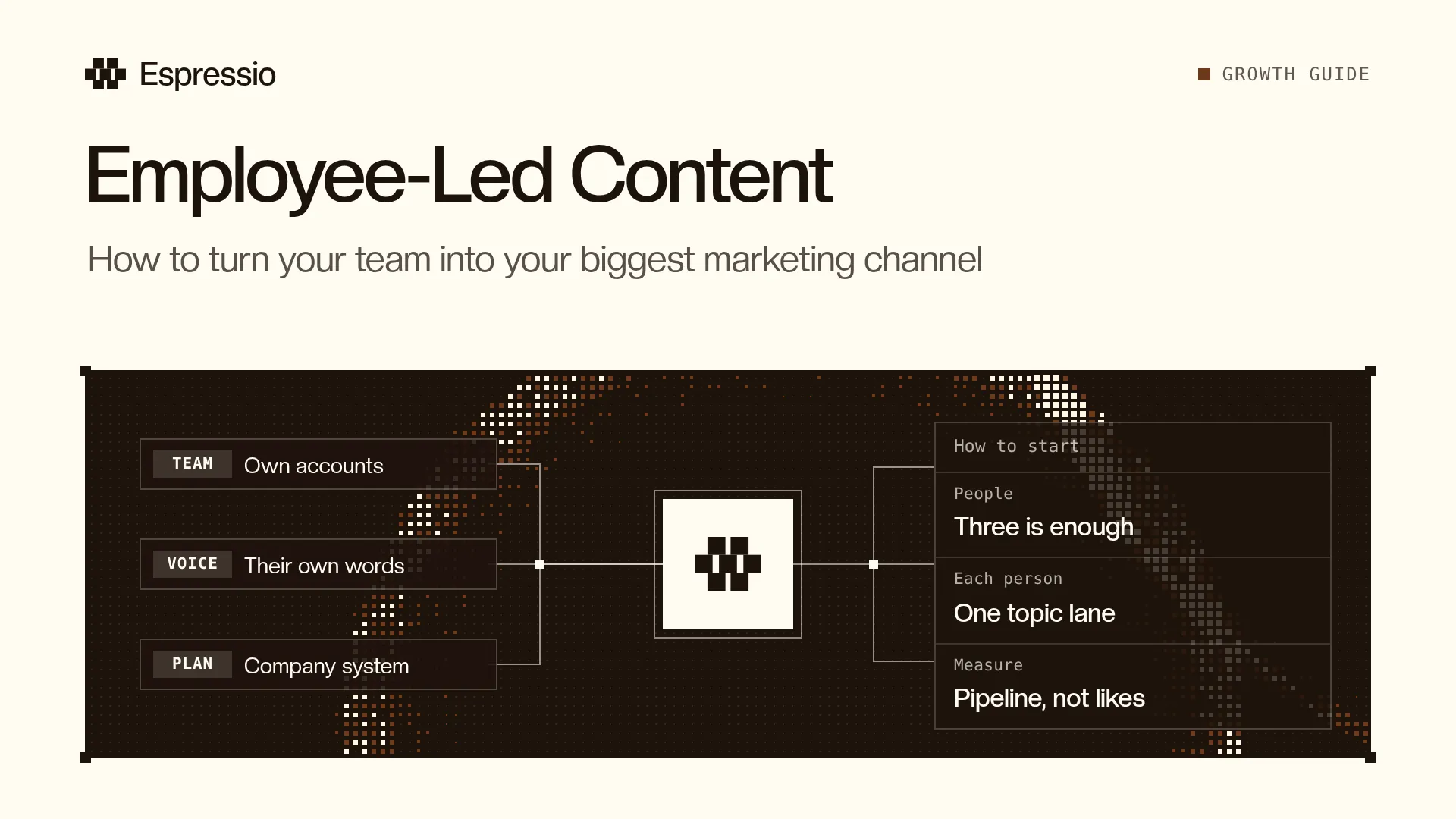
Start small. Fivos Aresti says it starts working with three or four regular posters and snowballs at 10+ (X, 28 October 2026). Julian Stafford’s plan is the same: three people, one lane each, for 30 days.
Week 1: Pick people and lanes
Choose three volunteers who already like to explain things. Give each one a lane, the topic only they own. For example:
- Builder lane: what the product team shipped, how and why.
- Customer lane: questions, mistakes and wins from real customer work.
- Market lane: what is changing in your category and what it means.
Fix their profiles first. Each bio should name the role and the company. On X, a company affiliate badge links the account to the brand, which is what makes counts like Mitchell’s possible. Julian Stafford’s breakdown puts that at about $1,000 a month for X Premium Business plus $50 per badge.
Week 2: Build the raw material feed
People stop posting when they run out of ideas, not time. Every week, send each person raw material for their lane:
- Customer questions from sales and support calls.
- Product changes and the reason behind them.
- Numbers you are happy to share publicly.
- Screenshots, demos and short clips.
- A list of what not to share, such as unreleased plans or customer names without permission.
A short brief beats a finished post. Postiv describes how Cognism gives colleagues an info pack with key messages and lets each person write in their own voice, so one launch becomes several different posts (Postiv).
Week 3: Go live with a simple rhythm
Ask for one post per person per weekday on X, or two to three a week on LinkedIn. Add a shared channel where people drop links so teammates can reply early. Keep review light: one person checks facts and anything sensitive within a few hours. If approval takes days, people stop.
Akanksha, writing about Wispr Flow’s team, listed a similar setup: the founder goes first, employees can post about what they want, a Slack channel collects every post, launches come with ready copy so taking part takes two minutes, and profiles share one small visual mark (X, 17 August 2026).
Week 4: Run the first launch together
Pick one product moment and have all three post from their lane on the same day. The founder takes the big announcement. The builder shows how it works. The customer lane explains who it helps. Then compare what each post did and keep the formats that worked.
After 30 days: Review and expand
Look at what each person posted, what got replies, and what led to a conversation. Keep the lanes that work. Add two or three more people. Add a public leaderboard or a small prize pool if your culture likes competition. Shown and Fivos Aresti’s team both use prizes.
How to measure employee-led content
Views are the easiest number and the least useful one alone. Measure it like a funnel:
| Stage | What to count | Where it comes from |
|---|---|---|
| Reach | Views and new followers per person | X and LinkedIn analytics |
| Fit | Share of new followers who match your buyer | Profile review or enrichment |
| Conversations | Replies, DMs and comments from buyers | Manual tag or CRM note |
| Meetings | Calls booked that started from a post | CRM source field |
| Pipeline | Deals and revenue touched by team posts | CRM |
Ask every new lead “where did you first hear about us?” and log the answer. Add a source field in your CRM for “team post” and name the person. After a quarter you’ll know which people and lanes bring buyers, not just views.
Common objections and how to handle them
“Our people don’t have time.” Most don’t need more time. They need a topic and raw material. A 20-minute weekly block and a brief per lane covers most of it.
“What if someone says the wrong thing?” Write a one-page guideline: what is fine to share, what isn’t, and who to ask. Sprout Social’s 2026 guide makes the same point: put guardrails in place before you put employees in front of the camera (Sprout Social, 11 February 2026).
“Can’t we just hire ghostwriters?” You can help people write. Don’t replace their voice. Julian Stafford’s advice is “do not outsource to ghostwriting agencies” because the posts have to come from your team, in their own words. Cost is the other issue. One founder on X called $6K per profile for 12 LinkedIn posts a month “bonkers” (X, 16 August 2026).
“What happens when people leave?” They take their audience with them. That’s the deal. While they are on the team, their reach works for you, and a team that posts well also helps you hire.
“Should we use an employee advocacy tool?” Use one if it saves time. As one marketer put it, “employee advocacy software should make employees forget they’re doing employee advocacy” (X, 28 August 2026). A tool that only pushes brand posts for resharing tends to produce flat, copied posts.
“Does this only work for tech companies?” No. Starbucks runs a Green Apron Creators program for its baristas and announced a TikTok Creator Network pilot for employee content in June 2026 (Marketing Dive, 23 June 2026). A local business can do the same with two or three people who like to post.
Where AI fits in employee-led content
AI should do the prep work, not the posting. Agents show up in marketing funnels and systems using Claude, Grok, Codex, and other AI solutions. In an employee-led program they are useful for:
- Research: pulling customer questions from call notes and support tickets into each lane’s weekly brief.
- Drafts: turning a voice note or a Slack message into a first draft the person rewrites.
- Tracking: counting views, replies and new followers per person every week.
- Reporting: matching posts to CRM leads so you can see which lanes bring meetings.
The post itself should still sound like the person. If people could swap names on a draft and nobody would notice, it isn’t employee-led content yet.
Related reading
- How the X algorithm works helps your team understand what the feed rewards.
- X clipping shows how to turn long videos into short posts your team can share.
- How to automate LinkedIn content with Claude and Make.com covers a drafting and approval flow you can give each person.
- Product launch marketing plan covers the launch day where the whole team posts together.
- How to build an AI marketing team with Grok Bot shows how to set up the research and reporting agents mentioned above.
Want help setting this up?
Espressio builds content writing systems for founder and team accounts, runs launches on X and ties the work to pipeline. If you want your team posting with lanes, a weekly raw material feed and reporting in place, book a call.
Frequently Asked Questions
What is employee-led content?
Employee-led content is content your team members publish from their own social accounts about their work, in their own words. The company supports it with topics, raw material, light review and credit. It is also called employee-generated content or team-led content.
What is the difference between employee-led content and employee advocacy?
Employee advocacy usually means employees reshare company posts, often through a tool. Employee-led content means employees create original posts about what they know. Original posts tend to reach further and read as more credible than reshared brand copy.
Is employee-led content better than founder-led content?
They work best together. Founder-led content sets the story and handles big moments. Employee-led content adds more voices, more audiences and more topics, so the company is not limited to one person’s time and network.
How many employees do you need to start?
Three is enough. Give each person one topic lane and run it for 30 days. Fivos Aresti says results start with three or four regular posters and grow quickly once 10 or more people post.
Which platform is best for employee-led content?
For B2B, LinkedIn and X. LinkedIn suits buyers who research vendors at work. X suits tech, AI and developer audiences and moves fast during launches. Consumer brands often do well on TikTok and Instagram, as Starbucks shows.
How do you measure employee-led content?
Track it like a funnel: views and followers per person, then replies and DMs from buyers, then meetings and pipeline. Add a “team post” source in your CRM and ask new leads where they first heard of you.
Should you pay employees for posting?
Some companies use prize pools or leaderboards. Shown’s own leaderboard counted 21M impressions on a $10K prize pool, according to Julian Stafford’s breakdown. Recognition, career growth and time set aside for posting matter as much as money for most people.
Get the latest AI workflows, tools and news
Sign up for the Espressio newsletter. We want to make you AI-native.
You're on the list.
The next issue goes to your inbox.