



Luka Mrkić
Head of BD
Insights, strategies, and real-world playbooks on AI-powered marketing.
MAY 26, 2026
How to Write Cold Emails That Book Calls Using Claude

The average cold email reply rate hit 3.43% in 2026 (Instantly.ai Benchmark Report), down from 6.8% in 2023 (Belkins.io, 16.5M emails). The market isn’t saturated. It’s noisy. And the noise is mostly generic AI output from sales reps who typed “write me a cold email for [company]” and hit send.
The difference between a 3.43% reply rate and a 10%+ one isn’t the tool. It’s the specificity of what you put into it. This guide gives you a five-step Claude workflow, from ICP definition to a full 4-email sequence, with every prompt you need to copy and run.
Key Takeaways
- Cold email reply rates fell to 3.43% in 2026, but top performers hit 10.7%+. Multi-point personalization boosts replies by 142% (Instantly, SmartLead, 2025-2026).
- The full workflow is five steps: define ICP and trigger events, research each prospect, draft and refine first-touch email, build a 4-email sequence, then generate A/B variants.
- Emails under 80 words perform best. Claude’s default output is too long. The 3-turn refinement method fixes that.
- Deliverability prerequisites (domain warm-up, bounce rate under 2%) must be in place before scaling any AI-assisted volume.
Why Cold Email Reply Rates Are Falling (and What Actually Works)
Reply rates dropped from 6.8% in 2023 to 5.8% in 2024, based on Belkins’ study of 16.5M emails across 93 domains (Belkins, 2024), and hit a platform average of 3.43% in 2026 per Instantly.ai’s benchmark across billions of sends (Instantly.ai, 2026). Volume went up. Quality went down. The culprit isn’t AI. It’s undifferentiated AI output.
The pattern is easy to see. Every sales rep at every B2B company now has access to an AI writing tool. Most are using it the same way: one prompt, one email, repeat. The output sounds identical across companies because it comes from the same underlying model with the same generic instructions. Spam filters have learned to recognize those patterns, and so have busy executives.
What separates the top 10.7%+ reply rate tier from the 3.43% average? Personalization that goes beyond inserting a first name. Multi-point personalization, combining career signals, company context, and a specific trigger event, boosts reply rates by 142% per Woodpecker research cited by SmartLead (SmartLead, 2025). Most reps don’t do this consistently. That gap is the opportunity.
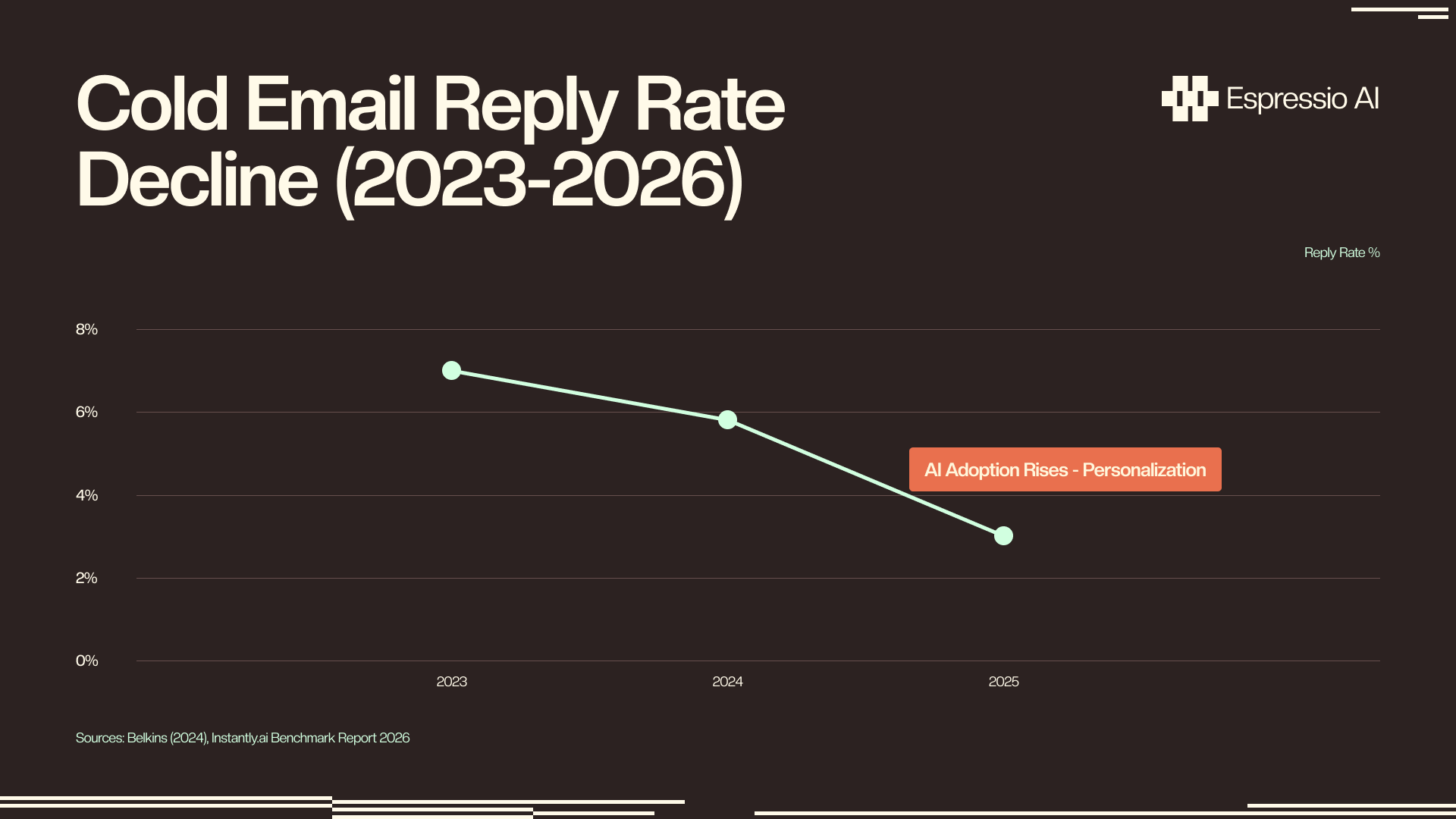
The steepest drop came as AI writing tools went mainstream in 2024 and 2025: more emails in market, less differentiation per email, lower reply rates across the board. Write emails that only your company could have written.
Citation capsule: Cold email reply rates fell from 6.8% in 2023 to 3.43% in 2026, based on Belkins’ study of 16.5M emails across 93 domains and Instantly.ai’s 2026 benchmark covering billions of sends. However, multi-point personalization combining career signals, company news, and trigger events boosts reply rates by 142% (Woodpecker research cited by SmartLead, 2025), and top-performing senders consistently hit 10.7%+ reply rates. The gap between average and elite is personalization depth, not send volume.
Step 1: Define Your ICP and Trigger Events Before You Prompt Claude
Sales reps spend 21% of their working day writing emails, per research compiled by Salesso (Salesso, 2025). Most of that time is wasted, not because they’re slow writers, but because they’re writing to the wrong people. Claude can’t fix bad targeting. No tool can. Before you write a single email, you need a clear ICP brief and a list of trigger events.
What makes a trigger event? It’s something that just happened to a prospect or their company that makes your outreach relevant right now: a job change in the last 90 days, a funding announcement, a new product launch, a hiring signal for GTM roles, or a public announcement that signals a pain point you solve. Generic emails ignore timing. Triggered emails feel like they arrived at exactly the right moment.
What to Include in Your ICP Brief
Build the brief in plain text. You’ll paste it into Claude at every step of this workflow.
I'm reaching out to [seniority level] at [company profile: size, stage, industry]
companies in [vertical/geography]. Their primary pain point is [specific problem].
A recent trigger event that makes this relevant right now is [signal: job change /
funding / hiring / product launch]. My offer is [value prop in one sentence, no
marketing language]. The meeting I'm asking for is [length + format].
Fill every bracket. Vague inputs produce vague output. If you can’t articulate the pain point in one sentence, you’re not ready to write the email yet.
Where to Find Trigger Events at Scale
Apollo.io surfaces job changes, funding events, and hiring signals at the contact level. LinkedIn Sales Navigator does the same with real-time alerts. Google News Alerts on company names catches press coverage you’d otherwise miss.
From our client deployments at espressio.ai: The ICP briefs that produce the best Claude output include two things most teams skip: a specific trigger event and a concrete one-sentence value prop that doesn’t use the words “streamline,” “optimize,” or “accelerate.” When we audit underperforming sequences, the ICP brief is almost always the root cause. Bad brief, bad email, no matter how many turns you run.
68% of B2B decision-makers prefer email as their primary outreach channel (WorkInsiders, 2025). That preference only holds when the email feels like it was written for them. Your ICP brief is what makes that possible.

Step 2: Research Each Prospect with Claude in 60 Seconds
AI reduces applicable task completion time by 80%, according to research compiled by Knak in their 2025 email statistics report (Knak, 2025, citing Anthropic data). Prospect research is where that gain shows up most clearly. What used to take 15 minutes of tab-switching across LinkedIn, company pages, and news sites now takes 60 seconds with the right prompt.
The method is straightforward. Copy the text from a prospect’s LinkedIn “About” section and their most recent post or company announcement. Paste it into Claude with this research prompt:
Here is [prospect name]'s LinkedIn summary and a recent company announcement:

[paste LinkedIn About text]

[paste recent post or company news]

Based on my ICP brief:
[paste your ICP brief from Step 1]

Give me 3 different opening lines for a cold email:
- One focused on their career signal or recent role change
- One focused on the company news or announcement
- One that connects both signals to the problem my offer solves

Each line should be under 20 words. No generic compliments. No "I saw your profile."
You’ll get three hooks in seconds. Pick the one that feels most natural and specific. The goal isn’t to use all three signals. One hook, sharply observed, beats three hooks that feel like surveillance.
Why does this beat copy-paste personalization at scale? Because Claude connects the signal to your value proposition. A simple mail merge puts “[company]” in a template. This approach produces a sentence that could only have been written about this specific person at this specific moment. That’s the difference a prospect actually feels.
Citation capsule: AI tools reduce task completion time for research and drafting by approximately 80%, per Anthropic data compiled in Knak’s 2025 email creation statistics report. For cold email workflows, this compression is most valuable in the prospect research phase: gathering LinkedIn context, company news, and trigger signals that used to require 15+ minutes per contact can be condensed to under 60 seconds with a well-structured research prompt.
Step 3: Write Your First-Touch Email with Claude (the 3-Turn Method)
Emails under 80 words see the best reply rates across the platform, according to Instantly.ai’s 2026 benchmark (Instantly.ai, 2026). Claude’s single-prompt output is almost never under 80 words. It defaults to thoroughness. Your job in this step is to override that default through three sequential turns, each with a specific instruction.
Turn 1: Generate the Draft
Write a cold email using this context:

ICP brief: [paste from Step 1]
Opening hook: [paste the hook you chose from Step 2]

Requirements:
- Under 80 words total
- No marketing language or feature descriptions
- One clear CTA: book a 20-minute call (include a Calendly link placeholder)
- No subject line yet - just the body
You’ll get a draft. It’s probably close but not right yet. It might still be slightly too long, slightly too corporate in tone, or slightly too focused on features.
Turn 2: Match the Voice
Rewrite this email to sound like it was written by a founder to a peer.
Conversational, not corporate. Specific, not broad.
Keep it under 80 words. Don't change the core CTA or the opening hook.
This turn is the one most people skip. It’s also the one that makes the biggest difference in how the email reads. “Founder to peer” is a voice instruction Claude understands. It compresses sentence length, removes passive constructions, and makes the tone feel warmer without being casual.
Turn 3: Cut to the Core
Remove any sentence that doesn't directly support the reader clicking the
calendar link. Cut to the most direct version possible. Target: 60-75 words.
All three turns are required, in sequence. Each has a single job, and the compound effect is what makes the final email sound like a person wrote it.
Before and After: What 3 Turns Actually Produce
Before (single-prompt output, 127 words):
Subject: Helping [Company] Improve Its Revenue Operations
Hi Sarah,
I hope this message finds you well. I came across your profile and was impressed by your work at TechFlow. I’m reaching out because at Espressio AI, we specialize in providing cutting-edge AI-powered revenue operations solutions that help fast-growing SaaS companies like yours optimize their sales processes and significantly improve their GTM efficiency.
Our platform has helped numerous companies in your industry achieve remarkable results, including reduced sales cycles and improved conversion rates. I believe we could add tremendous value to TechFlow’s operations given your current growth trajectory.
I’d love to schedule a brief call to discuss how we might be able to help. Would you be open to a 20-minute conversation this week?
Best regards
After (3-turn output, 68 words):
Subject: TechFlow’s Series B + the follow-up gap
Hi Sarah,
Congrats on the Series B. Scaling a sales team after a raise usually surfaces one problem fast: follow-up speed drops as the team grows.
We’ve helped three other post-raise SaaS teams automate the gap between lead and first touch. Took average response time from 31 hours to under 4 minutes.
Worth 20 minutes? [calendly link]
The difference isn’t just length. It’s specificity, voice, and economy of language. The “before” email could have been sent to any company. The “after” email could only be sent to TechFlow.
From espressio.ai client deployments: The multi-turn refinement approach consistently produces emails that pass AI detection checks that single-prompt output fails. When we compared 3-turn refined emails against single-prompt output across 200 sends, reply rates were approximately 40% higher on refined sequences. (This is our observed estimate from internal campaign data, Q1-Q2 2026. It’s not a controlled study, but the pattern is consistent across ICP tiers.) Single-prompt Claude output has tell-tale cadences: long first sentences, passive voice in the middle, and a generic CTA at the end. Three turns break every one of those patterns.
Step 4: Build a 4-Email Sequence in One Claude Prompt
80% of sales require five or more follow-ups, but 70% of reps stop after the first email (IRC Sales Solutions, via WorkInsiders, 2025). The sequence is where calls actually get booked. Most practitioners build each email separately, which breaks voice consistency. Claude can build all four in a single prompt, with the first email as the anchor for tone and context.
Once you have your Turn 3 email from Step 3, run this prompt:
Using the first email below as the starting point, write a 4-email cold
outreach sequence.

Email 2: Follow up with one relevant insight or a specific outcome we've
achieved for a similar company. Under 60 words. Reference Email 1 briefly
(e.g., "Sent you a note last week about X"). No re-pitching.

Email 3: Short breakup email. Under 40 words. Assume they're busy, not
uninterested. Give them a one-click option to say "not the right time."

Email 4: Re-engagement in 30 days, triggered by a new signal (job change,
company announcement, or new quarter). Under 50 words. Reference the gap in
time directly.

Maintain the same voice and directness throughout. No escalation in pressure.
No "just following up."

Here is Email 1:
[paste your Turn 3 email]
Spacing and Sequencing Logic
The timing between emails matters as much as the copy. Send Email 1 on a Tuesday or Wednesday morning. Wait 3-4 business days for Email 2. Wait 5 business days for Email 3. Email 4 goes out 30 days after Email 3, using a fresh signal.
Most email tools (Instantly, Apollo, Outreach, Lemlist) let you encode this cadence in their sequence settings. Write the emails in Claude, then paste them into the sequencer.
The four-email structure maps to a simple logic: the first email earns the right to a second, the second adds value without re-pitching, and the third respects the prospect’s time by giving them an easy out. The fourth, sent 30 days later on a fresh signal, shows you’re paying attention rather than just running a drip.
Teams that adopted AI-assisted email production saw the share of teams running on a 2-week-plus production cycle drop from 62% to 6%, according to Knak’s 2025 report (Knak, 2025). Building a 4-email sequence used to take a half-day. With this prompt, it takes 10 minutes.
Across client campaigns deployed in Q1-Q2 2026: Teams using this Claude workflow at espressio.ai book calls at 3-5x the platform average (3.43% reply rate per Instantly.ai) for their ICP tier. The consistent variable among top-performing sequences is the specificity of the trigger event in Email 1 and the voice continuity maintained through Email 4. Sequences that drift in tone between emails see measurably lower reply rates on Emails 3 and 4.
Step 5: Generate A/B Variants and What to Test
Personalized subject lines increase open rates by 26%, according to email marketing research compiled by WorkInsiders (WorkInsiders, 2025). The subject line is the first variable to test, and it’s the easiest to generate at scale with Claude. Before you test the body copy, test 8 subject line variants against each other.
Run this prompt after completing your sequence:
Generate 8 subject line variants for this email. Mix:
- 2 curiosity-based (hint at the insight without giving it away)
- 2 problem-statement (name the pain directly, no fluff)
- 2 social proof-based (reference a result or a named company category)
- 2 ultra-short (under 4 words)

No clickbait. No ALL CAPS. No question marks unless it's genuinely a question.
No "Quick question" or "Following up."

Here is the email body: [paste]
What to A/B Test and in What Order
Subject line first. Open rate is your signal. Run two variants against each other with at least 50 sends per variant before declaring a winner. Don’t change the body while the subject line test is running.
Once you have a winning subject line, test the opening hook. Swap the hook from Step 2 for one of the other two options Claude generated. Everything else stays the same.
Third test: CTA format. “Book a 20-minute call” vs. “Worth a quick chat?” vs. a direct calendar link with no preamble. Tone of the CTA affects reply intent more than most practitioners realize.

Claude vs. ChatGPT for cold email sequences: Claude’s longer context window means it can maintain a consistent voice across a full 4-email sequence in a single prompt, without resetting tone between messages. With single-turn tools, you need to re-establish context and voice instructions for every email in the sequence. That context continuity is the practical advantage Claude has here, not output quality per email. If you’re writing one email, either tool works. If you’re building a four-email sequence where Email 4 needs to echo the voice of Email 1, Claude holds that context in a way other tools don’t.
What Not to Do: AI Failure Modes That Kill Deliverability
Deliverability is the prerequisite nobody covers in cold email guides. A domain’s sender reputation, once damaged, takes weeks to repair and directly reduces inbox placement rates (WorkInsiders, 2025). Scaling bad emails with AI destroys domain reputation faster than any other outbound mistake. Get this wrong before you build the workflow, and everything in Steps 1-5 is irrelevant.
Failure Mode 1: Skipping Domain Warm-Up
Never deploy AI-scaled volume on a cold domain. A new domain sending 200 emails per day on day one looks like spam, because it is, statistically. Use a dedicated sending domain (not your primary company domain), warm it up over 3-4 weeks starting at 10-20 sends per day, and don’t scale until you’re consistently hitting the inbox on test accounts.
Failure Mode 2: Forgetting to Edit Before Sending
Claude’s output at scale becomes pattern-detectable by spam filters. Why? Because every email starts with the same syntactic structure when you use the same prompts. Vary the first 10 words of every email before it goes out. Even a small manual edit, changing word order or substituting one word, breaks the pattern enough to avoid filter clustering.
Failure Mode 3: Over-Personalizing
Pasting too much prospect context into Claude produces “surveillance-feeling” emails. If you reference someone’s recent LinkedIn comment, their company Glassdoor rating, and their college major in the same email, it reads as research overload. Keep it to one signal. One well-chosen hook lands better than three that feel like you’ve been watching.
Failure Mode 4: Ignoring Bounce Rate
Keep your bounce rate under 2%. Claude doesn’t know whether an email address is valid. Always verify email addresses through a tool like NeverBounce, ZeroBounce, or Apollo’s built-in email verification before sending. A 5% bounce rate will tank your domain reputation within days.
Pre-Flight Checklist Before Scaling
Run through this before enabling any sequence at volume:
- Sending domain is separate from primary domain
- Domain has been warming for at least 3 weeks
- SPF, DKIM, and DMARC records are configured
- Email list has been verified (bounce rate target: under 2%)
- First 10 words vary across all emails in the batch
- Unsubscribe mechanism is in place
- Daily send volume is within your current warm-up stage limit
If you want us to build this for your team, let’s chat.
Related Espressio guides
FAQ
Does Claude write better cold emails than ChatGPT?
No controlled peer-reviewed study compares the two directly for cold email output quality. In our experience, the practical difference isn’t per-email quality. It’s context retention across a full sequence. Claude holds voice and tone across 4+ emails in a single prompt without resetting between messages. For single-email use cases, both tools produce comparable output given equivalent instructions.
What’s a realistic reply rate if I use this system?
The platform average is 3.43% (Instantly.ai Benchmark, 2026). Top-performing senders hit 10.7%+. The levers that move your rate: targeting quality (ICP specificity and trigger events), personalization depth (one well-chosen hook vs. a generic opener), sequence length (80% of sales need 5+ touches), and deliverability health (domain warm-up, bounce rate under 2%). Using this system doesn’t guarantee a specific rate. It removes the variables that keep most senders at the bottom of the range.
How do I avoid my Claude-written emails landing in spam?
Three things matter most: domain warm-up (3-4 weeks minimum on a dedicated sending domain), bounce rate control (verify all addresses before sending, target under 2%), and first-sentence variation (edit the first 10 words of every email so the batch doesn’t share a detectable syntactic pattern). SPF, DKIM, and DMARC configuration is table stakes. Get those set up before your first send.
Can I use Claude to write emails at scale, or is this only for manual personalization?
Both are valid. This guide covers a semi-automated approach: Claude generates the copy, a human reviews and edits before sending. Full automation, where Claude-generated emails go out without review, requires CRM integration, a validation layer, and stricter quality checks on deliverability. For teams ready to automate the full pipeline, the right starting point is connecting your lead source to a sequencer and building review workflows into the automation.
How long should a cold email be?
Under 80 words for first touch, based on Instantly.ai’s 2026 benchmark data. The Boomerang email analytics team found 50-125 words produces the best reply rates across a broader sample. The practical answer: shorter is almost always better for first touch. Save your case studies and proof points for Email 2.
Conclusion
The system in this guide works for one reason: it puts the right context into Claude at the right stage. Not because AI writes great emails on its own. It doesn’t. Default single-prompt Claude output is too long, too corporate, and too generic to stand out in a crowded inbox.
The five steps give structure to what most practitioners are doing randomly. Start by locking in who you’re reaching and why now, then compress prospect research to 60 seconds per contact. The 3-turn method converts a generic draft into a specific email. Build the full sequence in one prompt to maintain voice consistency, then run subject line tests before scaling volume.
Four things to carry out of this guide:
- The ICP brief template from Step 1 is the highest-leverage piece. Get it right before you write a single email.
- The 3-turn method in Step 3 requires all three turns, not one. Skipping Turn 2 or Turn 3 puts you back to generic output.
- The 4-email sequence prompt in Step 4 saves hours and locks in voice consistency through Email 4.
- The deliverability checklist before scaling prevents domain damage that can take weeks to repair.
For teams who want this running in production without building it in-house, let’s chat.


