Kimmo Hakonen
Chief Innovation Officer
Insights, strategies, and real-world playbooks on AI-powered marketing.
JUN 29, 2026
Inside NVIDIA's AI Ecosystem: A Practical Guide for Builders
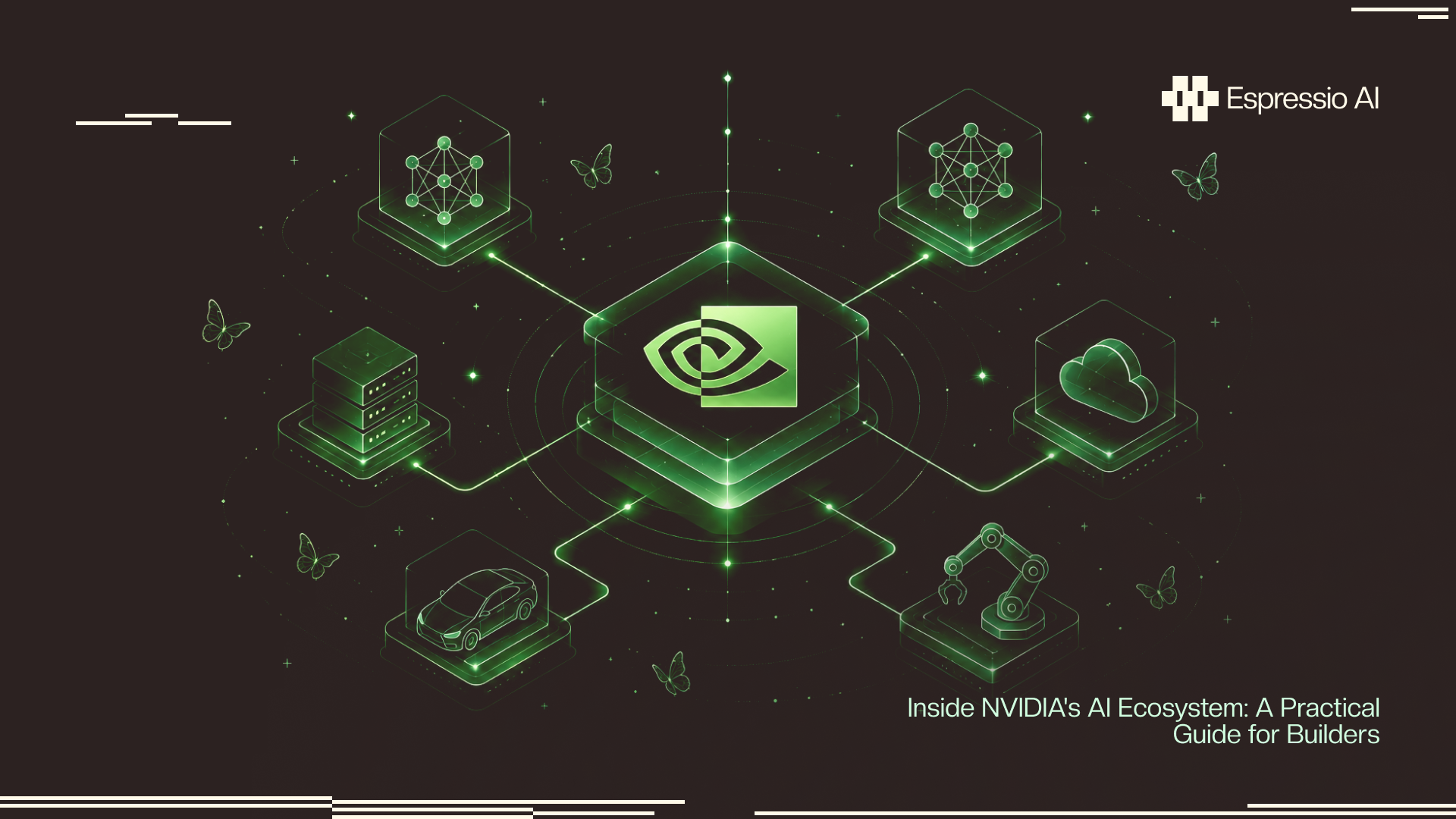
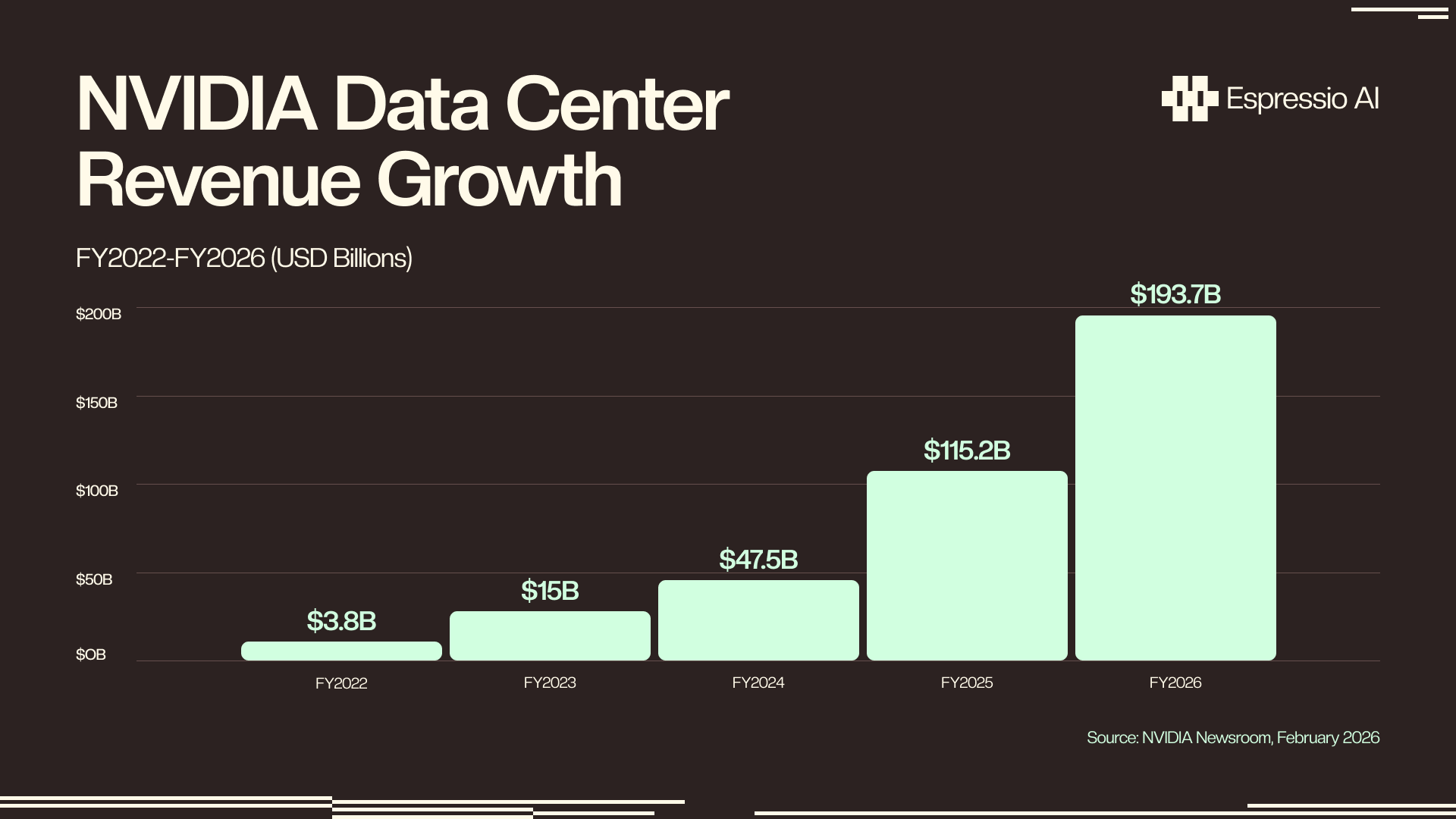
NVIDIA’s data center revenue hit $193.7B in FY2026 — up 68% year-over-year (NVIDIA Newsroom, Feb 2026). Most coverage describes the hardware or lists the product names. Builders need a map: which layer does what, how the pieces connect, and where to start without an enterprise contract.
This article maps every layer of the NVIDIA AI ecosystem — from CUDA to AgentIQ — with practical entry points for developers, architects, and growth teams.
Key Takeaways
- NVIDIA holds ~83% of the AI accelerator market, built on a CUDA ecosystem of 5M+ developer program members that has accumulated over a decade of optimized libraries and framework integrations (Silicon Analysts, 2026)
- NIM Microservices give developers access to 100+ production AI models via free API at build.nvidia.com — no GPU, no credit card, 40 requests per minute
- NeMo and AgentIQ form the agentic layer; AgentIQ (open-source, announced GTC 2026) composes multi-agent pipelines across LangChain, LlamaIndex, CrewAI, and raw Python
- AI Enterprise adds SLAs and on-prem deployment — most growth-stage teams reach production on the free NIM tier before needing it
- 88% of organizations using NVIDIA AI report increased annual revenue; 87% report cost reduction (NVIDIA State of AI 2026, n=3,200+)
Why NVIDIA Dominates AI Infrastructure (And Why It’s Not Just the Hardware)
NVIDIA holds approximately 83% of the AI accelerator market by revenue, generating $193.7B in data center revenue in FY2026, though that figure understates the actual moat (Silicon Analysts, 2026). Total company revenue reached $215.9B, up 65% year-over-year (NVIDIA Newsroom, Feb 2026). Understanding why that lead compounds rather than erodes requires looking past the chips.
The NVIDIA Developer Program has 5M+ members and over a decade of optimization work accumulated inside it (NVIDIA Technical Blog, Jul 2024). Every major AI framework (PyTorch, TensorFlow, JAX) runs natively on CUDA. The optimized libraries — cuDNN for deep learning primitives, TensorRT for inference, RAPIDS for data processing — encode performance improvements that took years to build. IDTechEx projects the AI chip market will exceed $400B in annual revenue by 2030 (IDTechEx, 2025), and NVIDIA sits at the center of that curve with the highest accumulated tooling investment by a wide margin.
AMD GPUs are competitive on benchmark sheets. They’re less so in practice because switching away from CUDA means abandoning 10+ years of tooling, model checkpoints trained on CUDA hardware, and a developer community that writes code assuming CUDA. The switching cost isn’t in the chip price — it’s in the ecosystem debt. Hardware can be replicated in two years; a developer ecosystem built over a decade cannot. That’s the moat.
The CUDA ecosystem backing NVIDIA’s market position has 5M+ developers and more than 10 years of accumulated optimization work. PyTorch, TensorFlow, and JAX all run on CUDA natively, and virtually every production model checkpoint in wide use was trained assuming CUDA hardware. Switching to a competing accelerator means rebuilding that foundation, not just swapping chips (Silicon Analysts, 2026; NVIDIA Newsroom, Feb 2026).
The NVIDIA AI Stack, Layer by Layer
The NVIDIA AI platform has five layers from bare metal to your application, and which layer you build on determines performance, cost, and how much flexibility you retain long-term. Most articles describe one.
Layer 1: CUDA and GPU Hardware. The foundation. All AI compute runs here. NVIDIA’s current training-class chips are the H100, H200, B100, and B200 (Blackwell architecture); the L40S is optimized for inference workloads. Without CUDA, none of the software layers above would work, which is why the GPU choice locks in everything downstream.
Layer 2: CUDA-X Libraries. This is where raw GPU performance gets translated into usable AI speed. cuDNN handles deep learning primitives; TensorRT optimizes inference graphs; RAPIDS accelerates data processing. These libraries are what make NVIDIA GPUs 10–100x faster than a naive Python implementation on the same hardware. Most developers never touch them directly; they’re invoked automatically by PyTorch and TensorFlow.
Layer 3: NIM Microservices. Pre-packaged, optimized inference containers for 100+ models: the “plug in and run” layer. A Docker container with the model weights, optimized runtime, and monitoring already bundled. NIM is where most growth teams and developers make first contact with the NVIDIA ecosystem. For , NIM is the inference backend.
Layer 4: NeMo and AgentIQ. The agentic layer. NeMo handles fine-tuning and agent orchestration; AgentIQ (open-source, released at GTC 2026) is the toolkit for composing multi-agent pipelines across any framework. This is where teams move from calling a single model to building systems that coordinate multiple models across steps.
Layer 5: NVIDIA AI Enterprise. The production license layer. On top of all the open layers, Enterprise adds SLAs, security scanning, enterprise integrations, and dedicated support. It’s what hospitals, banks, and defense contractors need. A growth-stage startup doesn’t need it on day one.
Most growth teams plug in at Layer 3 (NIM API) or Layer 5 (AI Enterprise via a cloud partner); Layers 1 and 2 are transparent infrastructure working silently beneath. Understanding all five prevents vendor lock-in surprises when you scale.
The NVIDIA AI stack runs from CUDA (hardware optimization) through NIM (inference) and NeMo (agent orchestration) to AI Enterprise (production licensing), each layer depending on the one below it. The layer you start building at determines your cost structure, performance ceiling, and long-term flexibility (NVIDIA Technical Blog, Mar 2024).
NVIDIA NIM — The Fastest Way to Run Production AI
NIM delivers 2.6x higher throughput than open-source baselines on H100 hardware (1,201 versus 613 tokens per second) and 4x faster time-to-first-token (NVIDIA Technical Blog / Introl, Feb 2026). That gap separates features you can ship from ones that are technically correct but too slow to use in production.
NIM is a Docker container bundling an AI model’s weights, an optimized inference runtime (TensorRT-LLM for language models), and a monitoring endpoint. Pull the container, run it, call it via an OpenAI-compatible API. No custom SDK, no GPU management required. The optimization is already done.
The free tier lives at build.nvidia.com. Create an account, choose from 100+ models (Llama, Mistral, Phi, Nemotron, Stable Diffusion, and more), and start calling the API immediately. The rate limit is 40 requests per minute, with no credit card or GPU needed. You’re calling NVIDIA’s hosted endpoints.
For NIM specifically, AI Enterprise includes downloadable containers for private deployment on up to 16 GPUs per developer seat, enterprise SLAs, security scanning, and 24/7 NVIDIA support. Pricing is approximately $4,500 per GPU per year, or per-use pricing on AWS, Azure, and GCP (NVIDIA AI Enterprise Pricing).
Why does the performance gap matter in practice? Cloudera achieved 36x faster LLM inference performance with NIM on H100 hardware (Cloudera, Oct 2024). For growth teams, throughput differences in the 2–3x range determine whether a feature is usable in a live customer interaction or only viable as a background batch process.
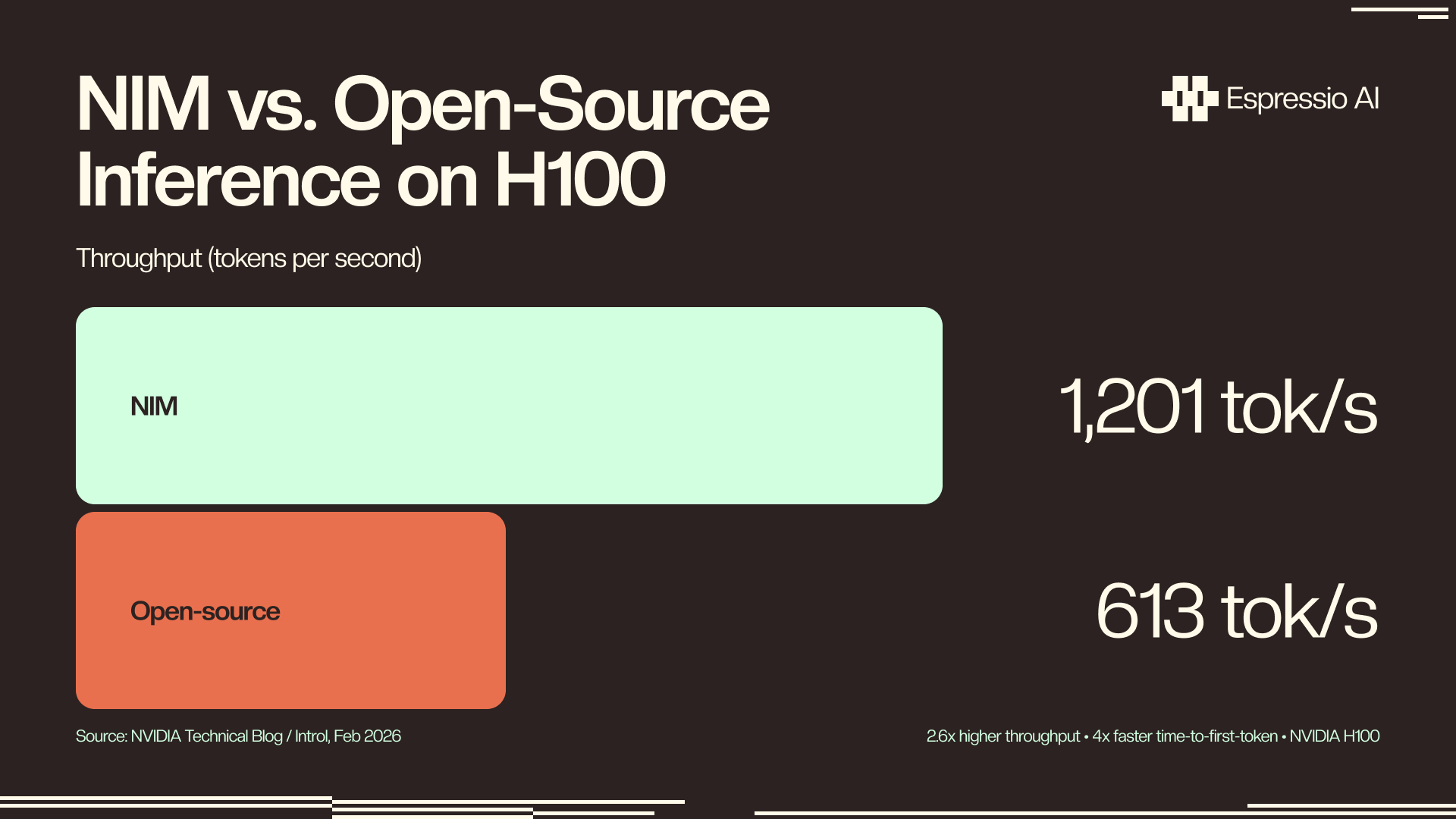
NVIDIA NIM delivers 2.6x higher throughput than open-source baselines on H100 GPUs (1,201 vs. 613 tokens/sec), with a free tier covering 100+ models at 40 requests per minute (no GPU or credit card required). NIM enables “10–100x more enterprise application developers to contribute to AI transformations,” according to NVIDIA’s Technical Blog (Mar 2024). Removing the infrastructure burden is what makes the ecosystem accessible beyond the GPU-fluent few.
NeMo and AgentIQ — Building Agents, Not Just Models
88% of organizations using NVIDIA AI report increased annual revenue; 87% report cost reduction, per NVIDIA’s State of AI 2026 survey of 3,200+ respondents (NVIDIA State of AI Report 2026). The gains come disproportionately from multi-step agentic pipelines, not single-model inference calls. That’s what NeMo and AgentIQ are built for.
NeMo has two distinct components that most builders conflate. NeMo Framework is the original library, battle-tested for training and fine-tuning large language models. If you’re customizing a Llama model on your proprietary data, NeMo Framework is the tool. NeMo Microservices is something different: a newer, modular agentic layer with four components — NeMo RL (reinforcement learning), NeMo Automodel (model adaptation), NeMo Gym (agent evaluation environments), and NeMo Retriever (RAG infrastructure). NVIDIA is actively splitting the NeMo architecture into this modular form. Most builders haven’t caught up to the distinction.
AgentIQ sits on top of both. Announced at GTC 2026, it’s an open-source toolkit for composing multi-agent pipelines across any framework (LangChain, LlamaIndex, CrewAI, or raw Python). Its defining feature is framework agnosticism; you don’t have to rebuild your orchestration layer to use it.
For most growth teams, the right architecture is simpler than it sounds: NIM API for inference, plus your existing orchestration layer (LangChain, n8n, custom Python). NeMo Microservices and AgentIQ become relevant when you’re building proprietary agent pipelines that need fine-tuning loops, evaluation environments, and the ability to customize behavior at the model level, not just the prompt level. That’s a later-stage need for most companies building on the NVIDIA stack today. For , NIM API plus a lightweight orchestration layer covers the vast majority of practical use cases.
88% of organizations using NVIDIA AI report increased annual revenue and 87% report measurable cost reduction, per NVIDIA’s State of AI 2026 survey (n=3,200+ across industries). The pattern driving both outcomes is the same: replacing repeatable, multi-step manual workflows with agent pipelines that run consistently at scale (NVIDIA State of AI Report 2026).
NVIDIA AI Enterprise — When the Free Tier Isn’t Enough
The free tier at build.nvidia.com covers prototyping and early production for most growth teams. AI Enterprise becomes the relevant choice under four specific conditions: you need SLA-backed uptime, you need downloadable models for on-prem or private cloud, your industry requires security scanning, or you need dedicated NVIDIA support. Before any of those apply, Enterprise is overhead.
AI Enterprise is a software subscription covering NIM, NeMo Microservices, RAPIDS, and Fleet Command; validated on all major cloud providers and VMware; with enterprise-grade support SLAs on top. It’s the full NVIDIA AI stack with production guarantees.
The clearest use cases for Enterprise: regulated industries (healthcare, financial services, defense) where data can’t leave a private environment; enterprise accounts running 10+ GPU nodes at sustained load; and teams where API downtime translates directly to lost revenue.
Growth-stage startups running inference via the NIM API probably don’t need it yet. The free tier’s rate limits are workable at startup scale, the API-compatible interface makes migration straightforward when ready, and skipping the SLA is an acceptable tradeoff while still iterating on the product.
86% of organizations are increasing AI budgets in 2026, and 40% are increasing by more than 10% (NVIDIA State of AI Report 2026). That budget growth pulls teams toward more durable infrastructure choices, but most growth-stage teams reach meaningful production volume on the free NIM tier before the Enterprise license becomes financially rational.
86% of organizations are increasing AI infrastructure budgets in 2026, and 40% are increasing by more than 10%. The determining factor for choosing between the free NIM tier and AI Enterprise isn’t budget; it’s whether your data can leave your cloud tenancy and whether downtime costs more than the contract does (NVIDIA State of AI Report 2026).
Practical Starting Points by Role
The right entry point into the NVIDIA AI ecosystem depends entirely on your role. A developer who starts by evaluating AI Enterprise will waste weeks. A growth leader who starts by reading CUDA documentation will never ship. Three separate paths, each optimized for its audience.
If you’re a developer, start building immediately:
- Create a free account at build.nvidia.com
- Browse 100+ NIM-powered model endpoints (Llama 3, Mistral, Phi-3, Nemotron, Stable Diffusion, and more)
- Call any model using OpenAI-compatible API syntax; your existing LangChain or OpenAI SDK code works without modification
- You get 40 requests per minute at no cost, with no local GPU required
- Prototype locally, benchmark latency for your use case, then decide whether to productionize on cloud infrastructure or apply for the Enterprise tier
If you’re an architect designing production pipelines:
- Pull the NIM throughput benchmarks for your target model family on the hardware you’re evaluating (NVIDIA publishes these per-chip, per-model)
- Map your architecture: which models run as NIMs on dedicated GPU infrastructure? Which run via the hosted API? Where does your orchestration layer live?
- Evaluate AgentIQ if you’re building multi-agent systems; it integrates with LangChain, LlamaIndex, CrewAI, and raw Python without requiring a full framework migration
- Assess the AI Enterprise licensing threshold: if data tenancy requirements mean models can’t leave your cloud environment, Enterprise is the answer; if not, the hosted NIM API plus standard cloud GPU instances covers most production scenarios
If you’re a growth leader, start with NVIDIA Inception before anything else. It’s free, 40,000+ startups are already members as of mid-2026 (Thunder Compute, 2026), and it comes with compute credits, partner discounts, and early access to NIM blueprints. From there, map the workflows most ripe for AI: content production, lead scoring, proposal generation, and competitive monitoring are the four highest-ROI starting points for most growth teams.
Then evaluate vendors and AI systems partners who build on NIM. Their choice of model family determines your performance floor and cost predictability at scale. Criteo saved roughly 17,000 GPU hours annually after switching model training to NVIDIA Blackwell GPUs (NVIDIA Blog, 2026); that’s the performance ceiling the infrastructure powering is built on.
NVIDIA Inception has 40,000+ startup members as of mid-2026, providing compute credits, partner discounts, and early access to NIM blueprints. It’s the practical on-ramp for growth-stage companies evaluating AI infrastructure before committing to an Enterprise contract (Thunder Compute, 2026).
Real-World Use Cases — What Growth Teams Actually Build
Criteo achieved a 2x speedup in AI model training using NVIDIA Blackwell GPUs, saving approximately 17,000 GPU hours annually (NVIDIA Blog, Cannes Lions, 2026). The use cases that actually drive results for marketing and sales teams are the operational ones: content at volume, personalized outbound, and proposal generation. These aren’t the enterprise transformation stories NVIDIA leads with in its marketing; they’re the workflows that eliminate repeatable manual work at the bottlenecks where revenue leaks.
Content production pipelines. NIM API plus an orchestration layer (n8n, LangChain, or custom Python) generates, edits, routes for review, and publishes content at volume. The Criteo case provides the performance ceiling: the same Blackwell infrastructure powers ad personalization and content generation at enterprise scale.
Competitive intelligence agents. The architecture is straightforward: a scraping layer (Firecrawl) feeding structured data into NIM inference, with results routed to Slack. Growth teams are running this today on the free NIM tier. The only infrastructure cost is the orchestration layer.
Personalized outbound follows a similar pattern. A NIM-backed language model combined with intent signal data produces outreach that reads as prospect-specific because it is. The signal layer does the targeting, NIM provides the inference, and the differentiation lives in what triggers the generation.
Meeting intelligence runs as a three-step pipeline: transcription, extraction, then proposal generation, all via NIM API. Latency at each step determines whether the feature works inside a live sales call or only as a post-meeting batch process.
From the Espressio AI team: When we built the RevenueOS pipeline on NIM-backed inference, the latency improvement over direct API calls was the difference between a 30-second proposal draft and a 3-second one. At 3 seconds, the feature is usable inside a live sales call. At 30, you’re asking the rep to wait — and they won’t.
Our stack: Espressio AI’s Content OS and RevenueOS both run on NIM API endpoints — Llama and Nemotron families for structured generation tasks. We chose NIM over direct API calls for two reasons: throughput consistency under concurrent load is measurably better, and the OpenAI-compatible interface meant zero SDK migration cost when we made the switch.
Frequently Asked Questions
What is NVIDIA NIM?
NIM (NVIDIA Inference Microservices) are pre-packaged, optimized AI model containers that run on NVIDIA GPUs. They deliver production-ready inference for 100+ models (Llama, Mistral, Stable Diffusion, and more) with a free tier at build.nvidia.com (40 requests per minute, no credit card required) and an enterprise license for on-prem deployment on your own GPU infrastructure.
How does NVIDIA AI Enterprise differ from the free tier?
The free tier runs inference via NIM API at build.nvidia.com, rate-limited at 40 RPM with no local GPU required. AI Enterprise adds downloadable NIM containers for private deployment on up to 16 GPUs per developer seat, enterprise SLAs with defined uptime guarantees, security scanning, and 24/7 NVIDIA support. Most growth-stage teams start on the free tier and sustain production there before the Enterprise license becomes justified.
What is the difference between NVIDIA NeMo Framework and NeMo Microservices?
NeMo Framework is NVIDIA’s original library for training and fine-tuning large language models — the tool for teams customizing model behavior on proprietary data. NeMo Microservices is the newer modular agentic layer (NeMo RL, Automodel, Gym, and Retriever) designed for building and evaluating AI agent pipelines. AgentIQ, released at GTC 2026, is the open-source toolkit for composing multi-agent systems across LangChain, LlamaIndex, CrewAI, or custom Python.
How do I start building with NVIDIA AI for free?
Go to build.nvidia.com, create a free account, and browse the 100+ NIM-powered model endpoints available immediately. Call any model using standard OpenAI-compatible API syntax, no new SDK needed, no GPU required. The free tier supports 40 requests per minute. When you’re ready for production-grade SLAs or need to run models inside your own infrastructure, that’s when AI Enterprise enters the picture.
What NVIDIA AI tools are most useful for marketing and sales teams?
NIM API for fast, cost-predictable inference powering content generation, email personalization, and meeting summaries. NeMo Retriever for grounding AI outputs in your CRM data and internal documents. AgentIQ for orchestrating multi-step autonomous agents that coordinate across multiple models. The NVIDIA Inception program (free to join, 40,000+ startup members) provides compute credits and partner discounts specifically designed for growth-stage teams evaluating AI infrastructure.
Conclusion
NVIDIA’s position in AI infrastructure isn’t primarily about hardware performance — it’s about ecosystem depth. Five million developers, 10+ years of CUDA-optimized libraries, and every major AI framework built to run natively on the same stack. That’s what makes the lead compound.
The practical implications for growth teams building today:
- NIM Microservices are the fastest path to production AI: 100+ models, free at build.nvidia.com, OpenAI-compatible API
- NeMo + AgentIQ is the agentic layer for teams who need more than single-model inference; start with AgentIQ when orchestrating multi-step pipelines
- AI Enterprise is a governance and deployment layer, not a capability upgrade. Most growth-stage teams don’t need it until data residency or uptime SLAs require it
- NVIDIA Inception is the fastest on-ramp for startups: compute credits, partner discounts, early blueprint access, and 40,000+ peers already building on the same stack
- The question matters as much as the infrastructure choice; the stack is only as valuable as the use cases you identify for it
If you want us to build this for your team, let’s chat.