How to Hire AI Automation Services (and What It Costs)
Hire AI automation services with confidence: provider types, the skills to look for, how to test a builder, the first month and what drives cost.

On this page
- 01What AI automation services are
- 02Before you hire: scope the work
- 03Who can do it for you
- 04The five options side by side
- 05The skills to look for
- 06How to choose: test before you commit
- 07How hiring works, step by step
- 08What it costs
- 09What to agree with your provider
- 10What changes when it works
- 11Where Espressio fits
- 12FAQ
Key takeaways
- AI automation services are the design, build and upkeep of workflows where software, and sometimes an AI model, does a repetitive task for your team.
- Five kinds of providers do this work: automation agencies, consultancies, freelancers, platform partners and dedicated remote specialists.
- Before you hire, list the three or four manual tasks that cost your team the most time. That list becomes the brief.
- The best way to pick a provider is a small paid test project on one of your real tasks.
- You pay for the build once, then a monthly cost for the platform, the AI model and upkeep. How many processes, systems and runs you have decides the price.
Searching for AI automation services returns dozens of agency pages that say “hours saved” but rarely explain what you get, who you should hire or what it costs. This guide explains it in plain terms.
It is for the founder or ops lead whose team already uses ChatGPT and a few Zapier or Make automations, and who feels there is a version of the business where much of the manual work simply disappears. Getting there takes someone who can look at how your company runs, spot what is worth automating and then build it.
What AI automation services are
Think of it as three levels of automation:
- Automations that repeat. They move data between apps or trigger an action, with no person in the middle. Example: a new form entry becomes a CRM contact.
- Automations that read. The same, plus an AI step that understands text. Example: it reads an email and decides if it is a sales lead or a support question.
- Agents that decide. The AI picks which tools to use and in what order. Example: it researches a new lead, scores it and writes a note for sales.
A provider of AI automation services designs, builds and looks after these automations for you. What you get is not “AI”. It is a process that runs on its own, with a clear start, a clear result and someone in charge of it.
What it looks like in practice
Most first projects are small and very concrete:
- Lead routing: new leads go to the right sales rep automatically, with a short summary.
- Client intake: answers from an intake form land in your project management tool, with the project set up.
- First drafts: recurring documents, such as proposals or weekly updates, start as a draft so your team edits instead of starting from zero.
- Reporting: numbers from several tools are pulled into one weekly report.
- Data entry: information moves between systems without copy and paste.
- Content prep: research and outlines for content, such as SEO content briefs with Perplexity and Claude.
Three kinds of automation work
Not every provider does every kind of work. Know which one you need before the first call:
| Kind of work | Example | Who usually does it well |
|---|---|---|
| Internal operations | Lead routing, reporting, data entry | Agencies, freelancers, specialists |
| Client-facing workflows | Onboarding emails, intake, support replies | Agencies, platform partners |
| AI inside your product | A feature that uses an AI model | Consultancies, specialist developers |
Someone who is great at internal workflows is not always the right person to build AI into your product. Asking for the right kind of work saves you weeks.
Before you hire: scope the work
The most common reason an automation project disappoints is not the provider. It is a vague brief. Without a clear list of what to fix, a good builder ends up doing whatever seems useful, which is rarely what matters most.
Spend a few hours on this before you talk to anyone:
List manual tasks → Pick the top 3 or 4 → Describe each one → Set one goal per task
- List manual tasks. Write down the repetitive work your team does every week: intake, reporting, internal updates, data entry, content prep.
- Pick the top 3 or 4. Choose the ones that cost the most time or cause the most delays.
- Describe each one. What starts it, what goes in, what comes out, and what the unusual cases are.
- Set one goal per task. One number you can check later, such as “leads reach sales in 5 minutes” or “the weekly report takes 10 minutes, not 3 hours”.
What to bring to the first call
Have answers to three questions. They make the first conversation much faster:
- Which process? Where it starts, where it ends and who does it today.
- How long does it take now? Hours per week, or how long a task waits.
- What result do you want? The goal you set above.
This list does three jobs. It tells the provider where to start, it gives you a way to judge the results, and it makes every sales call concrete instead of a general chat about AI.
Who can do it for you
1. Automation agencies
Small teams that build workflows and AI agents for many clients, usually on tools such as n8n, Make and Zapier.
- Good when: you have several related workflows and a deadline.
- How they charge: a fixed fee per project, then a monthly fee for care.
Example (hypothetical): a 40-person SaaS company hires an agency so new leads are scored and sent to the right sales rep within five minutes.
2. Consultancies
Larger firms that start with strategy and process design, then build the solution or hand it to a partner.
- Good when: many teams are involved, or the process touches health, financial or customer records.
- How they charge: a paid discovery phase, then a project priced in day rates.
Example (hypothetical): an insurer hires a consultancy to redesign how claims come in, with legal and security approval at each step.
3. Freelancers
Independent builders found through marketplaces, communities or referrals. Many have built the same workflow dozens of times.
- Good when: you need one clear workflow for one team.
- How they charge: by the hour or a fixed price per workflow.
Example (hypothetical): a marketing lead hires a freelancer to turn sales call recordings into CRM notes.
4. Platform partners
Agencies listed in a tool’s official directory. As of October 2026, Zapier runs a Solution Partner Directory with filters for budget, and n8n runs an Expert Partner Program.
- Good when: you already use that tool and want an expert in it.
- How they charge: like agencies. Some directories show budget ranges up front.
Example (hypothetical): a team that pays for Zapier hires a listed partner to tidy 60 old automations and rebuild the 10 that matter.
5. Dedicated remote specialists
One AI automation specialist who works with your team every week, often hired remotely through a recruiting firm or a talent marketplace.
- Good when: you have a steady stream of automation work, not one project.
- How they charge: a monthly salary or retainer.
Example (hypothetical): a 25-person agency hires a remote specialist to automate client reporting first, then intake, then internal updates.
The five options side by side
| Provider | Best when | How they charge |
|---|---|---|
| Automation agency | Several workflows, one deadline | Project fee, then monthly |
| Consultancy | Many teams or sensitive data | Discovery, then day rates |
| Freelancer | One clear workflow | Hourly or per workflow |
| Platform partner | You already use the tool | Project fee, then monthly |
| Remote specialist | Ongoing work every week | Monthly salary or retainer |
The skills to look for
Whichever type you choose, the person who builds your workflows needs four skills:
| Skill | What it looks like |
|---|---|
| Process thinking | Maps the steps, inputs and unusual cases before building anything |
| Real tool experience | Has built with n8n, Make, Zapier and AI APIs, and knows their limits |
| Plain-language communication | Explains the workflow so anyone on your team understands it |
| Keeps learning | Follows new tools and changes approach when something better appears |
Process thinking matters most. A builder who maps the logic first creates workflows that keep working with real data, not only in a demo.
Real tool experience means they can tell you which tool fits which job, instead of using the same setup for everything.
Plain-language communication makes the work easy to manage. If they can explain a workflow to a non-technical teammate, your team can trust it and use it.
Keeps learning matters because AI tools change every few months. Workflows built by someone who keeps up stay useful for longer.
How to choose: test before you commit
Conversations are a weak way to judge builders. A short paid test on a real task is the strongest one.
Short call → Walkthrough of a past project → Paid test project → Start
- Short call. Share your list of 3 or 4 tasks and ask how they would approach the first one.
- Walkthrough of a past project. Ask them to explain a workflow they built from start to finish: the problem, the logic, what broke and what they improved.
- Paid test project. Give them one small, real task from your list and pay for their time. Paying attracts serious candidates and gives you a working result either way.
- Start. Hire the provider whose test worked and who explained it most clearly.
During the test, notice how they work: good builders ask clarifying questions, think about unusual cases and explain their choices as they go.
How hiring works, step by step
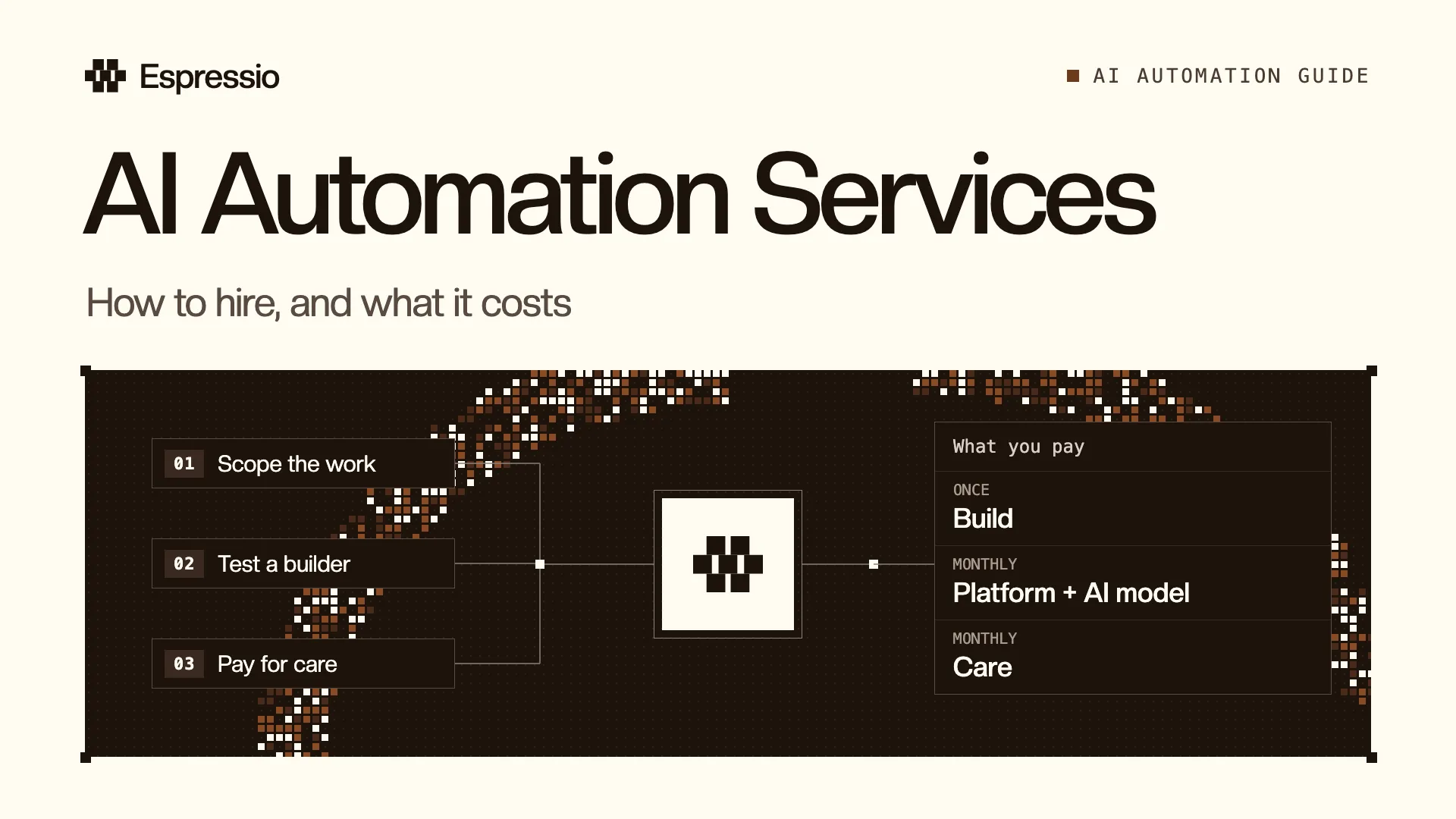
Almost every provider works in the same three steps:
Diagnosis → Build → Care
- Diagnosis. The provider studies your process and lists what is worth automating, with the time each item saves and the effort to build it.
- Build. The workflow gets built, tested and documented. It lives in your own accounts, and you get a short guide on how it works.
- Care. A monthly fee covers watching the workflow, fixing it when a connected app changes, and small improvements.
Some providers charge per result instead (for example, a fee per processed item). If you choose that, agree up front on how the result is counted.
What the first month looks like
The best builders learn how your team works before they build anything. A good first month runs like this:
| Weeks | Focus | What happens |
|---|---|---|
| 1 | Access | They get access to your tools, workflows and data, in your company’s accounts |
| 1 to 2 | Observe | They join team calls, review how work flows today and note where time is lost |
| 3 | First build | They build the first workflow from your list and test it with real data |
| 4 | Review | You check it against the goal you set and pick the next task |
Builders who start building on day one often deliver something that works on paper but does not fit how your team actually works. A week or two of observing avoids that.
What it costs
The price has two parts:
Total cost = Build (paid once) + Running cost (paid every month)
Running cost = Platform + AI model + Care
- Build: the provider’s hours to design, build and test the workflow.
- Platform: the tool the workflow runs on, such as n8n, Zapier or Make.
- AI model: the AI steps, billed by how much text the model reads and writes.
- Care: the provider’s monthly hours to keep it running.
With a dedicated remote specialist, build and care are covered by one monthly fee, and you still pay for the platform and the AI model.
What makes the price go up or down
| Factor | Price goes up when… |
|---|---|
| Number of processes | You automate more workflows at once |
| Systems connected | The workflow talks to many apps (CRM, billing, support) |
| Monthly volume | The workflow runs thousands of times a month |
| AI work per run | Each run reads long documents or writes long answers |
Platform prices at a glance
As of October 2026:
| Platform | Charges per | Entry paid plan |
|---|---|---|
| n8n | Full workflow run | Starter, €20/month (annual), 2,500 runs |
| Zapier | Each completed step | Pro, $19.99/month (annual), 750 tasks |
| Make | Each action (credits) | Free plan with 1,000 credits a month; paid tiers by credits |
The unit matters. A five-step workflow that runs 2,000 times a month counts as 2,000 runs on n8n, but up to 10,000 tasks on Zapier.
For the AI model, as of October 2026 Anthropic’s pricing page lists Claude Sonnet 5.5 at $2 per million input tokens and $10 per million output tokens. A token is roughly three-quarters of a word.
Where your provider is based
Automation skills do not depend on location. A builder in Latin America, Eastern Europe or Southeast Asia who has spent years building workflows for real businesses does the same work, often at a lower rate than in the US or Western Europe. Judge every candidate on their past projects and test project, not their time zone.
The one thing to plan for is overlap. If your team needs quick answers during the day, agree on a few shared working hours.
What to agree with your provider
Put these five points in the proposal or contract. They make the handover smooth for both sides:
- Accounts: the workflows live in your company’s accounts.
- Success: one number per task you will check, and when.
- Handover: a written guide and a recorded walkthrough of how it works.
- Monthly care: what the monthly fee covers, in a short list.
- Data: which tools see your data, and how it is protected.
What changes when it works
Good automation work adds up over time:
- Less manual work. Tasks that took hours each week run on their own.
- More time for judgment. Your team spends its time on decisions, clients and ideas, not copy and paste.
- Compounding gains. Each workflow you add builds on the last, so the time saved grows every quarter.
Where Espressio fits
Espressio does not build automations. To get workflows built, hire one of the five provider types above.
Espressio is a Lisbon-based AI marketing agency for AI and B2B tech companies, run by the team behind Lunar Strategy. That includes companies that sell AI automation and agent products: Espressio runs their launches, GTM strategy, ongoing marketing and paid acquisition, and reports sign-ups, active builders and buyers by channel. n8n is among the partner programs Espressio takes part in. If you run an automation or agent company and need more customers, book a strategy call.
FAQ
What are AI automation services?
They are the design, build and upkeep of workflows that handle repetitive tasks for you, often with an AI step that reads, sorts or writes text. Agencies, consultancies, freelancers, platform partners and remote specialists offer them. You should end up with a working process in your own accounts.
What does an AI automation specialist do?
They build systems that cut manual work. They connect your tools, create workflows and find where AI can take over repetitive tasks, such as routing leads, moving intake data or drafting recurring documents.
What skills should an AI automation specialist have?
Four: process thinking, real experience with tools like n8n, Make, Zapier and AI APIs, plain-language communication, and a habit of keeping up with new tools. Process thinking matters most.
How do I test a provider before hiring?
Ask them to walk you through a past project from start to finish, then pay for a small test project on one real task from your list. The test shows how they think, how they communicate and whether the result works.
How much do AI automation services cost?
You pay a one-time build fee, then a monthly cost for the platform, the AI model and care. A dedicated remote specialist is one monthly fee plus tools. Your price depends on how many processes, systems and monthly runs you have.
Is n8n, Zapier or Make cheapest?
It depends on your workflow. n8n charges per full run, Zapier per completed step and Make per action. A workflow with many steps and high volume costs very different amounts on each, so count your steps and monthly runs, then compare.
Do I need an AI agent or simple automation?
Start with simple automation when the steps are always the same. Add an AI step when something needs to be read or judged, such as scoring a lead. Use a full agent only when the path changes every time.